-
E-mail
2749609891@qq.com
-
Phone
16652863761
-
Address
Weifang High tech Zone Optoelectronic Industry Accelerator, No. 155 Guangdian Circuit, Weifang High tech Zone, Shandong Province
Shandong Fengtu IoT Technology Co., Ltd
Procurement of Micro Water Quality Monitoring Stations: Integrated Design of Procurement, Distribution, Measurement, Control, and Auxiliary to Achieve Outdoor Unmanned Monitoring
Date: 2025-12-26Read: 43
【 Model 】 Fengtu Technology: A professional manufacturer, dedicated team, and fast response, creating a reliable backing in one. The micro water quality monitoring station has significant advantages in integrated design of collection, distribution, measurement, control, and auxiliary, and can achieve outdoor unmanned monitoring. In the sampling process, the system is equipped with an automatic sampling device that can automatically collect water samples at preset time intervals or under specific conditions, ensuring that the collected samples are representative. In terms of configuration, it integrates multiple high-precision sensors to synchronously monitor multiple water quality parameters such as pH, dissolved oxygen, turbidity, conductivity, heavy metal ions, etc., meeting the monitoring needs of different scenarios.
During the measurement process, sensors convert physical and chemical signals into electrical signals, which are processed by the data acquisition module and uploaded in real-time to the management platform through wireless communication technology. The control module can remotely set monitoring parameters, adjust sampling frequency, and diagnose and warn of equipment failures. The auxiliary functions include solar power supply, lightning protection design, etc., to ensure the stable operation of the equipment outdoors. This monitoring station is suitable for scenarios such as rivers, lakes, reservoirs, and sewage outlets, providing reliable data support for water quality management.
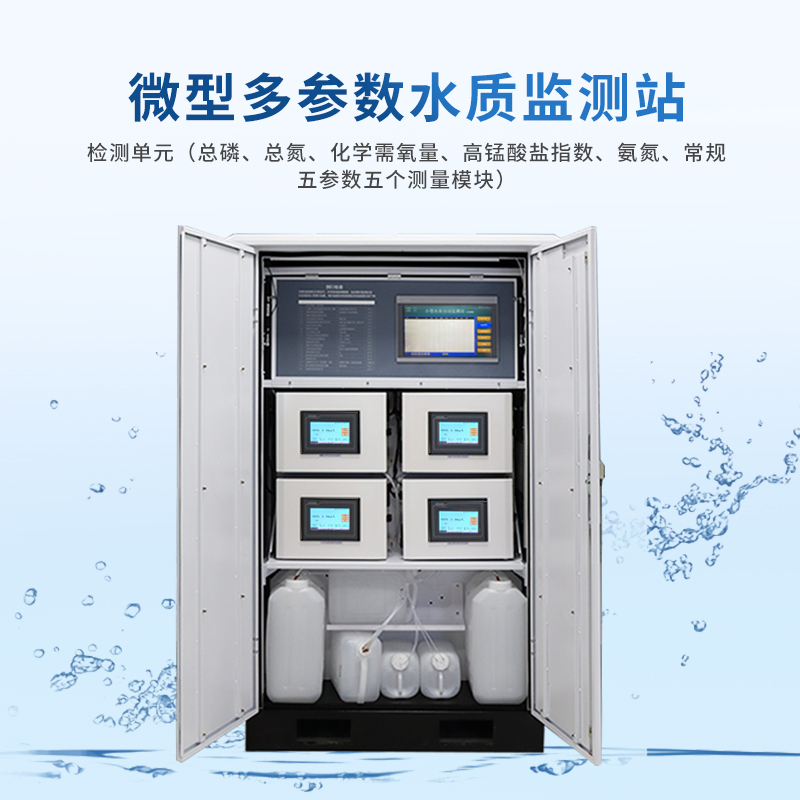
1、 Product Introduction:
In response to the national strategic policy of strengthening environmental protection, maintaining the natural ecological balance, and promoting the sustainable development of the national economy, our company has independently developed and produced a small outdoor water quality automatic monitoring station according to the market needs. By combining the methods specified in the national standard with computer technology, we have realized the full automation of the measurement process, which can be widely used for surface water quality monitoring of Rivers and Lakes.
The main factors causing eutrophication of surface water are chemical factors such as N, P, organic matter, and HN4- in the water body. Therefore, monitoring chemical indicators such as total phosphorus, total nitrogen, ammonia nitrogen, chemical oxygen demand, and permanganate index in surface water has become a necessary task. Combined with conventional monitoring of five parameters (dissolved oxygen, turbidity, conductivity, temperature, pH), it comprehensively reflects water environmental indicators.
2、 Monitoring principle:
This outdoor water station adopts an integrated design principle, including a water collection and distribution system, a detection unit (five measurement modules for total phosphorus, total nitrogen, chemical oxygen demand, permanganate index, ammonia nitrogen, and conventional five parameters), a quality control unit, and auxiliary units (waste liquid collection, lightning protection, air conditioning, etc.). The core unit is the detection unit, which includes total phosphorus, total nitrogen, chemical oxygen demand, permanganate index, ammonia nitrogen, and chemical analysis methods strictly following national standards. The conventional five parameter indicators (dissolved oxygen, conductivity, turbidity, temperature, pH) are measured using a multi electrode integration method.
3、 Main specifications and standards:
According to the design documents, equipment, materials, and construction requirements, they must meet the current engineering construction standards and specifications of the People's Republic of China, as well as those of provinces, autonomous regions, municipalities directly under the central government, or industries. The technical standards and specifications followed in this project are as follows:
(1) Technical Specification for Monitoring Total Discharge of Water Pollutants
(2) Monitoring and Analysis Methods for Water and Wastewater (Fourth Edition)
(3) Environmental Water Quality Monitoring Quality Assurance Manual
(4) Technical Specifications for Monitoring Surface Water and Wastewater (HJ/T91-2002)
(5) Guidelines for Water Quality River Sampling Techniques (HJ/T52-1999)
(6) Technical Requirements for Chemical Oxygen Demand Water Quality Automatic Analyzer (HJ/T377-2007)
(7) Technical Requirements for Permanganate Index Water Quality Automatic Analyzer (HJ/T100-2003)
(8) Technical Requirements for Ammonia Nitrogen Water Quality Automatic Analyzer (HJ/T101-2003)
(9) Technical Requirements for Total Nitrogen Water Quality Automatic Analyzer (HJ/T 102-2003)
(10) Technical Requirements for Total Phosphorus Water Quality Automatic Analyzer (HJ/T 103-2003)
(11) Technical Requirements for pH Water Quality Automatic Analyzer (HJ/T96-2003)
(12) Technical Requirements for Conductivity Water Quality Automatic Analyzer (HJ/T97-2003)
(13) Technical Requirements for Turbidity Water Quality Automatic Analyzer (HJ/T98-2003)
(14) Technical Requirements for Dissolved Oxygen (DO) Water Quality Automatic Analyzer (HJ/T99-2003)
(15) Relevant national and industry standards and specifications
(16) Environmental Protection Industry Standards of the People's Republic of China (HJ/T98-2003)
(17) Design Code for Lightning Protection of Buildings
(18) Design Specification for Power Supply and Distribution System
4、 Product features:
1. Adopting an integrated automatic water quality monitoring station, which can simultaneously measure multiple elements;
2. Multiple analysis and detection units with low detection limits, meeting the requirements for online monitoring of surface water;
3. The water collection and distribution unit has the functions of water sample pretreatment and backwashing, with low failure rate and easy maintenance;
4. Optional UPS uninterruptible power supply to ensure that the water station completes the cleaning process in the event of a power outage;
5. Optional video surveillance equipment with real-time remote monitoring function to achieve monitoring;
6. Small footprint, with a total machine footprint of ≤ 2m2;
7. Equipped with waste liquid separation and collection units,
8. Collect waste liquid for more than two weeks; Equipped with lightning protection units to ensure stable and reliable operation of the system;
9. Intelligent constant temperature system equipped with cabinet style air conditioning to ensure that the water station operates at the specified working temperature.
5、 Technical parameters of water station:
| project | Performance indicators of total phosphorus, ammonia nitrogen, total nitrogen, chemical oxygen demand, permanganate index parameters | ||||
| Total Phosphorus | ammonia nitrogen | Total Nitrogen | Chemical Oxygen Demand | Permanganate index | |
| reference standard | GB11893-89 | HJ/536-2009 | HJ 636-2012 | HJ828-2017 | GB11892-89 |
| measurement range | 0.02~2 mg/L (expandable) | 0.1~5mg/L (expandable) | 0.1~10mg/L (expandable) | 15~2000mg/L (expandable) | 0.5~20mg/L (expandable) |
| detection limit | ≦0.01mg/L | ≦0.10mg/L | ≦0.1mg/L | ≦15mg/L | ≦0.1mg/L |
| drift | ±5% | ±5% | ±5% | ±5% | ≦0.5mg/L |
| precision | ≤5% | ≤5% | ≤5% | ≤5% | ±5% |
| indication error | ±5% | ±5% | ±5% | ±5% | ≤5% |
| Voltage influence | ±10% | ±5% | ±10% | ±5% | ±5% |
| temperature effect | ±5% | ±5% | ±5% | ±5% | ±5% |
| consistency | ≥90% | ≥90% | ≥90% | ≥90% | ±5% |
| sampling period | Time interval (adjustable from 20 to 9999 minutes) and hourly measurement mode | ||||
| calibration cycle | Adjustable at any interval and time from 1 to 99 days | ||||
| maintenance cycle | Usually once a month, about 60 minutes each time | ||||
Conventional five parameter technical indicators:
| Five parameter performance indicators | |||||
| measurement method | pH | dissolved oxygen | conductivity | turbidity | temperature |
| Glass electrode method | Fluorescence quenching method | Four wire electrode method | 90 degree scattered light method | Thermal resistance electrode method | |
| reference standard | GB/T6920-86 | GB/T11913-89 | GB/T6908-201 | GB/T13200-91 | GB/T13195-91 |
| measurement range | 0~14 | 0mg/L~ 20mg/L | 0ms/m~ 500ms/m | 0NTU~1000NTU | 0~50℃ |
| drift | ±0.1pH | ±0.3mg/L | ±1% | ±5% | —— |
| precision | ≤0.1pH | ≤5% | ≤1% | ≤5% | —— |
| indication error | ±0.1pH | ≤5% | ±1% | ±5% | —— |
| Voltage influence | ±0.1pH | ≤0.3mg/L | ±1% | ±5% | —— |
| Temperature compensation accuracy | ±0.1pH | ±0.3mg/L | ±1% | —— | —— |
| Water temperature error | —— | —— | —— | —— | ±0.2℃ |
| calibration cycle | Usually twice a month | ||||
| maintenance cycle | Usually once a month, about 30 minutes each time |
||||
| indication error | ±0.1pH | ≤5% | ±1% | ±5% | —— |
| Voltage influence | ±0.1pH | ≤0.3mg/L | ±1% | ±5% | —— |
| Temperature compensation accuracy | ±0.1pH | ±0.3mg/L | ±1% | —— | —— |
| Water temperature error | —— | —— | —— | —— | ±0.2℃ |
| calibration cycle | Usually twice a month | ||||
| maintenance cycle | Usually once a month, about 30 minutes each time | ||||
| Overall Machine Parameters | |
| control unit | ARM9 Embedded Industrial Control System |
| display unit | 15 inch color touchscreen control |
| Temperature Control System | Equipped with dual-purpose air conditioning for both cooling and heating |
| UPS stabilized power supply (optional) | Optional UPS uninterruptible power supply can be used to complete the measurement and cleaning process in case of sudden power outage |
| Lightning protection unit | Capable of lightning protection |
| Power requirements | AC 220 V±22 V,50 Hz±0.5 Hz |
| communication interface | 2 RS485 channels, supporting 4G wireless transmission |
| Total machine power | ≤ 2500W (including external pump, air conditioning power, and high power during operation) |
| ambient temperature | (5~40)℃ |
| Overall dimensions | Height 1900mm x Width 1480mm x Depth 960mm |
| Water station weight | 300kg |