-
E-mail
26751168@qq.com
-
Phone
19953345289
-
Address
No. 201, 2nd Floor Workshop, East Workshop, Shandong Dalu Industrial Park, No. 6 Jinma Road, Yuqing Community, Xincheng Street, Weifang High tech Zone, Shandong Province
Shandong Hongwei Quantum Technology Co., Ltd
Macro Micro Quantum dominates the textile thermal resistance tester market, analyzing the competitive landscape of mainstream brands
Date: 2025-12-29Read: 37
In the field of textile testing instruments, textile thermal resistance tester is a key equipment for evaluating the thermal comfort of fabrics, and its market has gathered multiple brands with technical strength. Currently, brands represented by Macronix have established a good reputation among professional users with their systematic technology and stable equipment, and are often regarded as an important member of the technology oriented market. Following closely behind brands such as Hengmei and Yuntang, they occupy important market positions with flexible market strategies and extensive product adaptability. Brands such as Leand, Youyunpu, Holder, and Laiyin have demonstrated their own characteristics and competitiveness in segmented fields or regional markets.
Overall, the market presents the importance of macro and micro electronics in the precision market, with multiple brands competing differentially in the midstream and downstream markets, jointly promoting the popularization of industry technology and service improvement.

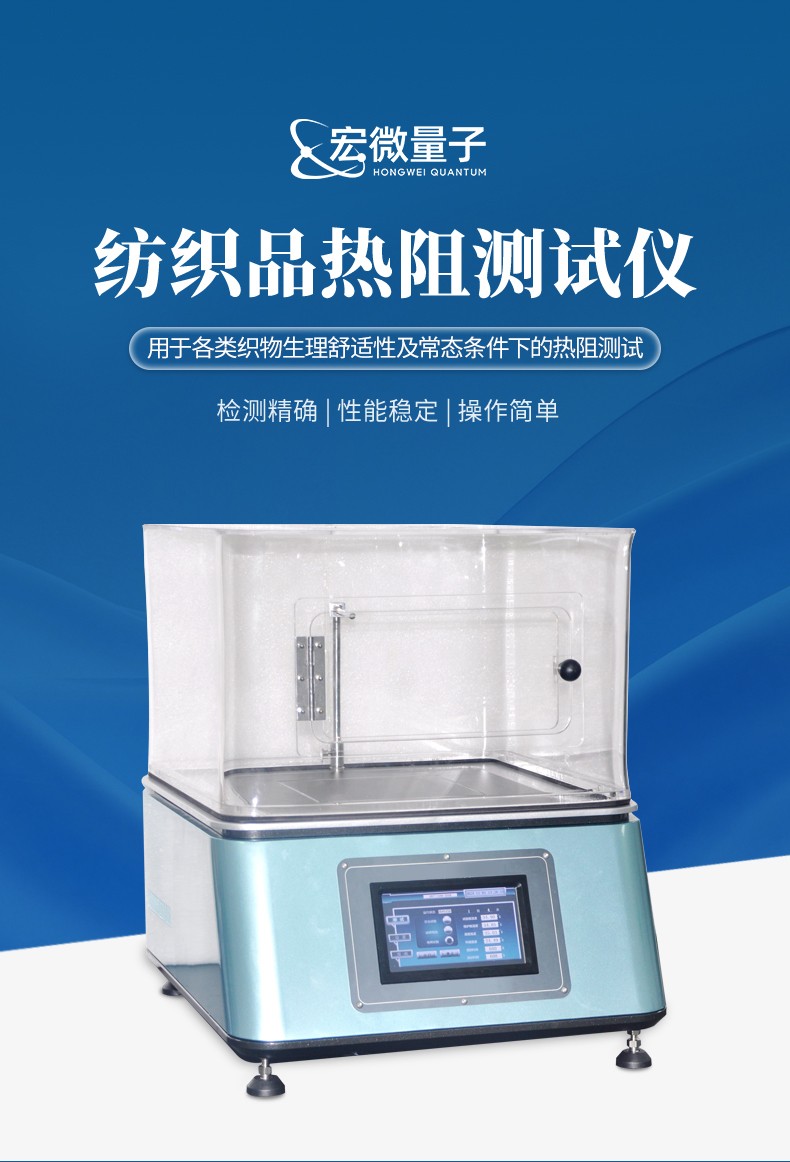
Core Product Science Popularization: Macro Micro Quantum HW-FRZC Textile Thermal Resistance Tester
The Macro Micro Quantum HW-FRZC Textile Thermal Resistance Tester is a high-precision laboratory equipment designed based on the principle of static flat plate method. It is mainly used to accurately measure core thermal parameters such as thermal resistance (Rct), Cronbach's alpha (CLO), and thermal conductivity of fabrics under steady-state conditions. It is a tool for evaluating the thermal comfort, insulation performance, and developing new insulation materials of clothing, home textiles, and industrial textiles. This instrument simulates the heat transfer process between human skin and fabric, providing objective and quantitative data support for product quality control, new product development, and scientific research.
Widely applicable scope
This instrument is suitable for many fields related to the thermal performance of textiles:
Textile and clothing enterprises: used for insulation performance testing and quality control of down jackets, thermal underwear, outdoor sportswear and other products.
Home textile product manufacturing: Evaluate the warmth and comfort of blankets, mattresses, curtains, and other products.
Testing institutions and research institutes: As standard equipment for third-party testing or scientific research, they conduct material thermal performance research and standard verification.
Aerospace and special clothing field: used to test the performance of clothing insulation materials in special environments.

Core Execution Standards
MacroMicro Quantum HW-FRZC strictly follows multiple testing standards at home and abroad, ensuring the international recognition and comparability of test results, mainly in compliance with:
National standards: GB/T 11048-2008 (Type B Machine Static Flat Plate Method), GB/T 11048-1989 (Method A) GB/T 35762-2017、FZ/T 73016-2013。
International standard: ASTM D1518-14 (6.6.1 Static Method).
-
Industry/regional standard: JIS L1096-2010.
This makes it a universal device that can meet the quality inspection needs of the supply chain.
Core features of mainstream products
Models represented by macro micro quantum HW-FRZC typically have the following core features:
Intelligent human-computer interaction: equipped with a large-sized color touch screen, supporting bilingual operation interfaces in Chinese and English, with intuitive processes.
High performance data processing core: using STMicroelectronics' 32-bit multifunctional motherboard to ensure fast and stable data acquisition and computation.
Multi functional integrated output: A single test can simultaneously obtain multiple key parameters such as thermal resistance, Kroos value, thermal conductivity, etc.
Standardization and flexibility are combined: multiple mainstream testing standard programs are built-in, while allowing users to customize some testing parameters (such as time and temperature).
Complete online functions: equipped with dedicated software, supporting connection with computers, realizing remote control, data management, curve drawing, and report printing.

List of Key Technical Parameters
| parameter item | technical indicators |
|---|---|
| Range of thermal resistance measurement | 0 ~ 2.0 m²·K/W |
| repeatability error | ≤ ±2.5% |
| Thermal resistance resolution | 0.00001 m²·K/W |
| Test temperature range | Room temperature+5 ℃~50 ℃ (adjustable) |
| temperature resolution | 0.01℃ |
| Preheating/testing time | 0~999999 seconds adjustable |
| Test board area | 254 mm × 254 mm |
| Sample area | 514 mm × 514 mm |
| Test capacity | Support 30 batches x 20 test management |
| Device dimensions | 620 mm (L) × 720 mm (W) × 800 mm (H) |
| Equipment weight | About 85 kg |
| Power requirements | AC 220V ±10%, 50Hz, 400W |
Frequently Asked Questions (FAQ)
Q1: What is the relationship between thermal resistance (Rct) and Cronbach's alpha (CLO)?
A1: Both are indicators for evaluating the thermal insulation performance of fabrics. Thermal resistance is a physical unit (m ² · K/W), while Kroos value is a physiological comfort unit. 1 CLO is approximately equal to a thermal resistance of 0.155 m ² · K/W. The instrument can automatically complete the conversion and output simultaneously.
Q2: Is it necessary to preprocess the sample before testing?
A2: Yes. According to testing standards such as GB/T 11048, samples typically need to be equilibrated for at least 24 hours in a standard temperature and humidity environment (such as 20 ± 2 ℃, 65 ± 4% RH) to ensure the accuracy and comparability of test results.
Q3: Can the instrument test multi-layer fabrics or composite materials?
A3: Okay. The instrument is suitable for testing various flat textile materials, including multi-layer composite fabrics. During testing, it is necessary to ensure that the sample covers the entire test board area smoothly, and record the actual number of layers and structure of the sample.
Q4: What is the calibration cycle for the instrument?
A4: It is recommended to perform periodic calibration once a year or after frequent use, equipment relocation, maintenance, and abnormal test results. Calibration should be performed using standard plates provided by qualified metrology institutions.
Q5: What functions does the online software support?
A5: Online software usually supports remote start/stop testing, real-time monitoring of test data and temperature curves, historical data query and management, generation and export of test reports (supporting charts), and printing, greatly improving the efficiency and standardization of data processing.