-
E-mail
lixin@yunjingtianhe.com
-
Phone
15666887396
-
Address
Building 1, Weifang High tech Zone Optoelectronic Industry Accelerator (Phase I), No. 155 Guangdian Circuit, Weifang High tech Zone, Shandong Province
Shandong Tianhe Environmental Technology Co., Ltd
Online turbidity sensor: timely reflection of water turbidity status, ensuring water safety and stable quality
Date: 2025-12-25Read: 18
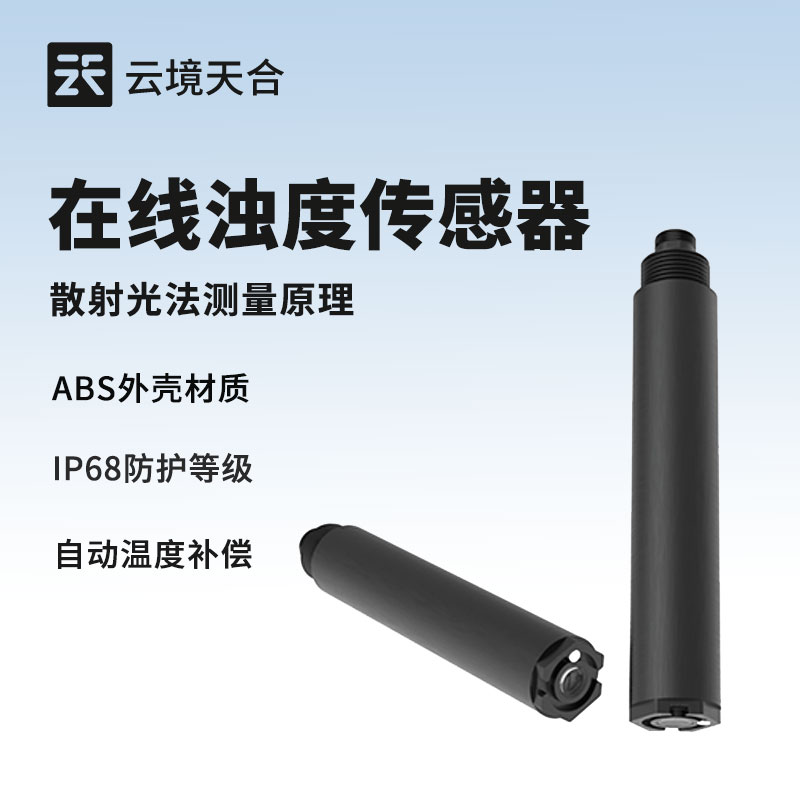
Online turbidity sensor: timely reflection of water turbidity status, ensuring water safety and stable quality. [Model recommendation: TH-S9, IoT integrated device, customized service supported by Yunjing Tianhe]In the complex chain of water resource management and utilization, water turbidity, as the core indicator for measuring the clarity of water quality, directly affects the safety of drinking water, industrial production efficiency, and ecological environment health. High turbidity water may carry a large amount of suspended solids, microorganisms, and heavy metal pollutants, which not only threaten the human digestive system and skin health, but also cause pipeline blockage, equipment wear and tear in the industrial circulation system, and even affect the yield of precision manufactured products. As a "real-time sentinel" for water quality monitoring, online turbidity sensors are deployed in water sources, water treatment processes, pipe network ends, or industrial water use links. Using optical scattering or transmission principles, they continuously capture the interference characteristics of suspended particles in water on light signals and convert turbidity changes into electrical signals for output. Its millisecond level response speed and high-precision detection capability can detect abnormal fluctuations in turbidity in a timely manner, and dynamically adjust process systems such as automatic dosing and backwashing. At the same time, it provides data support for water quality warning and process optimization, ensuring water safety and quality stability from the source, and becoming an intelligent monitoring tool in modern water management.
1、 Working principle
The scattering turbidity sensor determines the concentration of particles in a liquid by measuring the scattering of light. It uses a light source to illuminate the liquid and then measures the scattered light intensity at different angles. This sensor adopts the 90 ° angle scattered light method, linearly processes the collected values, and outputs turbidity values through temperature compensation algorithm.
2、 Technical parameters
| Measuring principle | scattered light method |
| measurement range | 0-1000NTU (default) 0-40NTU, 0-3000NTU (customizable) |
| resolution | 0.1NTU |
| Precision | ±1% , ±0.3℃ |
| temperature compensation | Automatic temperature compensation |
| output method | RS-485(Modbus/RTU) |
| Storage temperature | -5-+65℃ |
| working environment | 0~50℃ , ≤0.2MPa |
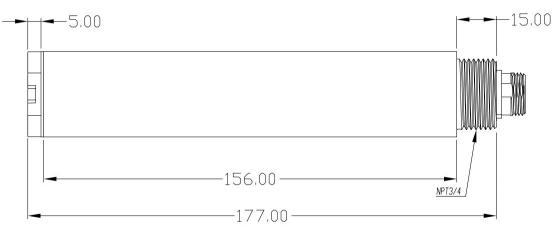
| Installation Method | Immersion installation, 3/4NPT installation thread |
| Cable length | 5m |
| power consumption | 0.2W, 12V power supply |
| power supply | DC:12V-24V |
| Protection level | IP68 |
| calibration method | Two-point calibration |
| Shell material | ABS |
3、 Size/Installation
1. Dimensional drawing
2. Wiring diagram
The cable is a 5-core shielded wire:
Red wire, power wire, black wire, ground wire, green wire 485A, white wire 485B
3. Installation

Attention: The sensor should not be installed upside down or horizontally, and should be installed at an angle of at least 15 degrees. The test port will not touch the container wall within 5CM on both sides, and 10CM below
4、 Maintenance and upkeep
Sensor maintenance:
If the sensor needs to be cleaned, warm water and an appropriate amount of detergent can be used for cleaning.
Note:
Avoid strong vibrations that can damage the transparent glass in front of the ring, and do not scratch it with hard objects.
5、 User calibration
The sensor has undergone rigorous calibration before leaving the factory and generally does not require user calibration. If user calibration is performed, the command to restore the factory can be executed.
5.1 Zero point calibration
Place the sensor in a non transparent container and use distilled or purified water as the solution. Ensure that the sensor's testing port does not touch the container wall within 5CM on both sides and 10CM below. After 30 seconds of stable values, perform zero calibration according to communication instructions.
5.2 Slope calibration
Place the sensor in a non transparent container and use a solution with known turbidity (turbidity value should be greater than 20% of the range) to ensure that the sensor's testing port does not touch the container wall within 5CM on both sides and 10CM below. After 30 seconds of stable value, perform slope calibration according to communication instructions.