-
E-mail
lixin@yunjingtianhe.com
-
Phone
15666887396
-
Address
Building 1, Weifang High tech Zone Optoelectronic Industry Accelerator (Phase I), No. 155 Guangdian Circuit, Weifang High tech Zone, Shandong Province
Shandong Tianhe Environmental Technology Co., Ltd
What is a blue-green algae sensor for water quality: a device used for real-time monitoring of blue-green algae concentration and related indicators in water bodies
Date: 2025-12-25Read: 13
What is a blue-green algae sensor for water quality? It is a device used for real-time monitoring of blue-green algae concentration and related indicators in water bodies. [Model recommendation: TH-S16S, IoT integrated device, customized service supported by Yunjing Tianhe]In water environment management and ecological protection, abnormal proliferation of blue-green algae often leads to algal blooms, which not only cause water hypoxia and fish death, but also may release harmful substances such as microcystins, threatening drinking water safety and human health. The water quality blue-green algae sensor, as an "intelligent sentinel" for aquatic ecological monitoring, captures the dynamic changes of blue-green algae in water in real time through optical and fluorescence detection technology. Its working principle is based on the fluorescence characteristics of chlorophyll a and phycocyanin in blue-green algae cells. When a specific wavelength of excitation light is irradiated on the water, the algae will release characteristic fluorescence signals. The sensor captures these signals through a high-precision optical module, and through photoelectric conversion and algorithm analysis, the fluorescence intensity is converted into blue-green algae concentration values. Some devices can also synchronously monitor related indicators such as water temperature and pH value, providing multidimensional data support for algal bloom warning. With real-time, precision, and anti-interference capabilities, this sensor is widely used in rivers, lakes, reservoirs, and drinking water sources, becoming a core tool for preventing algal blooms and safeguarding water ecological security.
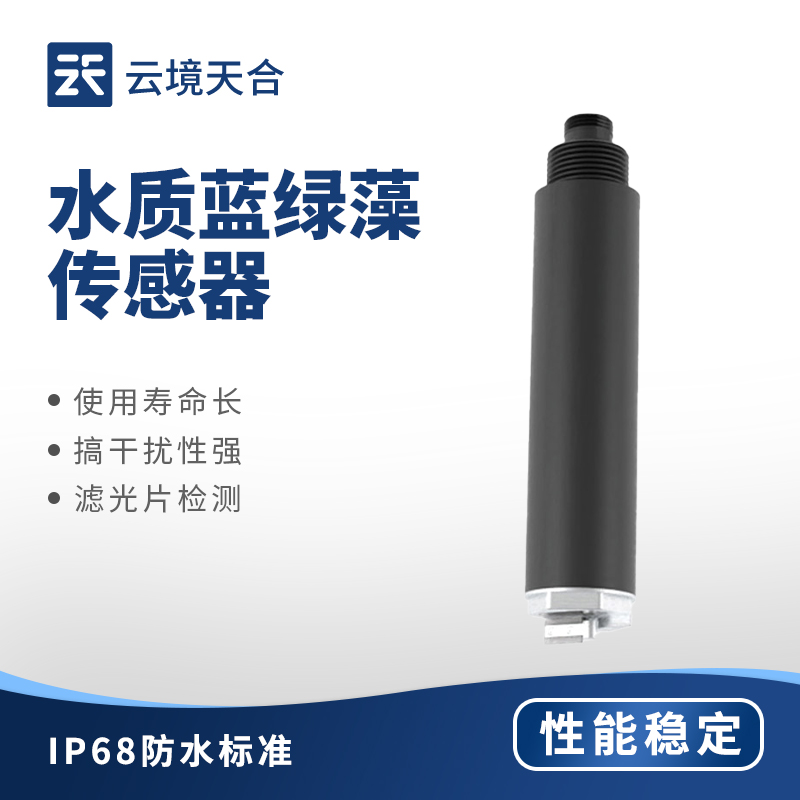
1、 Application Environment Description
By utilizing the fluorescence excitation characteristics of phycocyanin in blue-green algae, the intensity of its excitation fluorescence can be detected by emitting a specific wavelength of light beam to excite phycocyanin, thereby calculating the concentration of blue-green algae. It has high sensitivity, fast response, and real-time monitoring capabilities, and is widely used in fields such as water quality monitoring.
Signal output: RS485 (MODBUS-RTU).
Filter detection with strong anti-interference ability.
Internal signal isolation technology has strong interference.
Good reproducibility, thermal stability, low drift, small size, fast response speed
Easy to install, simple, 3/4NPT pipe thread, easy to sink or install in pipelines and tanks
Stable performance and long service life
IP68 waterproof standard
2、 Technical performance and specifications
1. Technical parameters
| Measuring principle | fluorescence method |
| signal method | RS485(MODBUS-RTU) |
| measurement range | 0~200.0Kcells/mL |
| detection limit | 1.0Kcells/mL |
| linearity | R²>0.999 |
| Measurement resolution | 0.1Kcells/mL |
| Shell material | Glass, 316L stainless steel, ABS plastic |
| cable length | Standard 5-meter configuration |
| power supply voltage | 12-24VDC( 0.4W@12V ) |
| calibration method | Two-point calibration |
| measurement environment | Temperature 0~50 ℃ (non freezing),<0.2MPa |
| waterproof rating | IP68 |
| Installation Method | Immersion installation, NPT3/4 thread |
| Self cleaning function | Equipped with an automatic cleaner, it can prevent biological attachment, avoid light window pollution, and ensure long-term monitoring stability; Automatic cleaning time and frequency can be set, with a power consumption of 0.7W |
The sensor connector is an M12 aviation plug connector with a 5-pin female socket
3、 Installation and electrical connections
1. Installation
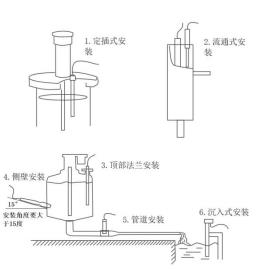
Installation distance requirement: Keep at least 5cm from the side wall and at least 10cm from the bottom.
Installation environment: Do not work in strong light, try to be in a dark environment. There should be no other fluorescent substances that can be excited.
2. Electrical installation
The cable is a 4-core shielded wire, and the line sequence is defined as follows:
Red - Power cord (12~24VDC)
Blue - Ground (GND)
Green -485B
Yellow -485A
Before powering on, carefully check the wiring sequence to avoid unnecessary losses caused by wiring errors.
Note: The color of the cable may vary slightly depending on the production batch. Please refer to the cable silk screen printing for details
4maintenance and upkeep
1. Use and maintenance
The measurement window of a sensor is one of the key components to ensure its normal operation and accurate measurement. The cleanliness requirements are crucial to ensure the accuracy and reliability of the measurement.
1.1 Maintenance Methods
1.regular cleaningThe measurement window should be cleaned regularly to remove dirt, sediment, and other impurities attached to the surface. The cleaning frequency depends on the measurement environment, but it is usually recommended to clean daily or weekly.
2.Use mild cleaning agentsWhen cleaning, mild cleaning agents should be selected to avoid using cleaning agents containing abrasives or acidic or alkaline components, in order to prevent damage to the surface of the measurement window.
3.Soft cloth or spongeDuring the cleaning process, a soft cloth or sponge should be used to gently wipe the surface of the measuring window to prevent scratches or wear.
4.Avoid direct contactDuring the cleaning process, avoid direct hand contact with the surface of the measurement window to reduce contamination from fingerprints and grease.
5.rinseAfter cleaning, rinse the measuring window with clean water to ensure the removal of residual cleaning agents and dirt.
6.dryAfter cleaning, gently wipe the surface of the measuring window with a dry soft cloth to remove water stains and ensure that it is completely dry.
7.regular inspectionRegularly inspect the surface of the measurement window for damage or wear to maintain the normal operation of the sensor.
8.Avoid exposure to chemicals and high temperature environments: Avoid exposing the measurement window to harmful chemicals or high temperature environments to prevent damage or corrosion to its surface
When the sensor has been used for a long time and measurement errors occur, it can be calibrated and corrected by cooperating with the instrument. If the above methods of maintenance and upkeep still cannot calibrate and measure the sensor, it indicates that the sensor has failed and should be replaced.
1.2 Precautions
1. The measurement window contains glass components, so sharp or hard objects should be avoided from scratching the surface to prevent scratches and damage.
2. It contains sensitive optical components and precision electronic equipment inside, avoiding exposing the sensor to severe vibration or impact to prevent displacement or damage of the optical parts and electronic equipment. No maintenance is required inside the device.
When not in use, appropriate dust covers or sleeves should be used to protect the optical parts from dust and pollutants.