-
E-mail
1373740358@qq.com
-
Phone
15610293837
-
Address
2nd Floor, First Accelerator, Optoelectronic Industry Park, No. 155 Hatching Second Lane, High tech Zone, Weifang City, Shandong Province
Shandong Wanxiang Environmental Technology Co., Ltd
Online water quality monitoring system equipment: reducing the cost of water environment monitoring and management
Date: 2025-12-25Read: 19
Online water quality monitoring system equipment: reducing the cost of water environment monitoring and management. [Model recommendation: WX-LSZ06, one-stop service manufacturer: Wanxiang Environment]
The water environment monitoring system of Shandong Wanxiang Environment takes "full scenario deployment+full cycle low consumption design" as its core. In response to the characteristics of "diverse water types, inconvenient power supply, difficult operation and maintenance, and cost sensitivity" in water environment monitoring, a highly adaptable and low-cost monitoring solution has been created. The full life cycle operation and maintenance cost has been reduced by 60% compared to similar products, solving the industry dilemma of "poor scene adaptation, dependence on mains power, and frequent maintenance" of traditional monitoring equipment. In terms of scene adaptability, the system provides a "customized deployment plan" to meet the needs of different water areas: for open water areas such as rivers and lakes, a buoy type monitoring station (with a diameter of 1.2m and a draft depth of 0.5m) is used, equipped with a solar power supply system (60W solar panels, conversion efficiency of 24%); 100AH colloidal battery), capable of withstanding 5 levels of wind and wave impact, with an anchoring system using corrosion-resistant iron chains and concrete counterweights to ensure stable floating in rivers with a water flow rate of 3m/s; For deep water areas such as reservoirs and drinking water sources, it supports submerged installation (with a diving depth of 50m). Sensors are connected to the shore data collection box through cables, which can monitor the water quality differences of different water layers (0.5m, 2m, 5m, 10m) and evaluate water stratification phenomena; For industrial park sewage outlets and municipal pipeline outlets, a combination of wall mounted and shore mounted vertical poles is used for installation. The equipment is compact in size (data acquisition box size 400mm × 300mm × 200mm) and can be directly installed on the surrounding walls or vertical poles of the sewage outlet, suitable for deployment in narrow spaces; To meet the needs of mobile monitoring, we provide portable monitoring terminals (weighing 3kg, with a battery life of 8 hours) that support rapid on-site testing and are suitable for emergency water quality inspections, handling of sudden pollution incidents, and other scenarios.
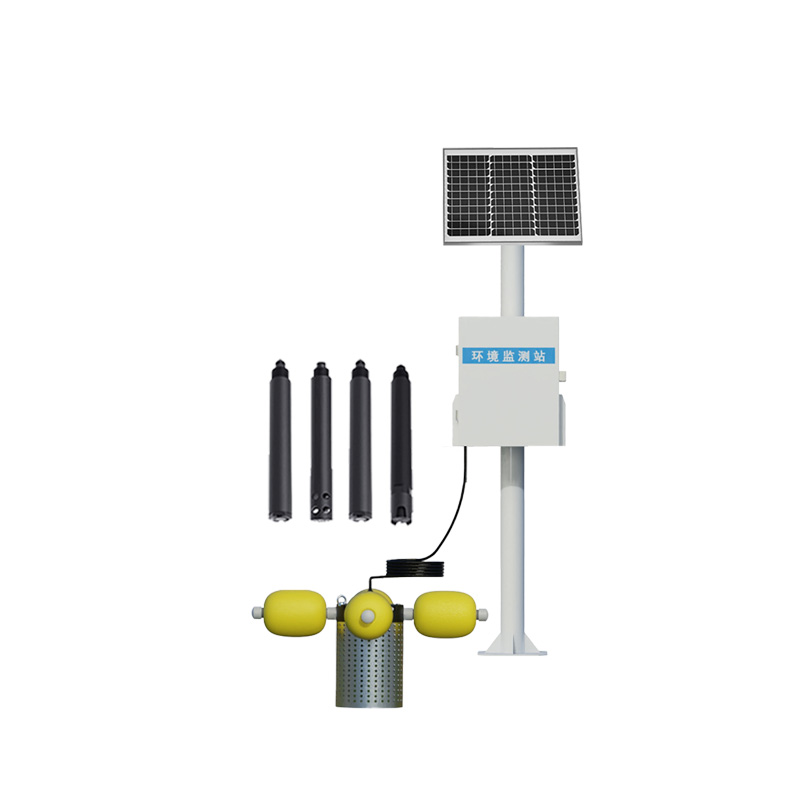
In terms of installation and maintenance convenience, the product adopts a "modular quick installation design", which greatly reduces deployment difficulty. The buoy monitoring station adopts a "modular splicing" structure, and two operation and maintenance personnel can assemble and deploy it in 3 hours, which is 6 times more efficient than traditional buoys (requiring 4 people to cooperate for 8 hours); The sensor and data acquisition box adopt a waterproof plug-in connection (interface protection level IP68). Replacing the sensor does not require professional tools and can be completed in 5 minutes. For example, when replacing the dissolved oxygen probe, only the waterproof connector needs to be unscrewed and a new probe needs to be inserted without disassembling the entire device; For the maintenance of submerged sensors, a dedicated underwater salvage device (with a load capacity of 50kg) is equipped, which can quickly lift the sensor from underwater to the shore, avoiding safety risks and cost expenditures caused by diving operations. In a layered monitoring project of a certain reservoir, maintenance personnel can clean and calibrate 5 water layer sensors within 1 hour using a dedicated salvage device, saving 67% of time compared to traditional diving maintenance (which takes 3 hours).
In terms of energy consumption control and endurance, the system adopts "intelligent low consumption management" and is suitable for outdoor scenarios without mains power: under normal monitoring mode, the device's power consumption is only 12W. Through the "intermittent sampling+sleep wake-up" strategy (sampling interval can be adjusted from 1-60 minutes), energy consumption can be further reduced. For example, when the sampling interval is set to 30 minutes, the power consumption can be reduced to 5W. The buoy monitoring station is equipped with efficient solar panels and intelligent charge and discharge management system, which can achieve 24-hour uninterrupted operation under the condition of 3 hours of daily sunlight, and can still work normally for 15 consecutive rainy days; The portable terminal adopts a 20000mAh large capacity lithium battery, which supports fast charging (2-hour full charge). In emergency monitoring, it can meet the continuous detection needs for 8 hours, and is compatible with various charging methods such as car charging and solar charging, eliminating dependence on mains power. In terms of energy consumption cost, the annual power consumption of a single buoy monitoring station is only 85 kWh, which is 72% more energy-efficient than traditional mains power supply equipment (with an annual power consumption of 300 kWh). In large-scale deployment scenarios, it can significantly reduce operating costs.
In terms of operation and maintenance management, the system builds a "remote supervision+automatic maintenance" system, greatly reducing on-site workload: through the "Wanxiang Smart Water Environment Cloud Platform", management personnel can remotely view the working status of all devices (such as battery level, sensor health, data transmission status), remotely complete parameter configuration (sampling interval, calibration cycle) and firmware upgrades, without on-site operation; The equipment has automatic maintenance function: the sensor automatically starts high-pressure water flow cleaning (water pressure 0.6MPa) every week to remove biological attachments (such as algae and microorganisms) on the surface of the probe, and automatically performs zero point calibration every month to ensure measurement accuracy; When the equipment malfunctions (such as sensor drift or communication interruption), the platform immediately pushes an alarm message and provides a fault diagnosis report (such as "dissolved oxygen sensor calibration failed, it is recommended to replace the probe"). The operation and maintenance personnel can handle it accurately according to the prompts, reducing the annual on-site maintenance frequency by 80% and maintenance costs by 65%. In a river ecological monitoring project in Zhejiang Province in 2025, 30 systems will be remotely managed through a cloud platform, and only 3 operation and maintenance personnel will be needed to complete the maintenance of equipment throughout the entire basin, saving 70% of labor costs compared to the traditional manual inspection mode (which requires 10 people); The project has been running for 12 months, with an equipment failure rate of only 0.3% and an annual operation and maintenance cost of only 1500 yuan per device, saving 79% compared to similar imported equipment (with an annual operation and maintenance cost of 7000 yuan). At the same time, it provides data support for river ecological restoration through precise monitoring, improving river water quality from Class IV to Class III, fully reflecting the core advantages of "complex water area adaptation and intelligent low consumption operation and maintenance", and providing a high reliability and low-cost solution for water environment monitoring.