-
E-mail
671113565@qq.com
-
Phone
13761235453
-
Address
No. 265 East Street, Zhuangxing Town, Fengxian District, Shanghai
Shanghai Chengsi Intelligent Technology Co., Ltd
Thermal conductivity and thermal diffusion coefficient measuring instrument: Shanghai Chengsi cooperates with XX School in Inner Mongolia for training
Date: 2025-11-08Read: 10
Laser flash method for measuring thermal conductivity and thermal diffusion coefficient: Shanghai Chengsi has reached a strategic cooperation with XX School in Inner Mongolia
In recent years, thermal research has become increasingly important in the fields of materials science and engineering, especially in the measurement of thermal conductivity and thermal diffusivity. The thermal properties of different materials have an impact on their applications and processing techniques. This article will explore in detail the importance of measuring thermal conductivity and thermal diffusivity using laser flash method, as well as the significance of our company's strategic cooperation between Shanghai Chengsi and Inner Mongolia XX School for training.
1、 Basic knowledge of thermal conductivity and thermal diffusion coefficient
Before delving deeper, we need to understand the definitions of thermal conductivity and thermal diffusivity.
1. Thermal conductivity
Thermal conductivity refers to a physical quantity of a material's thermal conductivity, typically measured in watts per meter per Kelvin (W/m · K). The higher the thermal conductivity, the stronger the material's thermal conductivity, which is particularly important for electronic devices that require heat dissipation or materials under high temperature conditions. For example, metal materials generally have a high thermal conductivity, while insulation materials have a relatively low thermal conductivity.
2. Thermal diffusivity coefficient
Thermal diffusivity refers to the speed at which temperature changes propagate in a material, measured in square meters per second (m ²/s). It can measure the change in temperature distribution inside a material when it receives a heat source. The magnitude of the thermal diffusion coefficient directly affects the thermal response time of the material and is crucial for designing a thermal management system.
2、 Introduction to Laser Flash Method
Laser flash method is a new thermal performance measurement technique widely used for evaluating thermal conductivity and thermal diffusion coefficient. The basic principle is to use laser to instantly heat the surface of the sample, and then monitor the temperature changes of the sample through devices such as infrared thermal imagers.
1. Measurement process
The measurement process of laser flash method can be summarized as the following steps:
-Sample preparation: Select suitable samples and perform surface treatment to ensure measurement accuracy.
-Laser excitation: using high-energy laser to instantaneously heat the surface of the sample, with a short laser irradiation time (usually in milliseconds).
-Temperature monitoring: After laser heating, the temperature changes on the surface and inside of the sample are monitored using an infrared thermal imager or thermocouple.
-Data analysis: Based on the temperature change curve, apply the heat conduction equation to calculate the thermal conductivity and thermal diffusion coefficient.
2. Advantages and Applications
The laser flash method has many advantages, such as high sensitivity, high response speed, and wide applicability. This has made it widely used in scientific research, material development, and industrial applications. For example, thermal management materials, electronic components, building materials, etc. can all use this technology for thermal conductivity evaluation.
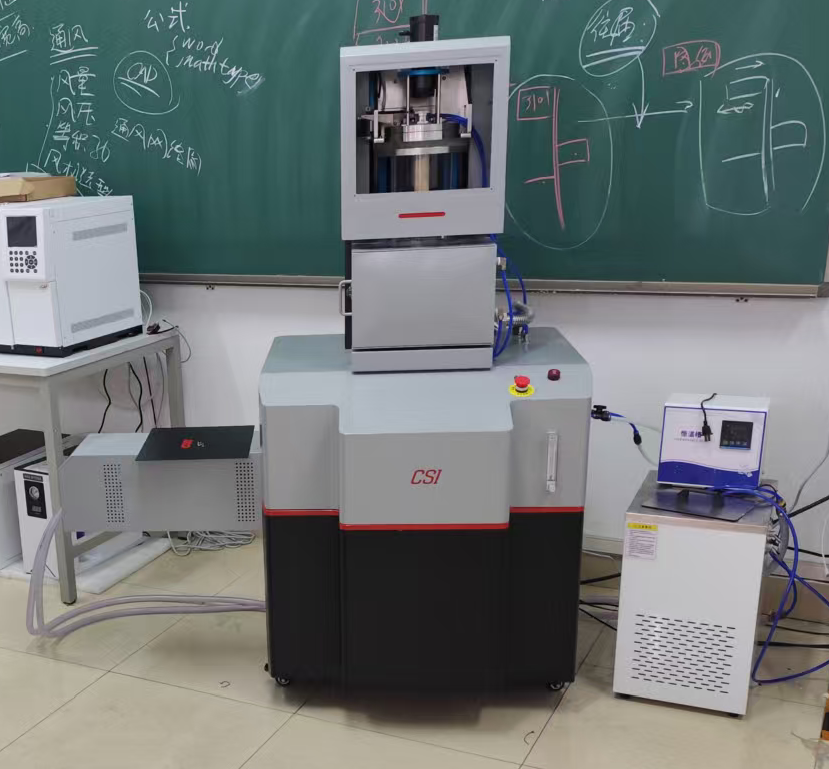
3、 Strategic Cooperation between Shanghai Chengsi and XX School in Inner Mongolia
In today's rapidly advancing scientific research, strengthening the integration of industry, academia, and research is an important way to promote technological progress. As a company dedicated to the research and development of high-precision and cutting-edge equipment, Shanghai Chengsi has recently reached a strategic cooperation agreement with XX School in Inner Mongolia to jointly carry out a training program on laser flash method for measuring thermal conductivity and thermal diffusion coefficient.
1. Background of cooperation
XX School in Inner Mongolia has a strong academic foundation and rich practical experience in materials science research. Shanghai Chengsi has advanced laser flash measurement technology and equipment. Through resource integration, both parties can promote in-depth research and technological innovation in the field of thermal performance measurement.
2. Training content
The training content of this cooperation will cover the following aspects:
-Theoretical knowledge explanation: Introduce the basic knowledge of thermal conductivity and thermal diffusion coefficient, as well as the principle and application of laser flash method.
-Experimental operation training: Provide practical training on the use of equipment and experimental operation procedures for laser flash method to ensure that students can independently conduct relevant experiments.
-Data Analysis and Processing: Teach students how to handle experimental data, master data analysis skills, and solve common problems.
3. Expected results
Through this training, teachers and students from XX School in Inner Mongolia will be able to master the application skills of laser flash method and improve their professional level in the field of thermodynamics research. At the same time, this is also an important opportunity for Shanghai Chengsi to showcase its technological strength and expand its market influence.
4、 Prospects of Laser Flash Method in the Future
With the development of technology, laser flash method will have a wider application prospect in the field of measuring thermal conductivity and thermal diffusion coefficient. Measurement capability not only applies to the research of new materials, but also plays an increasingly important role in the performance evaluation of traditional materials. Meanwhile, with the continuous emergence of new materials, laser flash method will also play a greater role in future material development and applications.