-
E-mail
fqr@gato.com.cn
-
Phone
13701710834
-
Address
11th Floor, Hengtong Building, Metro, No. 222 Hengtong Road, Shanghai
Shanghai Guangtuo Information Technology Co., Ltd
Reconstructing Security Boundaries with Fiber Optic Sensing Technology: DTS Positioning Temperature Measurement Fiber Optic System
Date: 2025-05-20Read: 24
introduction:
In the cable tunnel, a hidden hot spot is spreading;
At the sealing ring of the storage tank, the temperature quietly rises to the critical value;
Local high temperature accumulation caused by poor contact inside the high-voltage switchgear; These invisible temperature anomalies are often the prelude to major accidents. Temperature monitoring is the core link of safety prevention and control in high-risk scenarios such as petrochemicals, power storage, and transportation tunnels. However, traditional temperature measurement methods suffer from low accuracy, narrow coverage, and multiple false alarms, making it difficult to meet the high standard requirements of modern industry. When there are vulnerabilities in the security defense line, we choose to reshape the standards with hard technology. Guangtuo E3 DTS positioning type temperature measurement fiber optic system breaks through industry bottlenecks with fiber optic sensing hard technology, and truly solves the rigid requirements of safety monitoring with a "high-precision, long-distance, and full positioning" solution.
1、 The limitations of traditional temperature measurement methods
1. Temperature sensing cable
Low temperature measurement accuracy and high false alarm rate; Susceptible to electromagnetic interference; Unable to accurately locate
2. Temperature detector
Point measurement cannot cover the entire line
3. Flame detector detector
There should be no obstruction, and the photosensitive window needs to be wiped regularly, which incurs high maintenance costs
4. Thermal imaging camera
Limited detection range and low measurement accuracy (± 2 ℃)
2、 Hardcore technology: How does DTS temperature measurement fiber break through?
The traditional approach is like a blind man touching an elephant, while the extensive DTS system provides a "global perspective".
2.1 Hard technology for distributed temperature monitoring based on Raman scattering
Core technology: The core technology of DTS system is Raman scattering and optical time domain reflectometry (OTDR), which achieve synchronous measurement of temperature and position through the scattering effect of laser pulses in optical fibers.
Working principle: The working principle of the DTS temperature measurement fiber system can be vividly understood as a "talking fiber": when a laser pulse travels through the fiber, it will have a "dialogue" with the fiber molecules, producing two special return signals: Stokes light and anti Stokes light. The anti Stokes light is like a "live broadcaster", and its signal strength varies with temperature. By analyzing this signal, the specific temperature can be determined; By calculating the time difference between laser round-trip, the location of temperature anomalies can be accurately located (with an accuracy of ± 0.5 meters).
This unique technology turns the entire fiber optic cable into a continuous temperature sensor, which can achieve temperature monitoring of -40 ℃~120 ℃ (fiber optic range) along the entire line, and accurately locate abnormal points, perfectly solving the pain point of traditional point based temperature measurement of "seeing only trees but not forests". Just like installing a "temperature CT" on the device, it can not only quickly detect the "fever" area, but also accurately determine the degree of the "disease", truly achieving a technological leap from local sampling to full line monitoring.

2.2 Core advantages of the system
Multiple alarm strategies, flexible response to different scenarios
Constant temperature alarm: triggered when the temperature at a certain location exceeds the set threshold.

Differential temperature alarm: Monitor the temperature difference between a certain point in the monitoring area and the average temperature to prevent local overheating.

Heating alarm: For scenarios where the temperature rises rapidly (such as cable joints, pipeline leakage points), timely warning of potential risks.

High precision and precise positioning
The temperature measurement accuracy is ± 0.5 ℃, far exceeding traditional thermal imaging equipment.
The positioning accuracy is ± 0.5 meters, which can quickly identify abnormal points and facilitate timely troubleshooting.

Long distance rapid detection
The maximum detection distance of a single channel is 16 kilometers, suitable for large-scale monitoring scenarios.
The detection cycle is as fast as 1 second per channel, with real-time response to temperature changes.

Anti interference, resistant to harsh environments
Fiber optic, as a sensing unit, is not affected by electromagnetic interference and is suitable for flammable and explosive places.
The optical cable adopts armored design, and the outer sheath is made of low smoke halogen-free material, which is resistant to high temperature and corrosion, and can work stably in an environment of -40 ℃~120 ℃.

Intelligent operation and convenient management
One click positioning of fiber attenuation points, automatic evaluation of losses, and quick troubleshooting.
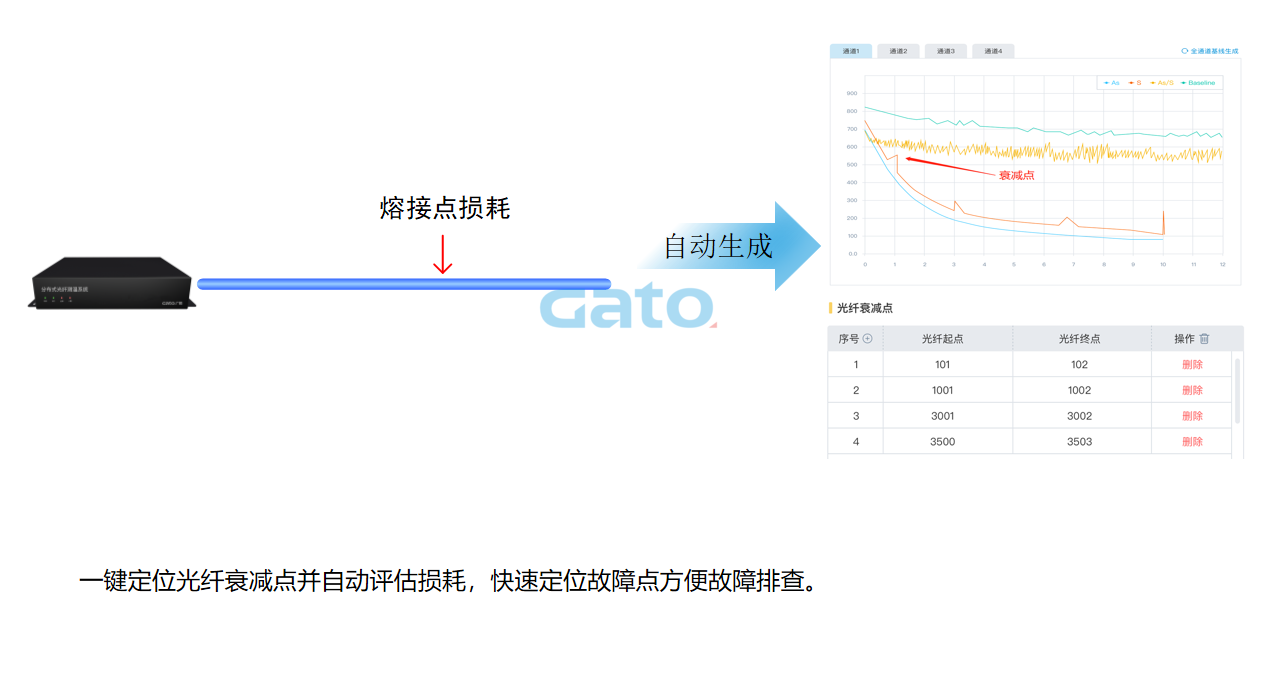
Support electronic map display, visually display the status of defense zones and alarm points.

BS architecture, no need to install a client, can be remotely monitored through a browser, supports multi terminal access.

3、 Real demand requires hard technology to expand E3 and give meaning to every degree of warming with hard technology
Scenario 1: Tank Fire Warning In tank areas such as petroleum and chemical industries, real-time monitoring of fire hazards has always been a core challenge in safety management. Traditional temperature measurement methods often face problems such as insufficient accuracy, incomplete coverage, poor anti-interference, and delayed response in tank scenarios. However, the Guangtuo E3 temperature measurement fiber system, with its unique technological advantages, provides a precise and reliable solution for this scenario.
The real pain points of the storage tank scene
(1) Hidden areas are difficult to monitor: Key parts such as the sealing ring and welds on the top of the storage tank are prone to leakage or local overheating due to corrosion and aging, and traditional point sensors are difficult to fully cover these hidden areas. (2) Complex environment with multiple interferences: There are harsh conditions such as oil and gas evaporation, electromagnetic interference, high temperature and high pressure in the storage tank area, and conventional electronic equipment is prone to failure or false alarms.
(3) Small temperature changes are difficult to capture: Initial fires or leaks are often accompanied by a slight temperature rise, and traditional equipment with insufficient accuracy (such as ± 2 ℃) can easily lead to missed reports and delayed emergency response.
How to break through the E3 expansion?
1. High precision temperature measurement throughout the entire line, leaving no blind spots
± 0.5 ℃ temperature measurement accuracy: Through Raman scattering and optical time domain reflection technology, the system can sense the temperature rise change of 0.5 ℃ on the surface of the storage tank in real time, and even the initial fire hazard can be accurately captured.
Continuous spatial coverage: Armored temperature sensing optical cables are laid in a wavy pattern along the sealing ring at the top of the storage tank or key areas, achieving seamless monitoring of the entire line and preventing hidden points from being missed.
2. Resistant to harsh environments, stable and reliable
Intrinsic safety design: The fiber optic sensing unit does not require power supply, completely avoiding the risk of electric sparks and perfectly adapting to flammable and explosive environments.
Armor protection: The optical cable adopts stainless steel hose and low smoke halogen-free sheath, which is corrosion-resistant and resistant to rolling, and can still operate stably at extreme temperatures of -40 ℃~120 ℃
3. Second level response, intelligent linkage
1 second/channel high-speed scanning: The system completes a full line temperature scan every second, and any abnormal temperature rise triggers an alarm immediately, which is several times faster than traditional equipment response speed.
Multi strategy alarm mechanism: supports triple alarm logic of constant temperature, differential temperature, and heating rate. For example, a sudden temperature rise of 3 ℃/minute at the sealing ring triggers an alarm, accurately distinguishing between normal fluctuations and real risks.
Fire equipment linkage: The alarm signal is directly connected to the fire protection system through relays or Modbus protocol, automatically starting sprinkler, smoke exhaust and other devices, and striving for golden time for emergency rescue.
Scenario 2: Temperature measurement of pipe gallery
The safe operation of cables in urban underground utility tunnels is directly related to the stability of power supply and urban infrastructure. Overheating of cables may cause fires, short circuits, and even explosions.
The real pain points of cable temperature measurement in the comprehensive pipe gallery
(1) The coverage blind spot is difficult to eliminate: the cables in the pipe gallery are densely distributed, and traditional point sensors or infrared thermal imagers can only monitor local points, which cannot achieve full line temperature tracking and are prone to missing hidden fault points (such as joints and bends).
(2) Complex environmental interference: The underground pipe gallery has high humidity and strong electromagnetic interference, and electronic sensors are susceptible to interference, leading to false alarms or failures.
(3) Small temperature rise is difficult to capture in a timely manner: cable overload or poor contact often accompanies small temperature rise in the early stage (such as 1-2 ℃), and traditional equipment with insufficient accuracy (± 2 ℃) is prone to missed reporting and delayed fault diagnosis.
How to break through the E3 expansion?
1. No blind spot monitoring throughout the entire line
Wave shaped fiber optic cable laying: The temperature sensing fiber optic cable is laid in a wave shaped pattern along the surface of the cable, closely following the direction of the cable, ensuring full coverage of high-risk areas such as joints and bends.
± 0.5 meters spatial resolution: The system can accurately locate temperature anomalies every 0.5 meters within a range of 16 kilometers, and even if the cables are densely arranged, it can lock in specific fault points.
2. Anti interference and corrosion-resistant design
Fiber optic intrinsic safety: Non electric sensing technology completely avoids electromagnetic interference and adapts to strong electromagnetic environments in pipe galleries.
Armored protective optical cable: Made of stainless steel hose and low smoke halogen-free sheath, it is resistant to moisture and corrosion, and can operate stably under extreme conditions of -40 ℃~120 ℃.
3. Second level response and intelligent warning
1 second/channel high-speed scanning: The system completes a full line temperature scan every second, capturing abnormal temperature rises such as cable overload and poor contact in real time.
Multi dimensional alarm strategy:
Constant temperature alarm: An alarm is triggered when the temperature of a certain section of the cable is greater than or equal to the threshold (such as 70 ℃).
Differential temperature alarm: When the temperature difference between different sections of the same cable is greater than or equal to the threshold (such as 10 ℃), it warns of local overheating.
Heating rate alarm: In the case where the heating rate at the cable joint is greater than 3 ℃/minute, potential short circuit risks are warned in advance.
Fault map visualization: Real time temperature anomaly points are annotated through electronic maps, allowing operation and maintenance personnel to quickly locate and troubleshoot faults.
Scenario 3: Temperature measurement of switchgear
High voltage switchgear is a key equipment in the power system, with many contacts and connection points inside. If these areas have poor contact or aging, it can cause local overheating, which may lead to faults or even fires.
The real pain points of temperature measurement in switchgear
(1) Contact blind spots are difficult to cover: there are many contacts and connections in the switchgear, and their positions are concealed. Traditional point sensors cannot fully monitor them, which can easily overlook local overheating hazards.
(2) Electromagnetic interference is prone to false alarms: The strong electromagnetic environment inside the cabinet leads to poor stability of electronic sensors and a high false alarm rate.
(3) Lack of real-time performance: Manual inspection or infrared temperature measurement cannot achieve continuous monitoring for 7 × 24 hours, making it difficult to detect temperature rise caused by poor contact in a timely manner.
How to break through the E3 expansion?
1. No blind spot monitoring and sub meter level positioning
Full coverage of contacts: Flexible armored temperature sensing optical cables are used to tightly adhere to high heating parts such as contacts and connection points through looping, winding, etc., achieving distributed continuous temperature measurement of all potential overheating points inside the cabinet.
± 0.5 ℃ high-precision temperature measurement: Based on Raman scattering technology, the system can sense subtle temperature rise changes of 0.5 ℃ in real time and accurately identify abnormal states in the early stage of contact oxidation (such as temperature rise of 2 ℃).
2. Anti electromagnetic interference and weather resistance design
Intrinsically safe passive sensing: Fiber optic sensing does not require power supply, completely avoiding the risk of electric sparks, and is completely immune to strong electromagnetic interference. It can still operate stably under 40kA short-circuit current impact.
Armored flexible optical cable: The outer layer of the optical cable is protected by stainless steel corrugated tubes and embedded with flame-retardant materials. It can withstand high temperatures above 100 ℃ and mechanical vibrations inside the cabinet, with a lifespan of up to 20 years and does not require frequent maintenance.
3. Second level warning and intelligent diagnosis
1 second/channel high-speed scanning: The system completes a full line temperature scan every second, capturing sudden temperature rises caused by loose contacts in real time, and improving efficiency by more than 90% compared to traditional infrared inspection.
Multi strategy alarm mechanism:
Constant temperature alarm: When the contact temperature is greater than or equal to the preset threshold (such as 80 ℃), a first level alarm is triggered;
Differential temperature alarm: When the temperature difference between different contacts on the same phase line is ≥ 15 ℃, a warning of poor contact is issued;
Heating rate alarm: When the temperature rise rate is greater than 5 ℃/minute, it is judged as an emergency fault and the linkage control is immediately activated.
Scenario 4: Tunnel Fire Warning
Tunnels are critical nodes for urban transportation and logistics, and fires can lead to prolonged road closures and economic losses. Tunnel fire warning is the lifeline of modern traffic safety system.
The real pain points of tunnel fire warning
(1) Insufficient long-distance coverage: Traditional point sensors or thermal imagers are difficult to cover the entire tunnel for several kilometers, and are prone to missed detection of local fires.
(2) Strong environmental interference: Dust, humidity, vehicle vibration, and electromagnetic interference inside the tunnel lead to high false alarm rates and poor stability of conventional equipment.
(3) Response delay risk: Manual inspection or periodic temperature measurement cannot capture the initial temperature rise of the fire in real time, which delays emergency response.
(4) Extreme conditions challenge: High temperature, low temperature, or chemically corrosive environments can easily damage traditional sensors and increase maintenance costs.
How to break through the E3 expansion?
1. No blind spot monitoring along the entire line: The temperature sensing optical cable is continuously laid in a straight line along the top of the tunnel, with a maximum coverage of 16 kilometers per channel, and real-time monitoring of temperature changes along the entire line.
2. Anti interference and weather resistance: Fiber optic sensors are not affected by electromagnetic interference, and armored optical cables are corrosion-resistant and vibration resistant, suitable for extreme environments ranging from -40 ℃ to 120 ℃. Second level warning linkage:
3. ± 0.5 ℃ high-precision temperature measurement: a. Accurately capture the abnormal temperature rise of 0.5 ℃ in the early stage of a fire. b. 1 second/channel high-speed scanning: Real time triggering of constant temperature and heating rate alarms, linkage of smoke exhaust and sprinkler systems, and striving for golden time for evacuation.
4. Intelligent visualization control: Real time annotation of fire point locations through SAM300 platform electronic maps, remote monitoring and multi-level alarm synchronization push, improving emergency efficiency.
4: The ultimate answer to temperature safety in all scenarios for the E3 temperature measurement fiber optic system of Guangtuo
From subway tunnels to oil and gas storage tanks, from power storage tanks to data center rooms, the Guangtuo E3 temperature measurement fiber optic system breaks through traditional monitoring boundaries with a hard technology core and provides customized solutions for high-risk scenarios
Flexible adaptation: wave shaped, Z-shaped, spiral shaped, and one shaped laying, accurately fitting the physical structure and risk points of different scenarios.
Global coverage: Single channel 16 kilometer ultra long monitoring, ± 0.5 ℃ high-precision temperature measurement, 1-second response speed, making temperature anomalies nowhere to hide.
Real demand driven: Targeting core pain points such as tank leaks, cable overheating, oxidation of switchgear contacts, and tunnel fires, we use fiber optic sensing technology to reconstruct safety logic and transform passive disaster relief into active prevention and control.