【
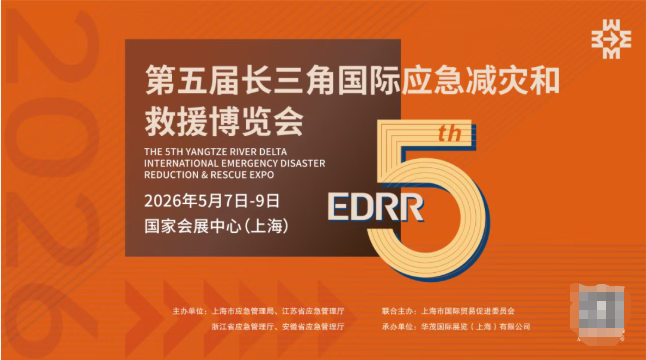
Smart CityOnline Exhibition Report】As the 18th National Disaster Prevention and Reduction Day approaches in China, the Yangtze River Delta region has once again delivered impressive results in the coordinated development of emergency management. On April 9th, the Shanghai Municipal Government Information Office held a press conference, where the emergency management departments of Shanghai, Jiangsu, Zhejiang, and Anhui, as well as the Shanghai Council for the Promotion of International Trade, jointly introduced the phased achievements of the coordinated development of emergency management in the Yangtze River Delta integration. They also announced that the 5th Yangtze River Delta International Emergency Disaster Reduction and Rescue Expo will be held from May 7th to 9th at the Shanghai National Convention and Exhibition Center.
At this press conference, the construction of the "Grassroots Flood Control and Typhoon Prevention Emergency Small Unit" special system from Zhejiang became the focus of attention in the fields of smart cities and grassroots governance. Faced with the severe situation of frequent extreme weather and overall emphasis on meteorological disasters during this year's flood season, Wu Xiaorong, Deputy Director of the Zhejiang Provincial Emergency Management Department, elaborated on this innovative measure aimed at bridging the "last mile" of flood and typhoon prevention.
Small units leverage big governance: from passive response to active prevention and control
Zhejiang Province is located on the southeast coast with complex terrain, and has always been one of the provinces in China with heavy pressure on disaster prevention and reduction. Wu Xiaorong pointed out that although Zhejiang has maintained zero casualties in recent years with the efficient "1833" joint command system, risks such as inadequate implementation at the end of the line are still prominent compared to the lessons learned from other provinces.
Therefore, relying on the "141" grassroots governance system, Zhejiang has innovatively explored and deployed the construction of more than 14000 grassroots flood and typhoon emergency small units. This system is not a new one, but rather an extension of the existing "1833" system, focusing on the core measure of "quick transfer and quick evacuation" of personnel in emergency situations, with small watershed flash floods and geological disasters caused by short-term heavy rainfall as the main scenarios.
Wu Xiaorong vividly summarized the operational logic of the small unit with a catchphrase: "The small unit is very important. Self rescue and mutual aid reach the end, one person does not miss full coverage, and the first step is to transfer and escape
Unit length activates peripheral nerves, AI empowers intelligent flood prevention
The key to whether the small unit system can exert its rotational function lies in the selection of the "unit length". According to the "four priorities" principle of "long-term residence, public prestige, young and strong, and Party member backbone", Zhejiang selects and assigns strong unit leaders, whose core responsibilities are early warning transmission, personnel transfer, and self rescue and mutual assistance. Xu Wenguang, Executive Vice Governor of Zhejiang Province, condensed his work into a catchphrase: "Put on a life jacket, put on a safety helmet, turn on a flashlight, whistle, honk the horn, sound the alarm, firmly grasp the satellite phone, and turn off the elderly, weak, sick, and disabled first
In addition to strengthening human resource organization, technological empowerment is another major highlight. Wu Xiaorong introduced that Zhejiang has leveraged its first mover advantage in artificial intelligence to promote the deep integration of AI technology with flood and typhoon prevention, and has developed two major applications: "Flood Control Staff" (AI+1833R) and "AI+Short term Warning". The former provides intelligent analysis and decision-making assistance for commanders; The latter is based on deep developed X-band radar data, which solves the problem of insufficient accuracy and short window period in previous short-term warning. Through digital platforms, warning information can penetrate to the lowest level in minutes, allowing frontline units to organize personnel transfers 1-2 hours earlier than before, and buying valuable time for the safety of life and property.
The "May Fourth Three" mnemonic ensures no chaos in the face of disasters
In order to enable the public to master the skills of self rescue and mutual aid, Zhejiang has also summarized and promoted the easy to understand "May Fourth Three" emergency transfer mnemonic: "5 must bring" (mobile phone, ID card, valuable items, clothing, medicine), "4 must leave" (must leave upon receiving instructions, cadre mobilization, receiving information, and hearing alarms), and "3 do not return" (do not receive notifications, do not assess, and do not take care of the elderly, weak, sick, and disabled).
Wu Xiaorong stated that the small unit system follows the principles of self-organization theory and systems theory. Through an indivisible architecture, self-organizing collaboration, and activation of key personnel, it has achieved a fundamental transformation of grassroots flood and typhoon prevention from passive response to active prevention and control.
Four Deepenings of Emergency Coordination in the Yangtze River Delta and Highlights of the Expo
At the press conference, Shen Weizhong, Deputy Director of the Shanghai Emergency Management Bureau, summarized the "four deepening" achievements of the special cooperation mechanism for emergency management in the Yangtze River Delta over the past seven years: policy standard coordination, risk joint prevention and control, emergency response coordination, and emergency resource force coordination guarantee. Three provinces and one city have made significant breakthroughs in data sharing, joint law enforcement, and cross regional exercises, such as shortening the cross regional investigation processing cycle from 15 days to 5 days.
On this basis, the 5th Yangtze River Delta International Emergency Disaster Reduction and Rescue Expo will achieve three major innovations: scene practicality, content precision, and publicity influence. The Expo has specially added special zones for aviation rescue, water rescue, grassroots emergency innovation, and more, with more than 70 themed activities. Ma Yi, Vice President of the Shanghai Council for the Promotion of International Trade, introduced that this expo will enhance its internationalization level through three major measures: "multi exhibition linkage", "global invitation" and "brand going global", and help China's emergency industry go global.
This press conference sends a clear signal: under the integration strategy of the Yangtze River Delta, emergency management is shifting from traditional administrative command style control to fine governance relying on digitization, grid, and intelligence. The practice of "emergency small units" in Zhejiang has provided a valuable "grassroots model" for the resilience and safety construction of smart cities nationwide.