-
Phone
18924664215
-
Address
9th Floor, Building B, Jingang Technology Industrial Zone, Yongfu Road, Fuyong Street, Bao'an District, Shenzhen City
Product Categories
Shenzhen Yima Xinnuo Technology Co., Ltd

7P rail type three-phase electronic energy meter
NegotiableUpdate on 05/03
- Model
- Nature of the Manufacturer
- Producers
- Product Category
- Place of Origin
Overview
7P rail type three-phase electronic energy meter
Product Details
|
product details
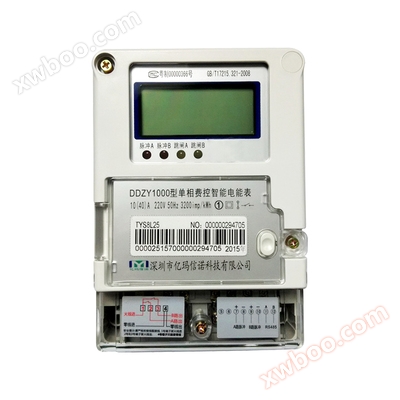
7P rail type three-phase electronic energy meterThe DIN rail mounted electric energy meter is a newly developed electric energy meter by our company, which adopts microelectronics technology and specialized large-scale integrated circuits, and applies advanced technologies such as digital sampling processing technology and SMT process. This meter can directly and accurately measure the active energy consumption of loads in a three-phase AC power grid with a rated frequency of 50Hz. This table displays operating parameters on an 8-bit LCD display, and has the characteristics of good reliability, small size, light weight, beautiful appearance, and easy installation. Widely applicable and convenient to set up. 7P rail type three-phase electronic energy meterAll technical indicators comply with national and industry standards such as GB/T 17215.321-2008, GB/T 17215.322-2008, GB/T 17215.323-2008, GB/T 17215.211-2006, GB/T 17215.301-2007, GB/T 15284-2002, DL/T614-2007, DL/T645-2007, etc.
1.7P rail type three-phase electronic energy meterFunction and characteristic 2.1. Energy Measurement stem or root of plants7P rail type three-phase electronic energy meterIt has the functions of measuring six basic types of electrical energy, including forward active power, reverse active power, and four quadrant reactive power of components A, B, and C, as well as the calculation functions of three types of combined electrical energy: combined active power, combined reactive power 1, and combined reactive power 2. The decimal place of electric energy during communication is fixed to 2 decimal places according to the standard DL/T 645-2007 Multi functional Electric Energy Meter Communication Protocol. 2.1. Quantity measurement Measure the maximum demand in both directions, the maximum demand in different time periods, and the date and time of their occurrence within the agreed time interval (one month), and store the data with time stamps. Can store maximum demand data for 12 settlement days. 2.2. clock The built-in hardware clock circuit with temperature compensation function is adopted, and strict protection measures are taken for the clock in the energy meter to ensure its correctness. Within 100 years, it has functions such as calendar, timing, and automatic switching of leap years. 2.3. Rate and Time Period Rate number: When programming, the rate number is used to indicate the operating rate of the energy meter. Rate numbers 1, 2, 3, and 4 are displayed as sharp, peak, flat, and valley. Daily Time Schedule: The 1-14 time slots can be combined with 1-4 rates as needed to form a daily time schedule (or seasonal rate), with a maximum of 2 sets available. Time Zone: The whole year can be divided into 1-2 time zones, and any one of them can be selected from 1-2 sets of daily time slot tables. Multi time zone usage instructions: Users can set the number of time zones they need to use, and the rate for each selected time zone can be set separately. The time zone setting must be continuous, that is, the end time of the first time zone is the start time of the second time zone. The electricity meter accumulates electricity based on the user's set rate, and when the time zone is converted, the rate automatically switches to the new time zone rate. 2.4. Settlement function 7P rail type three-phase electronic energy meterThe electricity metering data, maximum demand metering data, and time-sharing data not only store current data, but also historical data from January to December. The 'month' of this function refers to the settlement period, which can be set by setting the settlement date to set the settlement period of the instrument. The setting method can refer to the relevant standards of DL/T 645-2007 Multi functional Electric Energy Meter Communication Protocol. When the system clock of the instrument is the same as the set settlement time, the meter performs cross month settlement. First, the current month's electricity, maximum demand, and its occurrence time are stored in the previous month. Then, the maximum demand and its occurrence time of the current month are reset to zero, and the accumulation unit for calculating demand is reset to zero. Finally, the demand calculation is restarted. If the electricity meter loses power and crosses the settlement date, the meter will undergo cross month settlement after being powered on. But after 12 months or more, the electricity meter will not be subject to supplementary settlement.
2.5. Measurement and monitoring This instrument can measure the operating parameters such as apparent power, active power, reactive power, power factor, etc. of the composite element and the components A, B, and C. Capable of measuring the voltage and current of components A, B, and C, and displaying the direction of current, power, and power factor. The measurement error (citation error) shall not exceed ± 1%. 2.6. Data freezing Daily frozen storage of no less than 31 days of data, hourly frozen storage of no less than 168 hours of data (1 week). Daily frozen data content: forward active energy, reverse active energy, combined reactive power 1, combined reactive power 2, 4-quadrant reactive power, total maximum demand and time for forward active energy, total maximum demand and time for reverse active energy, variables. Freezing data content at the whole point: forward and reverse active power consumption. 2.1. communication The electric energy meter has one infrared communication interface and one RS485 communication interface. Infrared communication and RS485 communication interfaces are independent of each other in the physical layer, and the damage of one communication channel does not affect the other channel. The default RS485 interface is 2400bps (adjustable); The default modulated infrared communication interface is 1200bps (adjustable). 2.2. Wireless communication (expandable item, to be specified when placing the order) The communication channel adopts high-speed full duplex industrial grade NB IoT/LoRa modules. 2.3. Remote control switch Remote control commands can be sent to the energy meter through RS485 or wireless communication by the backend system, and the switch inside the meter will automatically respond upon receiving the remote control command. 1.7P rail type three-phase electronic energy meterMain technical parameters and specifications 3.1 Main Technical Parameters
|