-
E-mail
2881930832@qq.com
-
Phone
18721098078
-
Address
2nd Floor, Building 2, No. 253 Yulu Road, Jiading District, Shanghai
Ankerui Electric Co., Ltd
Ankerui Energy Storage Monitoring Platform: Intelligent 'Steward' of Energy Storage Systems
Date: 2025-05-07Read: 14
1、 Platform Overview
Ankerui Energy Storage Monitoring Platform is a comprehensive monitoring and management platform launched by Ankerui Electric Co., Ltd. for energy storage systems. It utilizes advanced information technology and automation control technology to monitor, control, and intelligently manage various devices in the energy storage system in real time, ensuring the safe, stable, and efficient operation of the energy storage system. It is suitable for various application scenarios such as industrial and commercial energy storage power stations, integrated light storage and charging power stations, and microgrid energy storage systems.
2、 Core functions
(1) Real time monitoring
-
Equipment status monitoring: capable of real-time collection of operational data such as voltage, current, temperature, power, etc. of key equipment in the energy storage system, including battery packs, energy storage converters (PCS), battery management systems (BMS), and distribution cabinets. It's like installing a 'health monitor' on every device to keep track of their operating status at all times. For example, by monitoring the temperature of the battery pack, abnormal temperature increases can be detected in a timely manner to avoid battery damage caused by overheating.
-
Environmental parameter monitoring: Monitor the environmental parameters of energy storage power plants, including environmental temperature, humidity, etc. Environmental factors can have an impact on the performance and lifespan of energy storage devices, and the platform provides suitable environmental references for device operation by monitoring these parameters. For example, in high temperature and high humidity environments, take measures in advance to prevent equipment from getting damp or malfunctioning due to poor heat dissipation.
(2) Data Analysis and Statistics
-
Operation data analysis: Conduct in-depth analysis of the collected equipment operation data, generate various reports and charts, such as daily reports, monthly reports, annual reports, etc. By analyzing the data, we can understand the operating trends, performance changes, and other aspects of the energy storage system. For example, analyzing the changes in the charging and discharging efficiency of a battery pack over time to determine the health status of the battery.
-
Energy consumption statistics: Collecting data on the charging and discharging capacity, energy consumption, and other aspects of energy storage systems to help users understand the energy utilization situation of the energy storage system. This is crucial for evaluating the economic and energy-saving benefits of energy storage systems. For example, by calculating the amount of electricity charged and discharged by the energy storage system during peak and off peak periods, the cost of electricity saved by the energy storage system for users can be calculated.
(3) Control and regulation
-
Charging and discharging control: Automatically control the charging and discharging process of the energy storage system based on factors such as grid load, electricity price policies, and energy storage system status. During periods of low electricity prices, control the charging of energy storage systems; During peak electricity price periods, control the discharge of energy storage systems to achieve peak valley arbitrage. For example, when the grid load is low and electricity prices are low, the platform automatically activates the charging function of the energy storage system to store electrical energy; When the power grid load is high and the electricity price is high, the platform automatically releases the stored electricity to supply the load for use.
-
Power regulation: Real time adjustment of the output power of the energy storage system based on the demand of the power grid and the capacity of the energy storage system. When the frequency of the power grid fluctuates, the energy storage system can quickly adjust the output power, participate in the frequency regulation of the power grid, and maintain the stable operation of the power grid. For example, when the frequency of the power grid decreases, the energy storage system rapidly increases its output power to provide support for the grid.
(4) Fault warning and diagnosis
-
Fault warning: By setting reasonable thresholds and algorithms, real-time monitoring and analysis of equipment operating data are carried out. When the operating parameters of the equipment exceed the normal range, timely warning information is issued. For example, when the voltage of the battery pack is too high or too low, the platform will immediately issue a warning to remind the operation and maintenance personnel to handle it in a timely manner to avoid the fault from expanding.
-
Fault diagnosis: When equipment malfunctions, the platform can diagnose and analyze the fault, determine the type, location, and cause of the fault, and provide corresponding solutions. This greatly shortens the time for troubleshooting and repair, and improves the availability of the energy storage system. For example, when the energy storage inverter malfunctions, the platform can quickly locate the fault point and guide maintenance personnel to carry out repairs by analyzing the fault code and operating data.
(5) Remote management
-
Remote monitoring: users can access the energy storage monitoring platform remotely at any time and anywhere through the Internet to view the operation status and data of the energy storage system in real time. Even if not on site at the energy storage plant, one can still have a comprehensive understanding of the system. For example, enterprise managers can log in to the platform through a computer or mobile phone in the office to check the operation status of their subordinate energy storage power plants.
-
Remote operation: supports remote operation of energy storage systems, such as remote start, stop of energy storage system charging and discharging, adjustment of equipment operating parameters, etc. This improves the efficiency and flexibility of operations and reduces the workload of on-site operations. For example, operation and maintenance personnel can remotely switch the operating mode of energy storage inverters.
3、 Platform advantages
(1) Highly integrated
Integrating various monitoring, control, and management functions in the energy storage system onto one platform avoids data silos and operational complexity between multiple systems. Users can complete comprehensive management of energy storage systems without switching between different software and systems. For example, on one platform, it is possible to simultaneously view the operational data of the battery pack, PCS, and BMS, and perform corresponding control operations.
(2) High degree of intelligence
Adopting advanced artificial intelligence and big data analysis technologies to achieve intelligent monitoring, control, and optimization of energy storage systems. The platform can automatically adjust control strategies based on historical data and real-time operating conditions, improving the operational efficiency and economic benefits of energy storage systems. For example, using machine learning algorithms to predict changes in grid load and electricity prices, and optimizing the charging and discharging plans of energy storage systems in advance.
(3) Safe and reliable
Having a comprehensive security protection mechanism to ensure the data security of the platform and the stable operation of the system. Adopting technologies such as data encryption and user permission management to prevent data leakage and illegal access. At the same time, the platform has a highly reliable hardware and software architecture that can operate stably in various harsh environments. For example, by adopting redundant design and fault-tolerant mechanisms, the platform can still function normally when some devices fail.
(4) Strong scalability
The platform adopts modular design and has good scalability. Monitoring equipment and management functions can be flexibly added or reduced according to the scale and requirements of the energy storage system. Whether it is a small-scale household energy storage system or a large-scale industrial and commercial energy storage power station, the platform can be adapted. For example, when expanding an energy storage power station, simply adding the corresponding equipment monitoring module on the platform can achieve monitoring and management of the newly added equipment.
4、 Application scenarios
(1) Industrial and commercial energy storage power station
In industrial and commercial enterprises, energy storage monitoring platforms can help companies achieve peak valley electricity price arbitrage and reduce electricity costs. At the same time, during power outages, energy storage systems can serve as backup power sources to ensure the continuity of production for enterprises. For example, a large factory has installed an energy storage system that charges during low electricity prices and discharges during high electricity prices through a monitoring platform, saving a significant amount of electricity costs annually.
(2) Integrated photovoltaic storage and charging power station
The integrated photovoltaic storage and charging power station integrates functions such as photovoltaic power generation, energy storage, and charging piles. The energy storage monitoring platform can uniformly monitor and manage photovoltaic power generation, energy storage systems, and charging piles, achieving efficient utilization and optimized configuration of energy. For example, when there is sufficient photovoltaic power generation during the day, excess electricity can be stored; At night or when there is insufficient photovoltaic power generation, use energy storage systems to supply power to charging stations to meet the charging needs of electric vehicles.
(3) Microgrid energy storage system
A microgrid is a small power generation and distribution system composed of distributed power sources, energy storage devices, loads, and other components. The energy storage monitoring platform can monitor and control the energy storage system in the microgrid in real time, achieving stable operation of the microgrid and friendly interaction with the large grid. For example, when the distributed power generation in the microgrid is insufficient, the energy storage system can release electrical energy to ensure the normal power supply of the load in the microgrid; When there is an excess of distributed power generation in a microgrid, the energy storage system can store the excess electricity.
The Ankerui energy storage monitoring platform provides strong guarantees for the safe, stable, and efficient operation of energy storage systems with its comprehensive functions, significant advantages, and wide range of application scenarios. It is an important tool in the field of energy storage.
5、 Acrel-2000ES Energy Storage Cabinet Energy Management System
5.1 System Overview
Acrel-2000ES, an energy storage management system developed specifically for industrial and commercial energy storage cabinets and containers, is an energy storage EMS with comprehensive energy storage monitoring and management functions. It covers detailed information of energy storage system equipment (PCS, BMS, electricity meters, fire protection, air conditioning, etc.), and realizes functions such as data collection, data processing, data storage, data query and analysis, visual monitoring, alarm management, statistical reporting, etc. Support energy scheduling in applications, with control functions such as planning curves, peak shaving and valley filling, demand control, and backflow prevention.
5.2 System Structure
Acrel-2000ES, The equipment inside the energy storage cabinet or container can be connected to the system through direct procurement, communication management, or serial server. The system structure is as follows:
5.3 System Functions
5.3.1 Real time monitoring
The system has a user-friendly human-machine interface that can display the operating status of the energy storage cabinet, monitor real-time PCS, BMS, and environmental parameter information such as electrical parameters, temperature, humidity, etc. Real time display of information related to faults, alarms, benefits, etc.

5.3.2 Equipment Monitoring
The system can monitor the operation status and mode of PCS, BMS, electricity meter, air conditioning, fire protection, dehumidifier and other equipment in real time.

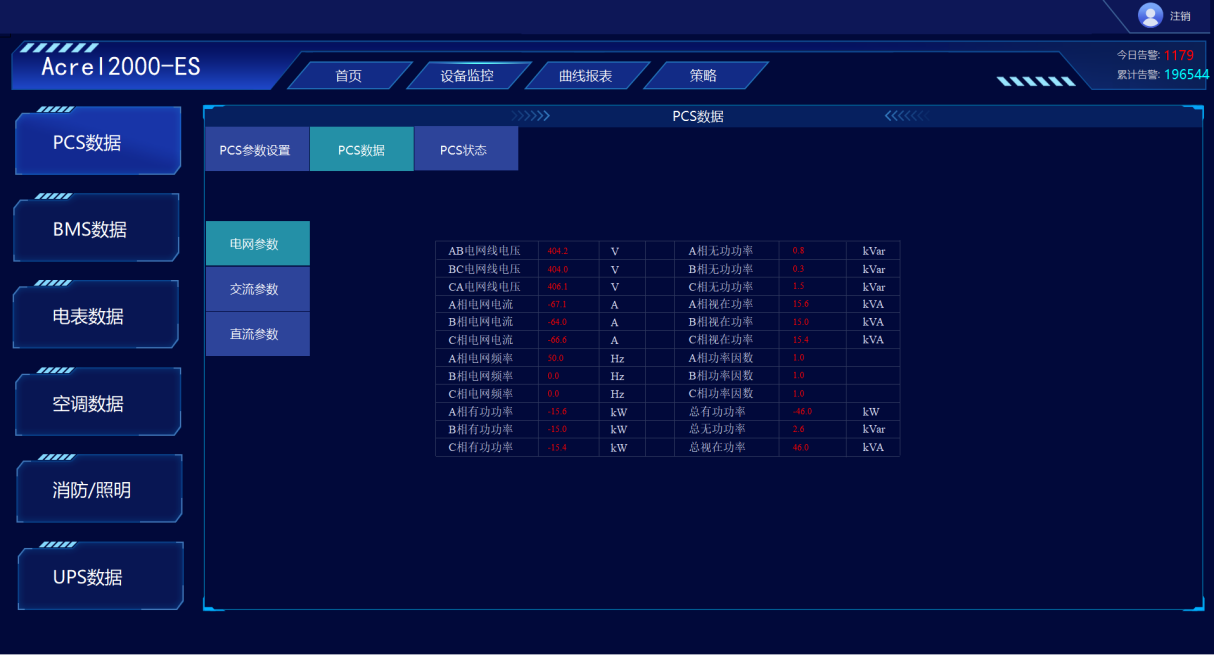


PCS monitoring: meet the parameter and limit settings of energy storage inverters; Operation mode setting; Realize the collection and display of voltage, current, power, and charging/discharging parameters on the AC/DC side of energy storage inverters; Implement monitoring of PCS communication status, start stop status, switch status, abnormal alarms, and other states.


BMS monitoring: meets the parameter and limit settings of the battery management system; Monitor the temperature, voltage, and current of energy storage battery cells and clusters; Realize alarms for abnormal battery charging and discharging status, voltage, current, and temperature.


Air conditioning monitoring: To meet the monitoring of environmental temperature, the air conditioning temperature can be linked and adjusted according to the set threshold, and the operating status and temperature and humidity data of the air conditioning can be monitored in real time, displayed in the form of curves.


UPS monitoring: meet the monitoring of UPS operation status and related electrical parameters.
5.3.3 Curve Report
The system is capable of querying and displaying PCS charging and discharging power curves, SOC conversion curves, as well as historical curves such as voltage, current, and temperature.


5.3.4 Strategy Configuration
Satisfy the configuration of energy storage system equipment parameters, the setting of electricity price parameters and time periods, and the selection of control strategies. The currently supported control strategies include planning curves, peak shaving and valley filling, demand control, etc.


5.3.5 Real time alarm
The energy storage management system has real-time alarm function, which can issue alarms for events such as energy storage charging and discharging exceeding limits, temperature exceeding limits, equipment failure or communication failure.
5.3.6 Event Query Statistics
The energy storage management system can store and manage event records such as remote signal displacement, temperature and humidity, and voltage exceeding limits, making it convenient for users to trace the history of system events and alarms, query statistics, and analyze accidents.

5.3.7 Remote control operation
The PCS, fans, dehumidifiers, air conditioning controllers, lighting and other equipment can be controlled through the red buttons below each device. However, when the devices are not communicating, the control buttons will display an invalid status.

5.3.8 User Permission Management
The energy storage management system has set up user permission management functions to ensure the safe and stable operation of the system. User permission management can prevent unauthorized operations (such as remote control operations, database modifications, etc.). It is possible to define login names, passwords, and operational permissions for users of different levels, providing reliable security for system operation, maintenance, and management.
