-
E-mail
2881930832@qq.com
-
Phone
18721098078
-
Address
2nd Floor, Building 2, No. 253 Yulu Road, Jiading District, Shanghai
Ankerui Electric Co., Ltd
Hospital energy management driven by dual carbon targets - intelligent control revolution
Date: 2025-04-28Read: 15
1、 Summary
Driven by the "dual carbon" goal, hospitals, as high energy consuming public buildings, need to achieve low-carbon transformation through systematic energy management strategies. The core strategy includes building a management system, applying intelligent technology, optimizing key systems, and promoting behavioral energy conservation. By utilizing energy consumption monitoring platforms, implementing energy-saving technology upgrades, and conducting energy-saving publicity, education, and training, we can achieve cost reduction and efficiency improvement, and promote high-quality development of hospitals.
【 Keywords 】 Energy audit; Energy consumption monitoring platform; Energy saving technology transformation; Energy consumption assessment; Hospital management.
2、 Related policies
During the 14th Five Year Plan period, the country issued the "Work Plan for Energy and Resource Conservation in Public Institutions", which clearly supports: adhering to green transformation, innovative upgrading, fully and comprehensively implementing the new development concept, ensuring that public institutions transform towards green and low-carbon directions, and using innovative means such as technology or management to enhance operational efficiency. In 2021, the National Health and Family Planning Commission issued the "Guiding Suggestions on Strengthening the Operation and Management of Public Hospitals", which pointed out that it is necessary to strengthen hospital logistics management to ensure its realization of socialized service development; For example, strengthening hygiene management in areas such as water, electricity, gas, heating, catering, and the environment, while also incorporating building space and safety protection, continuously optimizing their service processes, standardizing management systems, and enhancing low-carbon energy consumption; Further create a one-stop service model to lay the foundation for enhancing the quality of hospital services in the later stage. At the end of 2021, the "Guiding Opinions on Promoting the High Quality Development of Public Hospitals" were issued, which clearly stated that it is necessary to strengthen the management of cost consumption, reduce energy consumption investment of 10000 yuan, and achieve the development of hospital logistics intelligence and one-stop service.
3、 Analysis of energy-saving potential in hospitals
The sub systems that account for a large proportion of hospital energy consumption also have great energy-saving potential. The common problems of each system can be summarized as follows. (1) Common problems with cold and heat source systems: In order to ensure the stability of heating or cooling, hospitals usually choose higher power when installing heating boilers and central air conditioning units. Some hospitals have an unreasonable number of equipment configurations, which is not conducive to load regulation and increases both initial investment and daily operating costs. Central air conditioning units are mostly equipped with lithium bromide chillers, piston chillers, etc. Long term operation leads to a decrease in the heat transfer coefficient of the evaporator and condenser of the chiller unit due to fouling thermal resistance, resulting in a decrease in the performance coefficient of the unit. That is commonly referred to as "a big horse pulling a small car". The lack of air conditioning group control measures has reduced the unit's coefficient of performance (COP). The temperature difference between the inlet and outlet of the chilled water in the air conditioning unit is small, actually only 2 ℃ to 3 ℃, which increases the power loss of the water pump. Boiler units generally operate for a long time, with severe aging and low energy efficiency. The lack of flue gas waste heat recovery devices and condensate water recovery systems hinders further improvement in energy utilization efficiency. Heating cannot be adjusted in a timely manner according to changes in outdoor temperature, resulting in slow response to heat load.
(2) Common problems with the transmission and distribution system: The selection of central air conditioning chilled water pumps, cooling water pumps, and boiler heating circulation pumps is too large, and the water pumps are in a high flow and low temperature difference working state, resulting in hydraulic imbalance in the water system. The water pump operates mainly at the mains frequency, with a constant flow rate. There is no frequency conversion measure for the water pump, and the delivery coefficient (energy consumption of the water pump per unit water flow rate) is higher than the standard requirements. The parallel operation of the large pump and the small pump results in a mismatch in head, causing the small pump to be unable to output effectively.
(3) Common problems with electrical, lighting, and office equipment: Some hospitals have excessive lighting, with illuminance values far exceeding national standards, and unreasonable selection of light sources and fixtures, as well as failure to use high-efficiency energy-saving fixtures. The load rate of the power supply and distribution transformer is relatively low. The mechanical and electrical equipment in buildings, such as HVAC, air conditioning, lighting, water supply and drainage, lack intelligent control systems, and inadequate management can easily lead to energy waste.
(4) Common problems with end of pipe systems: In order to pursue comfort, users arbitrarily increase or decrease indoor temperature. The fan coil water system is not equipped with electric two-way valves or valves fail, resulting in excessive fan power consumption and no frequency conversion measures, leading to energy waste. The unreasonable arrangement of the end air vents leads to uneven indoor heating and cooling. The measures to improve energy-saving management in hospitals are as follows. (1) Partition and manage the air conditioning system according to the usage time of different functional rooms. (2) Timely activate the bypass system of the chilled water unit for chilled water. (3) Accurately set temperature standards for auxiliary rooms (warehouses, bathrooms, etc.) to avoid energy waste. (4) Systematically improve the energy-saving awareness and ability of medical personnel.
(5) Common problems with enclosure structure: Old hospital buildings usually use ordinary single-layer glass, with less use of double-layer glass and coated glass. The window frames are mostly made of ordinary aluminum alloy and no insulation measures have been taken, resulting in poor insulation performance of the enclosure structure. Some hospitals use a large number of transparent glass curtain walls to pursue the effect of building facades, which results in less shading outside the windows and is not conducive to energy conservation and consumption reduction.
4、 Ankrui provides hospital energy management strategies
The AcrelEMS MED Hospital Energy Management Platform fully integrates industry standards such as the "Code for Electrical Design of Medical Buildings", "Evaluation Standards for Green Hospital Buildings", and "Technical Guidelines for the Construction of Hospital Building Energy Consumption Supervision Systems". Based on the needs of hospital users and the requirements of energy management departments, it collects and analyzes energy, energy consumption, and energy efficiency data, monitors electricity quality, smart electricity related indicators, and other energy consumption indicators, and combines them with national energy policies and energy consumption mode reforms. It can assist hospital logistics management personnel in the operation and management of energy supply systems and equipment, help hospital management to grasp the hospital's energy consumption situation in real time, and provide a good technical platform for hospital energy information construction and energy-saving management.
Ankrui Hospital Energy Management System has established an integrated energy management system based on cloud platform for "monitoring, control, and maintenance". The system is designed from data collection, equipment control, data analysis, abnormal warning, operation and maintenance dispatch, system architecture, and comprehensive data services to help the hospital's logistics management department comprehensively understand the hospital's energy operation situation, pay attention to fire and electrical safety, timely warn of abnormal situations, and improve operation and maintenance efficiency. It integrates a 10KV/0.4KV substation power monitoring system, substation operation and maintenance cloud platform, distribution room comprehensive monitoring system, energy management system, intelligent lighting control system, smart fire platform, electrical fire monitoring system, fire equipment power monitoring system, fire door monitoring system, fire emergency lighting and evacuation indication system, charging pile management system, power quality governance solution, and medical isolation power solution.
1. Substation operation and maintenance cloud platform
The AcrelCloud-1000 power operation and maintenance cloud platform adopts multi-functional power sensor, wireless communication, edge computing gateway and big data analysis technology, collects field data through intelligent gateway and stores it locally, and then regularly pushes data to the cloud platform. The data collected by the platform includes electrical parameters of the substation circuit, transformer temperature, environmental temperature and humidity, immersion, smoke, video, access control and other information. If any abnormalities occur, an alarm signal will be sent out through SMS and APP within 10 seconds. The platform issues operation and maintenance tasks to the staff's mobile phones through a mobile app, and tracks the operation and maintenance execution process through GPS to achieve closed-loop, improve operation and maintenance efficiency, and promptly detect and eliminate operational defects.

2. Energy consumption management
Real time measurement of energy consumption data for various types of energy consuming equipment in buildings, and statistical and analytical analysis of collected data. Being able to reasonably determine the economic indicators and performance evaluation indicators of building energy consumption in each department, discover energy usage patterns and energy waste situations, and promote the awareness of proactive energy conservation among Tigao personnel. ① Establish the basic framework of a hospital's smart energy management system and conduct real-time monitoring of various energy consumption processes; ② Carbon emission digitization: Through the system, per capita energy consumption analysis (including water, electricity, and energy) within building units can be achieved, realizing low-carbon office digitization; ③ Regional energy efficiency ratio: achieving energy consumption comparison within building units, facilitating energy consumption assessment; ④ Same period energy efficiency ratio: achieve energy consumption comparison in the same year, same period, and same region, facilitating energy-saving data analysis; ⑤ Energy consumption assessment management: Analyze unit area energy consumption and per capita energy consumption indicators based on energy consumption quota standard constraint values, standard values, and guidance values; ⑥ Energy consumption competition ranking: comparing energy consumption of various departments, achieving energy consumption ranking, and enhancing the energy-saving awareness of all staff in the hospital; ⑦ Comprehensive analysis, statistics, printing, and querying of energy consumption usage data, and the ability to choose different styles of report printing according to the needs of the energy monitoring and management system. Provide reliable basis for energy consumption operation management department; ⑧ Energy consumption data collection, real-time query, and statistical analysis based on collected data, monitoring abnormal energy consumption, alerting for energy intelligent instrument failures, and improving the level of informationization and automation of the Tigao system.
3. Intelligent lighting
Hospitals have a high density of abortions and multiple departments, with lighting accounting for approximately 15% of the hospital's electricity consumption. Reasonably use the lighting control system, and maximize the use of natural light lighting in the experience of doctors and patients. Through induction control, the lights can be turned on when people come, turned off when people leave, or maintain ground intensity lighting to solve lighting electricity problems as much as possible. The ASL1000 intelligent lighting control system can achieve various control methods such as scene control, time control, area control, illumination sensing control, and infrared sensing control, effectively avoiding lighting waste in public areas and helping hospitals manage lighting. The modules of the system in the distribution box mainly include bus power supply, switch driver, IP gateway, coupler, dry contact input module, etc. These modules are installed using 35mm standard rails. The modules installed on the control site mainly include illuminance sensors, infrared sensors, and intelligent panels. Someone can set infrared sensing to control the lighting, and turn off the lights within the set time after leaving. The intelligent panel and other manual control devices can achieve a combination of automatic control, on-site control, and remote control from the duty room.

4. Safe use of electricity
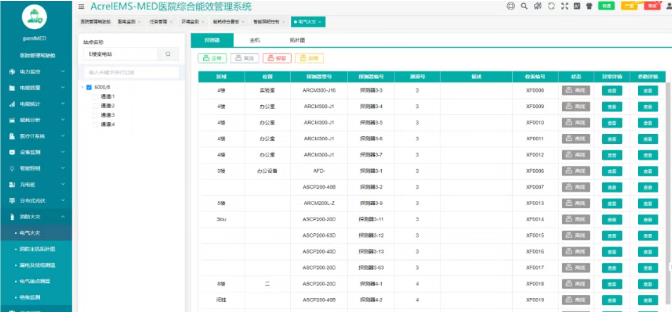
The secure electricity cloud platform is based on modern information technologies such as the Internet of Things, big data, and cloud computing. It connects scattered fire automatic alarm devices, electrical fire monitoring devices, smart smoke detectors, smart fire water and other devices to form a network, and intelligently perceives, identifies, and locates the status of these devices. It dynamically collects fire information in real time and analyzes data, mining, and trend analysis through the cloud platform to help achieve scientific fire warning, grid management, and the implementation of multiple responsibility supervision goals. We have achieved unmanned and intelligent firefighting, meeting the requirements of "automation", "intelligence", and "systematization" for intelligent firefighting. From fire prevention, to fire alarm, and then to control linkage, operating within a unified system platform, users, security personnel, and regulatory units can intuitively see the operation status of various fire-fighting equipment and sensors in each building through the platform. In case of detailed hidden dangers, fire incidents, and other emergency and non emergency situations, relevant alarm and event information can be quickly notified to relevant personnel through SMS, voice calls, email reminders, and APP push notifications within seconds.