-
E-mail
1660276275@qq.com
- Phone
-
Address
A306 Zhongguancun Software Park Information Center, Dongbeiwang West Road, Haidian District, Beijing
Beijing Blue Card Technology Co., Ltd
Intelligent neural network for urban transportation in IoT parking lot management system
Date: 2025-07-22Read: 49
Against the backdrop of accelerated urbanization, the difficulty of urban parking has become a core pain point that restricts traffic efficiency. The IoT parking lot management system integrates sensors, cloud computing, big data and other technologies to build a full chain intelligent system covering parking space perception, vehicle recognition, resource scheduling, and user services, providing innovative solutions for urban static traffic governance.
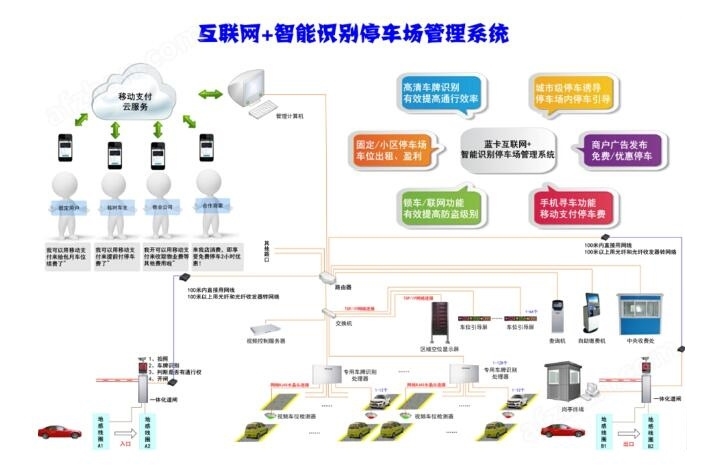
1. Intelligent perception: building a "digital twin" of parking lots
The system collects real-time data on parking space occupancy status, vehicle entry and exit time, license plate numbers, etc. through devices such as geomagnetic sensors, video license plate recognition cameras, and ultrasonic detectors. Taking the Tianmen Smart Parking Project as an example, the geomagnetic detectors installed in 7000 roadside parking spaces can accurately identify the entry/exit time of vehicles, with an error controlled within ± 2 seconds. Combined with AI intelligent monitoring cameras, the system can automatically identify abnormal behaviors such as illegal parking and occupying fire exits, and push alarm information to management personnel terminals through the Internet of Things platform. This closed-loop mechanism of "perception recognition warning" shifts parking lot management from passive response to active intervention.
2. Cloud collaboration: achieving global optimization of resources
The centralized management platform based on cloud computing is the "brain" of the system. Taking the Aiko Intelligent Parking Global Operation Platform as an example, it can access data from multiple scenarios such as on road parking, closed parking lots, charging stations, etc., and display key indicators such as parking turnover rate, traffic flow, and revenue in real-time through visualized large screens. In the new building project of Hefei Science and Technology Museum, the system is integrated with the "Hefei Urban Parking Platform" to dynamically release the remaining parking spaces in the city and guide car owners to divert to idle parking lots. The platform also supports advanced functions such as tidal lane management and peak parking warning. For example, in the second phase project of Shandong University Qilu Hospital (Qingdao), the system dynamically adjusted the charging strategy of the three-dimensional garage by analyzing data during peak medical periods, resulting in a 40% increase in parking space utilization.
3. User Service: Reshaping the Parking Experience
The system provides users with one-stop services such as parking reservation, navigation, payment, and electronic invoices through WeChat mini programs, apps, and other channels. In the Beijing Intelligent Security Industry Base project, visitors can enjoy VIP fast passage by registering their license plates online, avoiding manual registration and queuing. For new energy vehicles, the system can be integrated with the charging station management system to achieve "parking+charging" scenario linkage. At the headquarters building of Chengdu Urban Investment Group, car owners can view the distribution of remaining parking spaces in the garage in real time through a video parking guidance system. With the reverse search function, the search time has been reduced from 15 minutes to 2 minutes.
4. Dual enhancement of economic benefits and social value
From the perspective of the operator, the system can reduce labor costs by more than 30% through functions such as unmanned barrier gates and remote operation and maintenance. Taking Shenzhen Zhouming Technology Park as an example, after adopting the Dashi Smart Parking System, a single parking lot can save over 500000 yuan in labor costs annually. From the perspective of urban governance, the system reduces exhaust emissions by reducing vehicle detour time. According to calculations, after the application of a commercial complex project, the congestion index of surrounding roads decreased by 25%, and the PM2.5 concentration decreased by 18%.
Currently, the IoT parking lot management system is evolving towards the direction of "vehicle road cloud integration". In the future, with the deep integration of technologies such as 5G and digital twins, the system will achieve more accurate predictive scheduling and more personalized value-added services, becoming the core infrastructure of the smart city transportation system.