-
E-mail
2442648961@qq.com
-
Phone
13023169219
-
Address
No. 3666 Changcheng Road, Mudan District, Heze City, Shandong Province
Shandong Sairuite Testing Instrument Co., Ltd
Thermal conductivity and thermal diffusivity tester (laser flash method): Tangshan company visited the company for on-site inspection
Date: 2025-08-30Read: 17
On site acceptance of laser flash method thermal conductivity and thermal diffusion coefficient measuring instrument: Tangshan company on-site acceptance of instrument
In the field of modern materials science and engineering, the determination of thermal conductivity and thermal diffusion coefficient is a very important experimental task. These parameters not only play an indispensable role in new material research and development, physical property testing, and engineering applications, but also play an important role in promoting industry development. With the advancement of technology, laser flash method has become a popular measurement method, and it has gradually been widely used in the industry due to its fast and efficient characteristics. Tangshan company recently conducted on-site acceptance of the laser flash method thermal conductivity and thermal diffusion coefficient measuring instrument, and we will discuss this in detail.

1、 Introduction to Laser Flash Method
Laser flash method is a technique that uses laser pulses to heat the surface of a material, and then measures the thermal conductivity and thermal diffusion coefficient by monitoring the temperature changes inside the material. In this method, laser pulses are accurately directed onto the surface of the sample, causing a sharp increase in surface temperature. As heat diffuses inside the sample, thermal waves propagate from the surface to the interior, and temperature changes are recorded by high-precision detection instruments. Finally, the thermal physical parameters of the material can be obtained through calculation.
2、 The significance of thermal conductivity and thermal diffusion coefficient
1. Thermal conductivity is an important indicator for measuring the ability of materials to conduct heat. High thermal conductivity materials are commonly used in fields such as heat dissipation and insulation, such as heat sinks for electronic devices and building materials. The thermal conductivity varies with the composition, structure, and temperature of the material, so accurate measurement is crucial.
2. The thermal diffusion coefficient refers to the ability of a material to diffuse heat, which is closely related to the material's thermal conductivity, density, and specific heat capacity, and can reflect the material's heat transfer characteristics under non steady state conditions. By measuring the thermal diffusion coefficient, the performance of materials in different application environments can be evaluated, such as the reliability of thermal protection materials.
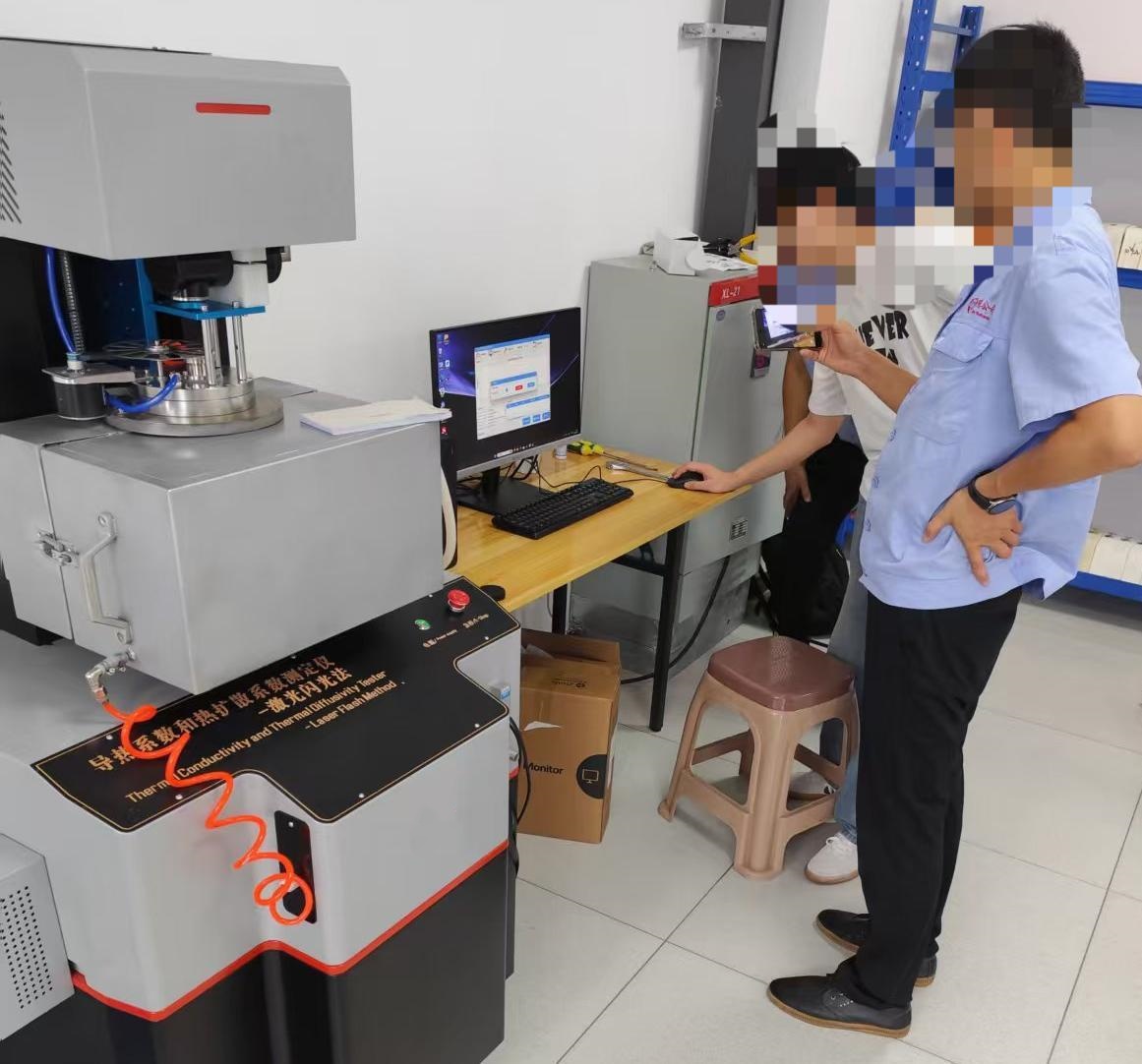
3、 On site acceptance service of a certain company in Tangshan
Recently, a certain company in Tangshan decided to conduct on-site acceptance of its newly purchased laser flash method thermal conductivity and thermal diffusion coefficient measuring instrument in order to promote technological development. This measure aims to ensure the performance stability of the instrument before use in the laboratory and provide experimental conditions for users. The company's service team is composed of multiple experienced professional engineers who conduct meticulous inspections during the equipment acceptance process.
1. Appearance and functional inspection of the instrument
During the acceptance process, the team first carefully inspected the appearance of the instrument, including whether the instrument's casing, display screen, operation panel, etc. were intact and undamaged. Subsequently, they conducted functional testing to ensure that all buttons, interfaces, and sensors were functioning properly. In this step, the team also checked the laser device equipped on the equipment to ensure stable power and accurate emission direction.
2. Performance testing
In addition to visual inspection, the team also conducted specialized performance testing. They selected different types of standard samples for measurement and compared the measured thermal conductivity with known values. Through this process, the team confirmed the measurement accuracy of the instrument and recorded the data for subsequent analysis.
3. Calibration and adjustment
To ensure the accuracy of the instrument during long-term use, engineers from a certain company in Tangshan also conducted necessary calibration and adjustment. Based on the test results, they optimized the parameter settings of the instrument to ensure accurate feedback in practical operation. At the same time, engineers also provide professional operation guidance to users, ensuring that the use of the instrument does not require additional cumbersome procedures.

4、 Application Fields and Prospects
The wide application of laser flash method for measuring thermal conductivity and thermal diffusion coefficient has shown great potential for development in multiple fields. Here are several specific application areas:
1. New material research and development: In the process of developing new materials, the determination of thermophysical parameters can promote the scientific and standardized design of materials.
2. Construction industry: The selection of building materials can improve the overall energy efficiency of buildings by measuring their thermal conductivity and diffusion coefficients.
3. Electronic devices: The research and testing of heat dissipation materials is an important field in the electronics industry, and the laser flash method provides decision-making basis to help design higher performance heat dissipation systems.
4. Aerospace: Material performance evaluation in the environment, accurate performance evaluation provides assurance for the safety of aircraft and spacecraft.
5、 Summary
The on-site acceptance service of a certain company in Tangshan demonstrates their professionalism and sense of responsibility in the field of thermal physics testing instruments. Through refined services, they provide convenience to users, ensuring that the performance of thermal conductivity and thermal diffusion coefficient measuring instruments reaches the required state, paving the way for daily experiments.