-
E-mail
2442648961@qq.com
-
Phone
13023169219
-
Address
No. 3666 Changcheng Road, Mudan District, Heze City, Shandong Province
Shandong Sairuite Testing Instrument Co., Ltd
SRT-L007 Thermal Conductivity Tester - Transient Plane Heat Source Method (including Room Temperature and High/Low Temperature) Introduction Professional Production
Date: 2025-12-29Read: 15
The transient plane heat source method is a high-precision testing technique based on the theory of thermal conduction. By heating the plane probe transiently and analyzing its temperature response, the thermal conductivity, thermal diffusivity, and specific heat capacity of the material can be directly calculated.
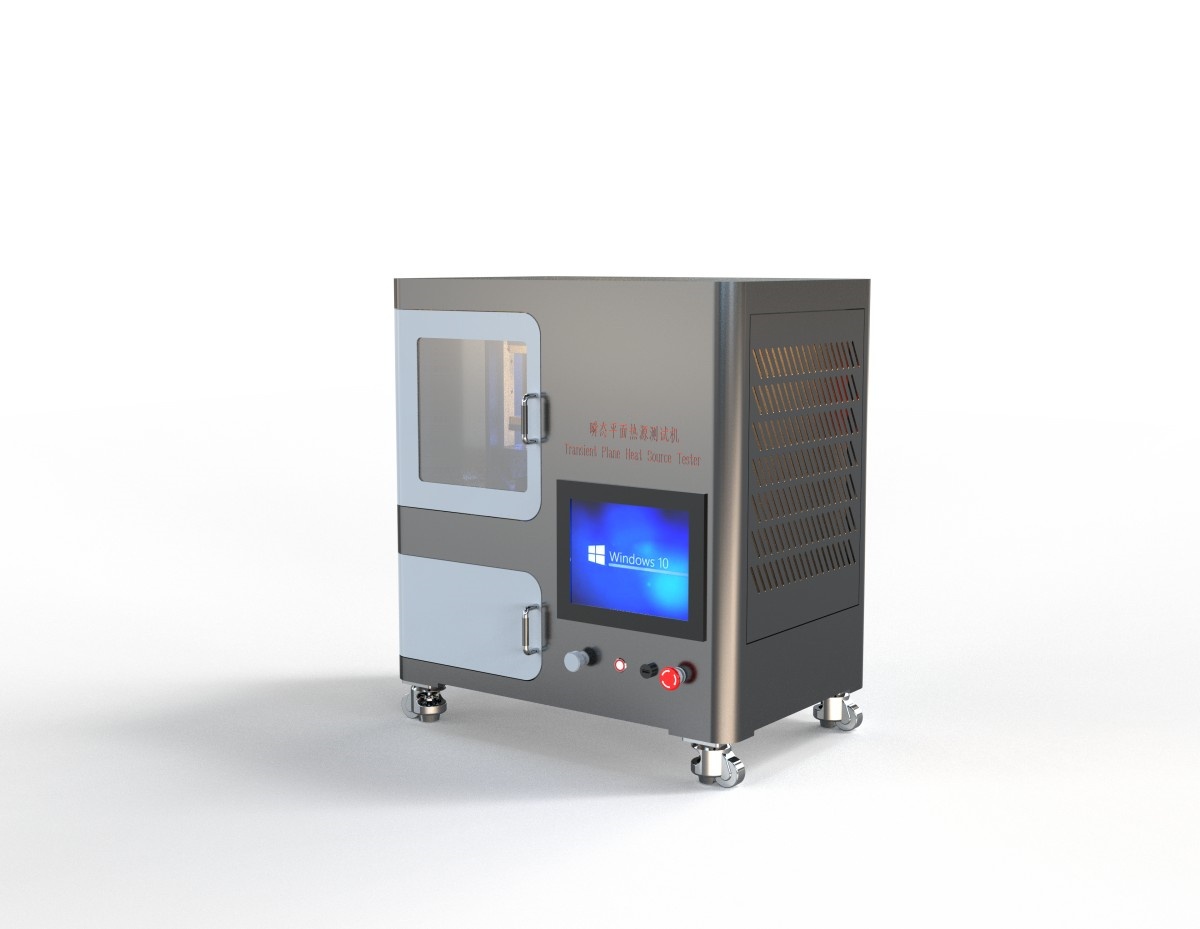
Room temperature version
1、 Principle
The probe is made of thermal resistant material and serves as both a heat source and a temperature sensor. Its resistance is linearly related to temperature, and heat loss can be calculated by monitoring changes in resistance.
During testing, the probe is sandwiched between two samples to form a "sandwich" structure, and a constant current is applied to generate a temperature rise of 2-5K. The speed at which heat diffuses into the sample depends on the material's thermal conductivity, with high conductivity materials dissipating heat quickly and low conductivity materials dissipating heat slowly.
2、 Characteristics
Efficient and accurate:
The testing time is short, and the thermal conductivity, thermal diffusivity, and specific heat capacity can be obtained synchronously, with much higher efficiency than traditional steady-state methods.
Adopting high-precision sensors and digital control systems to avoid human errors.
Wide applicability:
Wide measurement range, covering metals, ceramics, polymers, composite materials, liquids, powders, and paste solids.
Low requirements for sample shape, only requiring a flat surface and a length and width ≥ twice the probe diameter, without the need for special preparation.
Easy to operate:
Automated control and data collection, supporting touch screen operation and software analysis, reducing human intervention.

High and low temperature models
3、 Application Fields
Materials Science:
Study the thermal conductivity of new materials, optimize material formulations and structures.
Test the thermal conductivity of basic materials such as metals, ceramics, and polymers to provide data support for material development.
Electronics and Communication:
Evaluate the performance of heat dissipation materials for electronic devices to ensure device stability.
Test thermal management materials for miniaturized devices such as 5G smartphones and high-power systems to solve heat dissipation problems.
Architecture and Building Materials:
Measure the thermal conductivity of walls and thermal insulation materials (such as mineral wool and foam plastic), and evaluate the building energy efficiency.
Test the thermal insulation performance of cement walls and glass reinforced composite panels, and optimize building design.
Automobile manufacturing:
Analyze the thermal conductivity of materials such as engine components and battery packs to enhance the safety and comfort of automobiles.
Test the thermal stability of lightweight materials to support the development of new energy vehicles.
Aerospace:
Measure the thermal conductivity of aerospace materials in high-temperature environments to ensure material reliability.
Test the thermal insulation performance of the spacecraft's thermal protection system to ensure mission safety.
Energy and Chemical Industry:
Analyze the thermal properties of battery electrolytes and phase change materials to optimize the efficiency of energy storage systems.
Test the thermal conductivity of fluids in the petroleum and chemical industries to support process design.