-
E-mail
yinyangyang@yunjingtianhe.com
-
Phone
13276363313
-
Address
Weifang Optoelectronic Industry Accelerator, Shandong Province
Shandong Tianhe Environmental Technology Co., Ltd
Online boiler water hardness tester: adjust water quality in a timely manner based on water hardness information to reduce the risk of boiler failure
Date: 2025-12-29Read: 30
Online boiler water hardness tester: adjust water quality in a timely manner based on water hardness information to reduce the risk of boiler failure. 【 Model recommendation: 】TH-GL02IoT integrated devices, cloud based Tianhe supports customized servicesIn the operation of industrial boilers, the hardness of water quality can be regarded as a "hidden killer" that affects equipment safety and energy efficiency - water with excessively high hardness will quickly precipitate and form scale after heating, which will adhere to the inner wall, pipeline, and heating element surface of the boiler. This not only reduces heat conduction efficiency and increases energy consumption, but also may cause serious faults such as pipe bursting and leakage due to local overheating, and even lead to the paralysis of the entire heating system. The online boiler water hardness tester serves as an "intelligent sentinel" for water quality management, capturing real-time changes in calcium and magnesium ion concentrations in water through high-precision sensors. Its core function is to convert abstract water hardness into quantifiable electrical signals and use intelligent algorithms to achieve dynamic data analysis. Once the hardness exceeds the standard, the system immediately triggers a warning signal, synchronously links with the water quality regulation device, automatically injects softening agents or starts the descaling program to block the generation of scale from the source. From steam boilers in chemical enterprises to thermal boilers in heating systems, online detectors are managed in a closed-loop system of "monitoring warning regulation" to help enterprises nip boiler failure risks in the bud, ensuring production continuity and equipment service life.
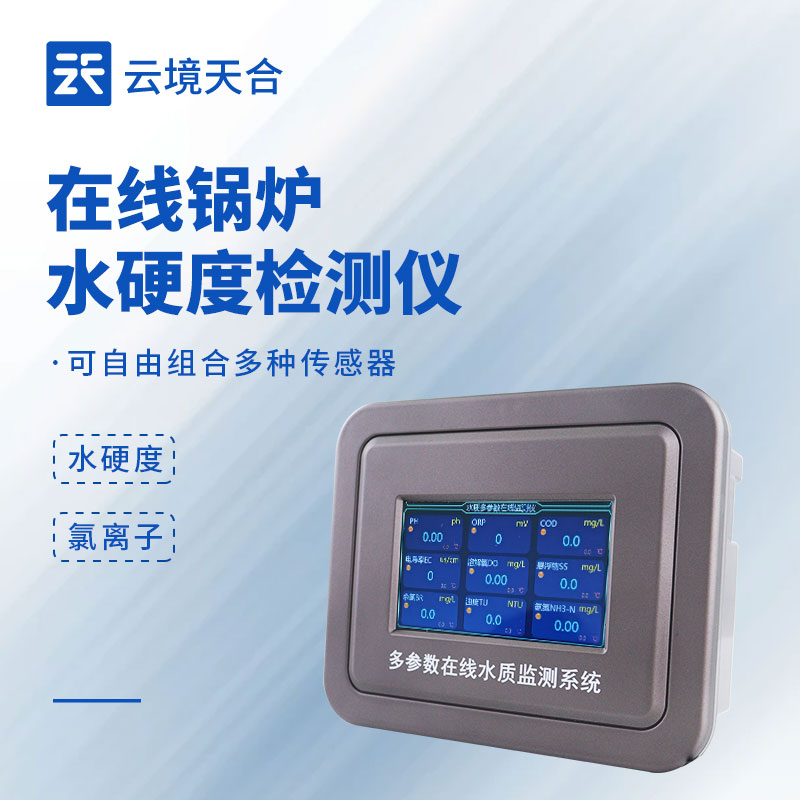
1、 Product Introduction
Online water quality analyzer is an instrument that can monitor water hardness and chloride ions online, and can quickly and accurately record key parameters in water bodies. At the same time, the instrument supports the expansion of water quality multi parameter sensors, which can be combined and configured according to different needs and applications, record and store historical monitoring data and alarm history records, and support the export of historical data. The RS485 interface supports the MODBUS-RTU communication protocol, making it convenient for users to communicate freely. It can connect and transmit data with devices such as PLC, DCS, configuration software, DTU, etc.
2、 Application Fields
1. Factory boiler water quality monitoring: used to prevent the formation of scale, prevent equipment corrosion, and ensure equipment safety.
2. Groundwater monitoring: used to monitor parameters such as pH value, conductivity, temperature, etc. of groundwater, in order to timely detect and solve water quality problems.
3. River and lake monitoring: used to monitor the water quality of rivers and lakes, such as dissolved oxygen, turbidity, ammonia nitrogen and other parameters, in order to take timely pollution control measures.
4. Ocean monitoring: used to monitor the water quality of the ocean, such as salinity, dissolved oxygen, temperature and other parameters, in order to timely detect and control marine pollution.
5. Sewage treatment: used to monitor the water quality parameters of sewage, such as pH value COD、 Ammonia nitrogen and other substances are used to control and regulate the sewage treatment process.
6. Industrial production: used to monitor the water quality status in the industrial production process, such as pH, conductivity, dissolved oxygen and other parameters, in order to adjust the process in a timely manner and ensure product quality.
7. Water treatment plant: used to monitor the pH value, dissolved oxygen, turbidity and other parameters of tap water, ensuring the safety and hygiene of tap water.
8. Scientific research: used for water quality monitoring in the field of scientific research, such as eutrophication of lakes, climate change, and other studies.
3、 Product Features
1. High reliability: suitable for long-term work in outdoor environments, with stable measurement and strong anti-interference ability.
2. Flexible and portable: Each probe can be freely combined and replaced independently, plug and play.
3. Scalability: Multiple sensors can be freely combined.
4. Multiple applications: rapid on-site measurement, emergency monitoring, or long-term online monitoring of groundwater, river water, lake water sources, and urban pipeline water.
5. Resilient shell: ABS+PC material, corrosion-resistant, capable of long-term continuous normal operation.
6. Compact structure: can be installed in smaller sizes.
7. Communication connection: RS485 expansion interface, isolated master/slave interface for independent communication.
4、 Technical parameters of multi parameter water quality analyzer
| display output | 4.3-inch touch screen with strong LED backlight, operable under direct sunlight |
| power supply | DC power supply: DC12V |
| power consumption | The power consumption of the instrument is about 12V/1W |
| Sound output | buzzer |
| communication protocol | Standard RS485 Modbus RTU protocol and device master/slave transmission channel support |
| Main materials | ABS+PC material |
| Storage temperature | -20 to 70 ℃ |
| Operating temperature | -10 to 50 ℃ |
| Protection level | IP65 |
| size | 175mm * 140mm * 49mm (length x width x height) |
| weight | About 0.5KG |
5、 Sensor parameters
| model | name | measurement range | principle | measurement accuracy | resolution | Is it standard | remark |
| S1S | cod | 0~1000mg/ L | UV254 absorption method | ±5%, ±0.3℃ | 0.1mg/L | COD turbidity integrated; Self cleaning with brush and temperature compensation | |
| turbidity | 0~400NTU | scattered light method | ± 1%, ±0.3℃ | 0.1NTU | |||
| S2 | Water hardness | 0~1000.0mg/L | Contact electrode method | ± 10% of the reading; ±0.3℃ | 0.1mg/L | √ | |
| S3 | pH | 0~14(ph) | Electrochemistry (salt bridge) | ± 0.1PH; ±0.1℃ | 0.01 | Warm compensation | |
| S4 | residual chlorine | 0~5.00 mg/L | Ion selective electrode method | ± 5% of the reading; ±0.3℃ | 0.01mg/L | Integrated residual chlorine pH; The best accuracy is achieved when the flow rate is between 0.42m/s and 0.85m/s; Warm compensation | |
| pH | 0~14(ph) | Electrochemistry (salt bridge) | ± 0.1PH; ±0.1℃ | 0.01 | |||
| S5 | ammonia nitrogen | 0~1000mg/l | Ion selective electrode method | 10% of the reading, ± 0.5 ℃ | 0.01mg | Ammonia nitrogen pH integrated; Warm compensation | |
| pH | 0~14(ph) | Electrochemistry (salt bridge) | ± 0.1PH; ±0.1℃ | 0.01 | |||
| S6 | ORP | -1500mv~1500mv | Electrochemistry (salt bridge) | ± 6mv | 1mV | ||
| S7 | conductivity | 0~10000uS/cm | Contact electrode method | ± 1.5%; ±0.1 °C | 1uS/cm | Warm compensation | |
| S7H | High range conductivity | 0~30000μS/cm | Contact electrode method | ± 1.5%; ±0.1 °C | 1uS/cm | High range conductivity TDS salinity integrated sensor; Warm compensation | |
| TDS | 0-10000ppm | Contact electrode method | ± 1.5%; ±0.1 °C | 1ppm | |||
| salinity | 0-10000ppm | Contact electrode method | ± 1.5%; ±0.1 °C | 1ppm | |||
| S8 | dissolved oxygen | 0~20mg/L | Fluorescence lifetime method | ±2%, ±0.3℃ | 0.01mg/L | Warm compensation | |
| S9 | turbidity | 0~1000NTU | scattered light method | ±1% , ±0.3℃ | 0.1NTU | Warm compensation | |
| S9S | Self cleaning turbidity | 0~1000NTU | scattered light method | ±1% , ±0.3℃ | 0.1NTU | Self cleaning with brush; Warm compensation | |
| S10 | suspended solids | 0~2000mg/L | scattered light method | ± 5% (depending on sludge homogeneity) | 0.1mg/L | ||
| S11S | sludge concentration | 0~20.000g/L | scattered light method | ± 5% (depending on sludge homogeneity) | 0.001g/L | Self cleaning with brush | |
| S14 | chloride ion | 0-3500.0mg/L | Ion selective electrode method | ±5%; ±0.3℃ | 0.1mg/L | √ | |
| S15S | chlorophyll | 0~400ug/L | fluorescence method | R²>0.999 | 0.01ug/L | Self cleaning with brush; Warm compensation | |
| S16S | blue-green algae | 0~200.0Kcells/mL | fluorescence method | R²>0.999 | 0.1Kcells/mL | Self cleaning with brush | |
| S17S | 水中油 | 0~60ppm | fluorescence method | 0.1ppm | 0.01ppm | Self cleaning with brush | |
| S20 | transparency | 50~1000mm | scattered light method | ± 5% (depending on sludge homogeneity) | 1mm | Warm compensation | |
| S21 | water temperature | −20℃~85℃ | High precision digital sensor | ±0.1℃ | 0.1℃ |