【
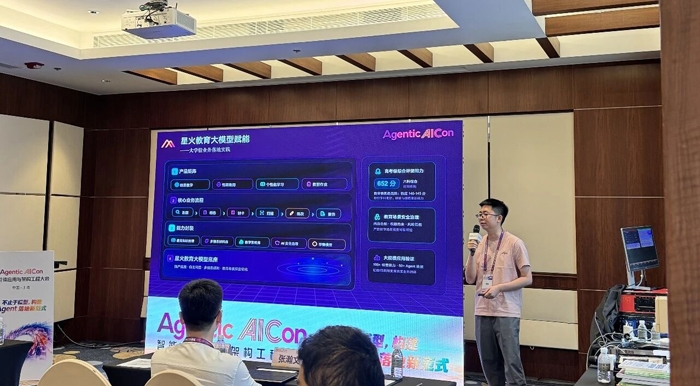
Smart CityOnline Brand Column】From June 5th to 6th, the Agentic AICon Intelligent Agent Application and Architecture Engineering Conference, a professional industry summit focusing on the entire lifecycle of Agentic AI, was held in Shanghai.
At the "Vertical Industry Intelligent Agent Application Special Session", Li Heng, Senior System Architect at iFlytek, introduced in his report that relying on the Spark Education Model and Agent capabilities, educational SaaS software achieves dynamic capability delivery to meet the diverse needs of users in real scenarios. He mentioned that in the past, software solved the problem of "people finding functions", while today's big models are solving the problem of "system understanding goals".
From meeting to doing: AI evaluation standards are changing
Since 2025, agents have become almost the hottest topic in the field of artificial intelligence. Compared to whether AI can answer questions, people are starting to focus on whether AI can complete tasks. This is seen as an ongoing AI paradigm shift.
If the core value of generative AI lies in "better predicting the next token," then the core value of Agentic AI lies in "continuously taking action to achieve goals. The underlying reflection is that the focus of AI development has gradually shifted from single point capabilities such as answering questions, generating text, and generating code to system capabilities such as goal planning, tool invocation, multi-step execution, and result delivery.
As AI moves from being able to say to being able to do, the key factors that determine the final outcome are also changing. The general ability of large models is still the foundation, but completing complex tasks in real scenarios relies more on their understanding and mastery of industry knowledge, business processes, rule systems, and professional scenarios.
In other words, in the era of agents, the competition is not only about model capabilities, but also about the industry capabilities that models have accumulated and possessed. Only large-scale models deeply integrated into industry scenarios can truly transform intelligence into productivity, achieving a leap from "generating answers" to "solving problems".
This change is profoundly affecting the development direction of various industries, with education being one of the most representative areas. As described by Li Heng in the report, traditional education SaaS products with fixed function delivery are difficult to meet the demand, and dynamic capability delivery agent systems will become mainstream.
The truly challenging part of educational AI is the model's ability to perceive scenarios and predict intentions, transforming data into decision basis that AI can directly call upon.
Behind this, a truly 'educational' intelligent base is crucial.
Why does education need a dedicated big model
The emergence of agents does not mean that general models can directly solve educational problems. On the contrary, the actual value of agents in educational settings largely depends on the industry understanding of the base model and the industry accumulation behind it.
The education industry naturally possesses characteristics such as high professionalism, high seriousness, and high complexity, involving curriculum standards, subject systems, teaching laws, and value orientation. Many seemingly simple tasks contain a lot of implicit professional experience behind them.
Taking lesson preparation as an example, behind a lesson plan, it is necessary to simultaneously consider course standards, textbook content, student foundations, classroom activity design, and post class practice arrangements. For example, in homework grading, teachers often focus not only on the correctness of the results, but also on why students make mistakes, where the problems lie, and how to adjust teaching strategies in the future. The same wrong question may correspond to knowledge gaps, reflect weak abilities, or even be related to study habits.
These questions do not have a standard answer and require continuous analysis, judgment, and decision-making. This is also a real challenge that big models face after entering real-life educational scenarios.
Therefore, what the education industry needs is a big model that truly understands the laws of education, not just a big model that cheats educational knowledge bases.
Taking the Spark Education Model as an example, its capacity building has been centered around educational scenarios from the beginning and continuously validated and iterated in real teaching environments.
It can not only deeply understand educational content such as textbooks, curriculum standards, and test questions, but also reason according to a thinking chain that conforms to teaching laws and generate content that is suitable for teaching scenarios. At the same time, by utilizing learning profiling, traceability attribution, and complex task planning capabilities, it helps teachers understand students, assist in teaching decisions, and support more complex applications of educational agents.
The competition of educational AI lies in its system capability
After Agent enters the real education business process, the focus of competition is shifting towards the system capabilities behind the model. Whoever has a better understanding of educational scenarios, possesses richer educational practice accumulation, and can integrate data, resources, and business processes, is more likely to truly transform intelligence into educational productivity.
What kind of questions are suitable for the current teaching process, why students make the same mistakes, whether knowledge gaps come from lack of knowledge, lack of ability, or learning habits, and what teaching strategies are most suitable for the current class .....
Behind these issues, what is needed is not only reasoning ability, but also industry cognition formed through long-term educational practice and procedural data accumulated through long-term application.
The Spark Education Model was born on the basis of more than 20 years of in-depth service provided by iFlytek to over 60000 schools and more than 160 million teachers and students in large-scale educational practice.
The long-term accumulation of educational knowledge graph, learning situation analysis system, teaching strategy model, multimodal teaching resources, safety governance capability, as well as more than 60 billion procedural teaching data generated from real classrooms in 33 provincial-level administrative regions, together constitute the soil for the growth of the Spark Education Big Model.
These data are sourced from real teaching practices in different regions, stages, and schools across the country. They not only reflect the common patterns of education, but also retain the differentiated features of teaching scenarios and student characteristics in different regions, enabling the model to better understand and adapt to local educational needs.
In the special evaluation of the education model organized by the National Engineering Research Center for Intelligent Technology and Application of Internet Education, the Spark education model won six first places in the evaluation of seven core educational scenarios, demonstrating strong knowledge accuracy and educational professional adaptability.
In the iFlytek smart education system, the Spark Education big model plays an intelligent central role in understanding needs, planning tasks, calling capabilities, organizing processes, and forming results.
When a teacher proposes a requirement, the system calls upon the entire educational capability system, rather than just model capabilities. For example, when a teacher wishes to analyze the results of a learning situation test, the system not only generates an analysis report, but also identifies problems based on learning situation data, associates knowledge graphs to locate knowledge gaps, forms improvement suggestions based on teaching strategies, and further generates targeted teaching plans.
From identifying problems to forming action recommendations, build a complete closed loop. This means that tasks that used to require multiple systems and operations to complete now only require one natural language interaction with the Starlight Teacher super agent.
The Spark Education model is no longer connected to isolated functions, but to the entire education business system. From this perspective, the Spark Education Model is the new generation of intelligent foundation for iFlytek's smart education to move towards the era of educational intelligence.
From generative AI to agentic AI, educational AI is moving from the era of tools to the era of systems. What truly drives industry change is the system capability formed after the deep integration of technology and industry practice.
When AI begins to understand teaching and growth, its value shifts from generating answers to addressing real problems in educational contexts.
And this may be the most anticipated future for educational AI.