-
E-mail
2880956079@qq.com
-
Phone
13524471462
-
Address
No. 253 Yulu Road, Jiading District, Shanghai
Product Categories
Ankerui Electric Co., Ltd


APD wireless partial discharge sensor
NegotiableUpdate on 01/08
- Model
- Nature of the Manufacturer
- Producers
- Product Category
- Place of Origin
Overview
The APD wireless partial discharge sensor series medium voltage switchgear partial discharge monitoring device monitors and detects the partial discharge signals of electrical equipment during operation through ultra-high frequency sensors (UHF), ground electric wave sensors (TEV), and ultrasonic sensors (AE), in order to determine whether there are insulation hazards inside high-voltage electrical equipment, provide early warning, and ensure the safe and reliable operation of the power system.
Product Details
What is the partial discharge monitoring device for switchgear?
The partial discharge monitoring device for switchgear is a device used to monitor the partial discharge situation of high-voltage switchgear, which is of great significance for ensuring the safe and stable operation of the power system.
Monitoring and detecting partial discharge in switchgear is an important means of evaluating the insulation condition of equipment.
Defects such as bubble gaps, impurities, spikes, etc. inside the insulation of electrical equipment, under the action of strong electric fields, cause uneven distribution of electric fields inside the insulation of the switchgear. The electric field strength at the defect site will increase, which can easily lead to partial discharge that does not penetrate the entire insulation at that location.
Partial discharge generally does not cause penetrative breakdown of the insulation inside the switchgear, but it can lead to local damage to the insulation medium. If it exists for a long time, it will cause insulation devices under certain conditionselectric strengthThe damage ultimately caused insulation breakdown inside the switchgear.
Partial discharge monitoring of switchgear can detect potential equipment faults as early as possible, achieve fault warning, and is one of the effective measures to avoid faults from occurring
Partial discharge phenomenon in switchgear
When partial discharge occurs in electrical equipment, it is accompanied by a series of electrical, optical, acoustic, thermal, and other factors
The occurrence of physical phenomena, therefore, the partial discharge monitoring methods for high-voltage switchgear are based on detecting these
The expansion of physical quantities that can reflect the phenomenon of partial discharge.
Partial discharge monitoring methods for switchgear: Sound waves, transient ground voltage, ultra-high frequency
1. The transient to ground voltage (TEV) method is based on Maxwell's electromagnetic field theory. When partial discharge occurs in a high-voltage switchgear, alternating electromagnetic fields will be generated and electromagnetic waves will be excited. The electromagnetic wave signal will propagate inside the cabinet and leak to the outer shell of the cabinet in areas with discontinuous shielding. The leaked electromagnetic wave signal will induce an induced current on the casing, and form a pulse voltage through the wave impedance existing on the surface of the equipment, namely the transient to ground voltage signal, abbreviated as TEV.
2. Ultrasonic detection utilizes the short occurrence time and high instantaneous power of partial discharge, and the released energy is absorbed by the surrounding medium in the form of thermal energy. After the molecules are heated, a sound source is formed, generating ultrasonic signals. Due to the short discharge time, the generated sound waves have a wide spectral range. Ultrasonic signals propagate in the switchgear cabinet, are received and converted into electrical signals by the piezoelectric crystals of sensors, and are further amplified and collected for subsequent analysis.
3. The theoretical basis of the ultra-high frequency method is the electromagnetic waves excited when partial discharge occurs inside the switchgear, whose frequency may reach up to GHz level. The electromagnetic signal at this frequency can be received by the antenna sensor set inside the switchgear, and further analysis of the signal can be carried out to determine the type and distance of the fault.
APD wireless partial discharge sensor
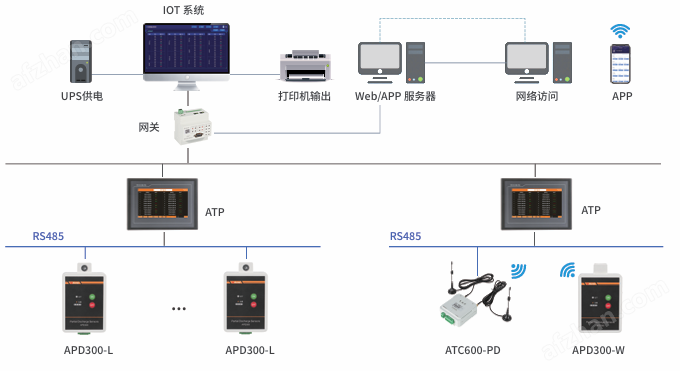
usage scenario:suitable formedium-voltage switchgear(61 cabinets, 28 cabinets, ring main unit) are integrated and installed before leaving the factory, or the high-voltage switchgear that has been put into use is installed after power outage.
Product Features:The system has strong anti-interference ability and high reliability.
Application installation:The ultra-high frequency sensor is installed in the cable room by magnetic suction, and the acquisition device is installed in the instrument room by guide rail.
Implementation process:Ultra high frequency sensorThe detected signal is sent to the partial discharge online monitoring device of the switchgear through coaxial cable for amplification, filtering, detection, digital pulse extraction, digital filtering, partial discharge characteristic calculation and other digital processing, and completes partial discharge visualization operation, partial discharge judgment, data storage, data uploading and other functions.
Monitoring content: discharge frequency, discharge capacity, PRPD/PRPS map, etc.
Alarm mechanism: Sampling period is 1 second. If the sampling exceeds the alarm threshold for 5 consecutive times, an alarm will be triggered (register set+DO output).

Partial discharge collector installed in the instrument room
APD wireless partial discharge sensor
Similar Product Recommend