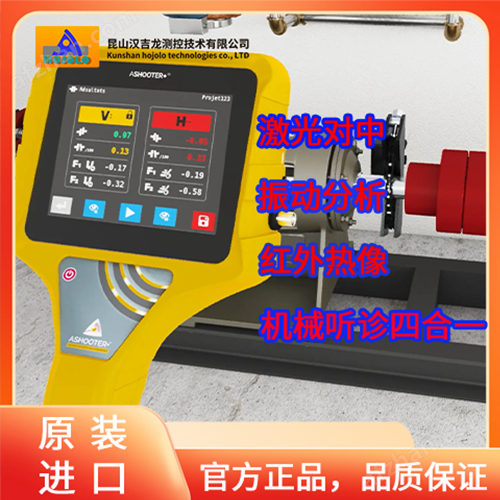
CCD laser induction centering instrument graphical operation soft foot measurement With high-precision detection, graphical operation interface and professional soft foot measurement function, CCD laser induction centering instrument has become the core tool for installation and maintenance of rotating equipment, especially in solving shaft alignment deviation and foot support problems, it has significant technical advantages.
CCD laser induction centering instrument graphical operation soft foot measurement
CCD laser induction centering instrument graphical operation soft foot measurement
The CCD laser induction centering instrument, with its high-precision detection, graphical operation interface, and professional soft foot measurement function, has become a core tool for the installation and maintenance of rotating equipment, especially in solving the problems of shaft alignment deviation and foot support, with significant technical advantages. The following in-depth analysis is conducted from four dimensions: technical principles, functional value, application points, and product selection:

CCD (Charge Coupled Device) as the core detection unit, throughLaser triangulation methodRealize micrometer level precision detection. Its 30mm large-sized photosensitive array (such as an ET laser alignment instrument) can capture laser spots with wavelengths of 635-670nm. After converting the optical signal into an electrical signal, the displacement of the spot is calculated through digital signal processing technology, with a resolution of up to 1 μ m and a radial measurement accuracy of up to ± 0.001mm. Compared with traditional PSD detectors, CCD has stronger resistance to environmental light interference, and can maintain stable detection accuracy even in strong light or hot flow environments in the workshop.
During the measurement process, the laser emitter and CCD detector are respectively installed on two axes (such as the motor axis and the pump axis). When rotating with the axis (usually collecting data at four angles of 0 °, 90 °, 180 °, and 270 °), the system converts the spot offset into radial deviation (horizontal deviation) and axial deviation (angle opening) through geometric algorithms, and establishes a three-dimensional coordinate system to output intuitive deviation data.

Soft foot refers to the insufficient support stiffness caused by poor contact between the equipment foundation and the base (gap>0.05mm), which can lead to problems such as dynamic alignment deviation and abnormal vibration of the shaft system. The CCD laser alignment instrument achieves soft foot detection through two core methods:
Static gap measurementBy combining a digital inclinometer (with an accuracy of 0.1 °) and laser ranging function, the deformation of the base before and after tightening the anchor bolts can be detected, and the clearance values of each foot can be automatically calculated. For example, ASHOOTER AS500 can directly display the adjustment thickness requirements of the anchor gasket;
Dynamic Impact AnalysisBy analyzing the fluctuation characteristics of deviation data during the rotation of the shaft system, determine the dynamic misalignment caused by soft feet (such as periodic changes in deviation values), and label the position of the risk foot on the graphical interface.
A graphical user interface is the key to improving work efficiency. Mainstream devices use industrial touch screens of 6.4 inches or more, which lower the operating threshold through visual design. The core functions include:
The system has a built-in standardized workflow, providing graphical guidance throughout the entire process from installation and calibration to data collection
Installation stage: 3D animation demonstration of the concentric installation steps of the laser emitter and detector, marking the key points for fixing the magnetic seat (such as adsorption force ≥ 200N);
Measurement stage: Dynamically display the axis rotation angle, automatically prompt the data acquisition node, support the "arbitrary three-point method" (measurement can be completed by rotating ≥ 20 °), and omit the traditional cumbersome angle positioning steps;
Adjustment stage: Use arrows and numerical values to indicate the direction of foot adjustment (such as "front foot left shift 0.2mm"). Some models (such as ET laser) provide real-time deviation change curves, and the adjustment effect is immediately visible.
Deviation graphical presentationUsing red and blue dual color labeling to indicate the center deviation of the two axes, radial offset is displayed with a "translation arrow", angular deviation is indicated with a "fan-shaped area", and out of tolerance data is automatically marked with a red warning (threshold can be customized);
Soft Foot Inspection ReportGenerate bar charts of foot gap values in various regions, compare them with industry standards (such as ≤ 0.05mm) to automatically determine the qualified level, and recommend gasket materials (such as stainless steel gasket thickness accuracy ± 0.01mm);
3D animation simulationSynchronously demonstrate the improvement effect of eliminating soft feet on the operation status of the shaft system, helping operators understand the necessity of adjustment.

Preprocessing checkFirst, use a feeler gauge to check the original gap between the feet, record the position of the feet that are greater than 0.05mm, and remove any oil stains or rust on the surface of the foundation;
Laser alignment instrument settingEnter the soft foot measurement mode, input parameters such as the size of the device base and the number of feet, and tighten the bolts in diagonal order in stages (increasing torque by 20% each time);
data validationAfter adjusting the soft feet (usually using stacked high-precision gaskets), re measure the axis alignment to ensure that the deviation value is reduced to the allowable range (such as radial ≤ 0.05mm, axial ≤ 0.1mm/m);
dynamic monitoringDynamic compensation function should be enabled for high-temperature equipment (such as compressors) to calculate the impact of thermal expansion on soft feet and preset the cold state deviation.
Working in a confined spaceThin and light measuring unit (thickness<50mm) combined with wireless Bluetooth transmission (distance up to 10m), can be remotely operated through a tablet graphical interface to avoid inconvenience caused by device obstruction;
Multi axis centering sceneSupport customizing the number of axis systems (such as triple pump units), displaying the deviation relationship of each axis in a layered graphical interface, and automatically generating an overall adjustment plan;
Data traceability requirementsExport a PDF report via USB interface, including measurement time, operator, deviation data, and adjustment records, to meet ISO quality system traceability requirements.
precision requirementPriority should be given to selecting ± 0.001mm grade products (such as AS500) for wind power, precision machine tools, and other equipment, while ± 0.01mm grade equipment can be selected for ordinary pump sets;
environmental adaptabilityMetallurgical workshops with high levels of dust require IP65 protection level, and models with thermal compensation function should be selected for high temperature environments (>50 ℃);
Operational complexityNovice led scenarios prioritize guided operation models such as ET laser, while professional teams can choose the AS500 with more customizable features.
The application value of this equipment is significant in industries such as chemical, wind power, and automobile manufacturing
Chemical pump maintenanceThrough soft foot measurement, it was found that the gap (0.12mm) was caused by loose anchor bolts. After adjustment, the vibration value of the pump shaft decreased from 5.2mm/s to 1.8mm/s, and the bearing life was extended by 40%;
Installation of wind turbine gearboxUsing the 3D guidance of a graphical interface, the main shaft and gearbox input shaft are aligned in a narrow space at high altitude. After eliminating the soft feet, the operating noise of the unit is reduced by 15dB;
Calibration of automotive production line machine toolsCCD high-precision measurement combined with soft foot optimization has improved the centering accuracy of the machine tool spindle to ± 0.002mm, and the qualification rate of component processing has increased from 96% to 99.5%.