-
E-mail
Mark@hojolo.com
-
Phone
18118173241
-
Address
No. 120 Changtai Road, Kunshan City
Product Categories
Kunshan Hanjilong Measurement and Control Technology Co., Ltd



Handheld gas leak detector LEAKSHOOTER for compressed air measurement
NegotiableUpdate on 01/08
- Model
- Nature of the Manufacturer
- Producers
- Product Category
- Place of Origin
Overview
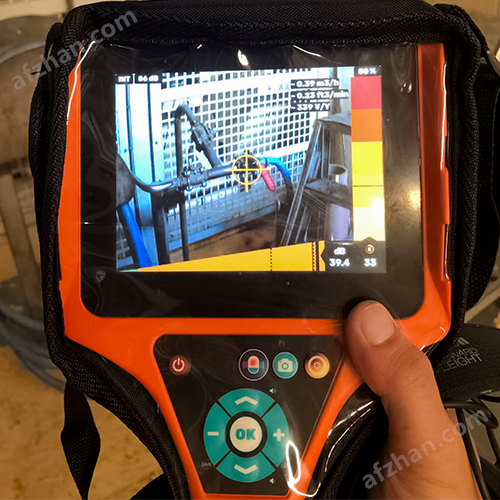
Handheld gas leak detector LEAKSHOOTER compressed air gas leak imaging instrument, also known as ultrasonic gas wave leak detection instrument, will display a leak point box on the color LCD screen after detecting a leak signal during the mobile scanning process. The leakage source on the LCD screen is yellow (indicating small leakage and weak signal) or red (indicating large leakage and strong signal), and the real-time visible image is displayed.
Product Details
Handheld gas leak detector LEAKSHOOTER for compressed air measurement
Handheld gas leak detector LEAKSHOOTER for compressed air measurement
As a visual ultrasonic leak detection brand, LEAKSHOOTER's handheld gas leak detector, with its third-generation visual detection technology, has become the core tool for leak detection in compressed air systems in industrial scenarios. It has revolutionized the inefficient mode of traditional soap water leak detection, achieving fast positioning, accurate identification, and data retention of leak points.

1、 Core technology and equipment advantages
The core of the LEAKSHOOTER handheld leak detector is the fusion technology of ultrasonic leak detection and visual imaging. Unlike the previous two generations of instruments that could only determine leaks through sound or numbers, it has the full process capability of "listening, watching, storing, and analyzing", especially suitable for the complex industrial environment of compressed air systems:

Ultra high detection sensitivity
It can accurately identify tiny leakage points with a pressure of 3bar and an aperture of 0.1mm within a distance of 20 meters, far exceeding the detection range of traditional leak detection tools; The center frequency of its ultrasonic sensor is 40kHz ± 1kHz, which can be adjusted in the frequency range of 34kHz-46kHz. It can filter out interference noise in industrial environments and lock in specific ultrasonic signals generated by compressed air leaks.
Visual imaging positioning
The instrument is equipped with a 3.5-inch color LCD display screen. When the sensor captures a leakage signal, dynamic identification will be generated on the screen: small leaks will be displayed as yellow areas, and large leaks will be displayed as red areas. The leakage core position will be locked with a crosshair to achieve intuitive positioning of "what you see is what you get" and avoid errors in manual judgment.
Multi dimensional data presentation
The decibel bar at the bottom of the screen will synchronously display the effective value (RMS) and value (MAX) of the leakage signal. The operator can confirm the degree of leakage from both visual and auditory dimensions by combining the audio signal in the headphones (volume adjustable from 0-10 levels); At the same time, the device supports storing 1000 leaked images, each with a timestamp and decibel value, which can be transmitted to a computer through a USB interface for subsequent analysis.
Strong adaptability to the environment
The working temperature range of the equipment is -10 ℃ to 50 ℃, with a protection level of IP54, which can adapt to complex working conditions such as high temperature and high dust in factories; The built-in lithium-ion battery supports 6 hours of continuous operation, and the adjustable gain of 50dB-110dB can adapt to the detection needs of different noise environments, ensuring stable operation in scenarios such as air compressor stations and pipeline racks.

2、 Standardized process for on-site testing of compressed air
LEAKSHOOTER has clear operational steps for leak detection in compressed air systems, forming a closed loop from early preparation to data retention, greatly improving detection efficiency:
1. Preparation before testing
Confirm that the compressed air system is at normal operating pressure (usually 0.6-0.8MPa), turn off unrelated temporary pressure relief devices, and avoid interfering with signals;
Debugging instrument parameters: Adjust the frequency to the reference value of 40kHz, set the gain to around 80dB (adjustable according to on-site noise), enable screen visualization and audio functions, and wear dedicated noise cancelling headphones to enhance signal recognition.
2. On site scanning and positioning
Remote initial screening: The operator scans horizontally/vertically along the vulnerable areas such as compressed air pipelines, valves, flanges, and joints within a range of 20 meters. If a yellow mark appears on the instrument screen at this time, it can be determined as a suspected leakage point;
Close range confirmation: gradually approach the suspected area, adjust the gain to above 100dB. At this point, the leakage indicator will change from yellow to red, and the crosshair will automatically lock the leakage core position. At the same time, the screen decibel value will significantly increase (usually more than 10dB higher than the background value);
Complex position detection: For leakage points in high-altitude pipelines or narrow spaces, LKSFLEX series flexible probes (400mm or 1500mm specifications) can be used to extend the detection range and ensure no blind spots are detected.
3. Data retention and report generation
After confirming the leakage point, press the photo button to save the leakage image, and the device will automatically label the detection time, decibel value, and other information;
By using specialized software to transfer stored images and data to a computer, standardized detection reports can be generated to clarify the location, degree, and corresponding energy loss of leakage points, providing data support for subsequent leak repair.
3、 The core value of compressed air testing
The leakage rate of industrial compressed air systems usually reaches 30% -50%, and the cost of electricity accounts for 76% of the total cost of air compression systems. The application of LEAKSHOOTER can create value for enterprises from multiple dimensions:
Energy saving and cost reduction
Quickly locating the leakage point and promptly plugging it can reduce the ineffective energy consumption of the air compression system. According to industry data, a compressed air system in a medium-sized factory can save hundreds of thousands of yuan in annual electricity costs after testing and plugging, and the instrument investment can be recovered within 1-2 years;
enhance security
Avoiding problems such as abnormal pipeline pressure and increased equipment wear caused by long-term leakage of compressed air, especially in high-risk scenarios such as chemical and power industries, can prevent equipment failures and safety accidents caused by leaks;
Optimize operation and maintenance management
The detection data can form a historical ledger, which can evaluate the aging trend and plugging effect of pipelines by comparing the leakage situation in different cycles, achieve the transformation from "passive maintenance" to "predictive maintenance", and improve equipment management efficiency.
4、 Typical application scenarios and precautions
1. Applicable scenarios
LEAKSHOOTER is widely used for leak detection in factory air compression station pipelines, workshop gas terminals, pneumatic valves, gas storage tanks, and other parts. It can also be extended to leak detection in other gas systems such as nitrogen and steam, adapting to the needs of multiple industries such as petrochemicals, automotive manufacturing, and electronic processing.
2. Precautions for operation
During testing, it is necessary to stay away from strong electromagnetic interference sources (such as high-frequency welding machines) to avoid affecting the reception of ultrasonic signals;
For low-temperature or high-temperature pipelines, a safe distance should be maintained to prevent damage to the instrument due to excessive temperature differences;
Regularly calibrate ultrasonic sensors to ensure detection accuracy, while charging them in a timely manner to ensure long-term on-site operation needs.
Similar Product Recommend