-
E-mail
2881505714@qq.com
-
Phone
13524668266
-
Address
Yuanjiang Road, Minhang District
Product Categories
Shanghai Enzyme Linked Biotechnology Co., Ltd


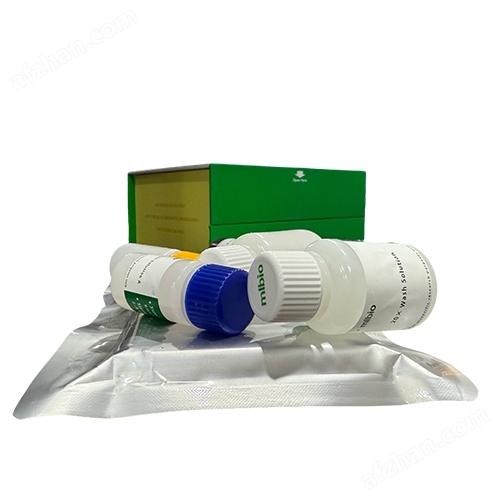


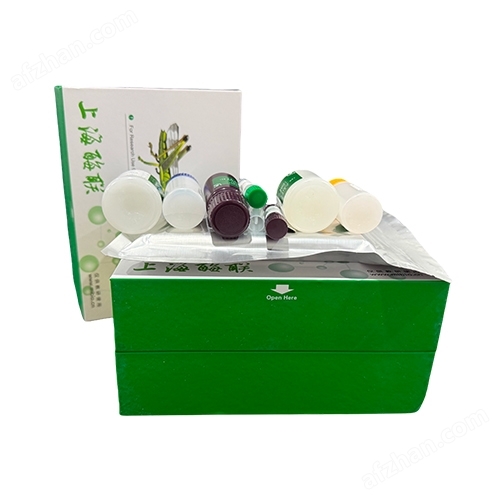
Ml105965 collagen type IV alpha 1 (COL4 alpha 1) human reagent kit
NegotiableUpdate on 01/08
- Model
- Nature of the Manufacturer
- Producers
- Product Category
- Place of Origin
Overview
ML105965 Collagen Type IV Alpha 1 (COL4 Alpha 1) Human Kit, Collagen Type IV Alpha 1 (COL4A1) is a protein encoded by the COL4A1 gene on chromosome 13. It belongs to the IV collagen family and consists of three domains: a short N-terminal domain, a long triple helix 7S domain located at its center, and a non collagenous 1 (NC1) domain located at its C-terminus.
Product Details
Ml105965 collagen type IV alpha 1 (COL4 alpha 1) human reagent kit
Introduction
Collagen type IV alpha 1 (COL4A1) is a protein encoded by the COL4A1 gene on chromosome 13. It belongs to the IV collagen family and consists of three domains: a short N-terminal domain, a long triple helix 7S domain located at its center, and a non collagenous 1 (NC1) domain located at its C-terminus. It is widely expressed in many tissues and cell types. COL4A1 is a subunit of type IV collagen that plays a role in angiogenesis. The mutation of this gene is associated with diseases of the brain, muscles, kidneys, eyes, and cardiovascular system. This kit for human COL4 α 1 immunoassay is a three-step solid-phase sandwich ELISA used to measure human COL4 α 1 in cell culture supernatant, serum, and plasma. The kit contains E. coli expression of recombinant human COL4 α 1 and antibodies against the recombinant protein. The results obtained using natural human COL4 α 1 showed a linear curve parallel to the standard curve obtained using recombinant standards. These results indicate that the kit can be used to determine the relative mass value of natural human COL4 α 1.
Detection Principle
The reagent kit adopts the double antibody sandwich methodELISA technology: Capture antibodies are coated on an enzyme-linked immunosorbent assay (ELISA) plate to capture the analyte COL4 α 1 in the sample and standard. After incubation and cleaning, labeled detection antibodies are added for incubation and cleaning to form a "capture antibody antigen detection antibody" immune complex. Then, horseradish peroxidase conjugated with streptavidin is added for incubation. After incubation, the sample is washed and TMB chromogenic solution is added. If the analyte in the sample appears blue, stop the reaction by adding termination solution. During the detection process, all free components were washed away, and the OD value was measured at 450nm using an enzyme-linked immunosorbent assay (ELISA) reader. The color intensity was proportional to the content of the analyte in the sample, and the concentration of COL4 α 1 in the sample was calculated by plotting a standard curve.
Key Operating Points
When mixing protein solutions, always avoid foaming. To avoid cross contamination, the pipette tip should be replaced when adding each standard, sample, and reagent. In addition, each reagent should be used in a separate container.
2. Ensure that the reagents are continuously added to the plate wells. To ensure accurate results, it is necessary to bond the sealing film well during the incubation step.
When using an automatic washing machine, adding a 30 second soaking period after adding the washing buffer, or rotating the plate 180 degrees between washing steps, can improve the measurement accuracy.
4. The color developer should remain colorless until added to the plate. Ensure that the color developer is not exposed to light. The color developer should change from colorless to blue.
5. The termination solution should be added to the plate in the same order as the color developer. After adding the termination solution, the color formed in the pores will change from blue to yellow. The green holes indicate that the termination solution has not been fully mixed with the matrix solution.
Other materials required
1. Enzyme linked immunosorbent assay (ELISA) analyzer, with a measurement wavelength of 450nm and a preferred calibration wavelength of 600-680nm;
2. Pipette and nozzle;
3. Distilled water or deionized water;
4. 100-1000 mL graduated cylinder;
5. Bottle washing, gun discharge or automatic microplate cleaning machine;
6. Horizontal track microplate oscillator capable of maintaining a speed of 500 ± 50 rpm;
7. Test tubes used for diluting standards and samples.
Ml105965 collagen type IV alpha 1 (COL4 alpha 1) human reagent kit
Precautions
The termination solution provided by this reagent kit is a dilute sulfuric acid solution, which has certain corrosiveness and should be handled with caution.
2. Some ingredients in this kit contain preservatives, which may cause skin allergies. Masks should be worn to avoid inhaling light mist.
3. Color developer B may cause skin, eye, and respiratory irritation, and masks should be worn to avoid inhaling light mist.
4. Wear protective gloves, eye and facial protection, and wash hands after handling.
Reagent preparation
Before use, let all reagents equilibrate at room temperature for about 30 minutes.
2. Washing solution/diluent configuration: If there is crystal precipitation in the washing solution/diluent (20x), all crystals need to be dissolved by heating at 37 ℃. Dilute 1:20 with distilled water (e.g. add 1mL of concentrated washing solution to 19mL of distilled water)
Standard product configuration
Retrieve the standard from the reagent kit and prepare it7 test tubes, starting with1μg/mLStandard product(Dilute a certain amount of 50ng/mL (e.g. 50 μ L of standard mother liquor+950 μ L of 1 × dilution solution to prepare 1000 μ L of 50ng/mL concentration standard) as needed, and then add 500 μ L of 1 × dilution solution to each of the 6 test tubes. Dilute the 50ng/mL standard in these 6 separate test tubes at a ratio of 2 times to 6 gradients, and prepare a total of 7 concentration standards, which are:50% of / ml 、 25% of / ml 、 12.5% of / ml 、 6.25 ng / ml 、 3.125 ng / ml 、 1.563 ng / ml,Extract from concentration standard solutionTransfer 500 μ L of standard substance to the next test tube, gently blow and mix well, and repeat the process to dilute the standard substance by multiple ratios (as shown in the figure). Use 1 x dilution solution as the zero concentration standard substance (0ng/mL)

Calculation of results
Calculate the average of standard samples and sample wellsSubtract the OD value of the blank hole from the OD value as the correction value. Plot the standard curve of the four parameter logic function on a coordinate paper with concentration as the horizontal axis and OD value as the vertical axis (with blank values removed when plotting), or use computer software that can generate a four parameter logic (4-P) curve fit to create the standard curve. If the OD value of the sample is higher than the upper limit of the standard curve, it should be diluted appropriately and retested, and multiplied by the corresponding dilution factor when calculating the sample concentration.
sample data
The following data and curves are for reference only. Experimenters need to establish a standard curve based on their own experimental data.
Standard concentration(ng/mL) |
50 |
25 |
12.5 |
6.25 |
3.125 |
1.563 |
0.781 |
0 |
OD value |
2.48 |
1.745 |
0.981 |
0.715 |
0.463 |
0.254 |
0.151 |
0.058 |
correctionOD value |
2.422 |
1.687 |
0.923 |
0.657 |
0.405 |
0.196 |
0.093 |
0.0 |
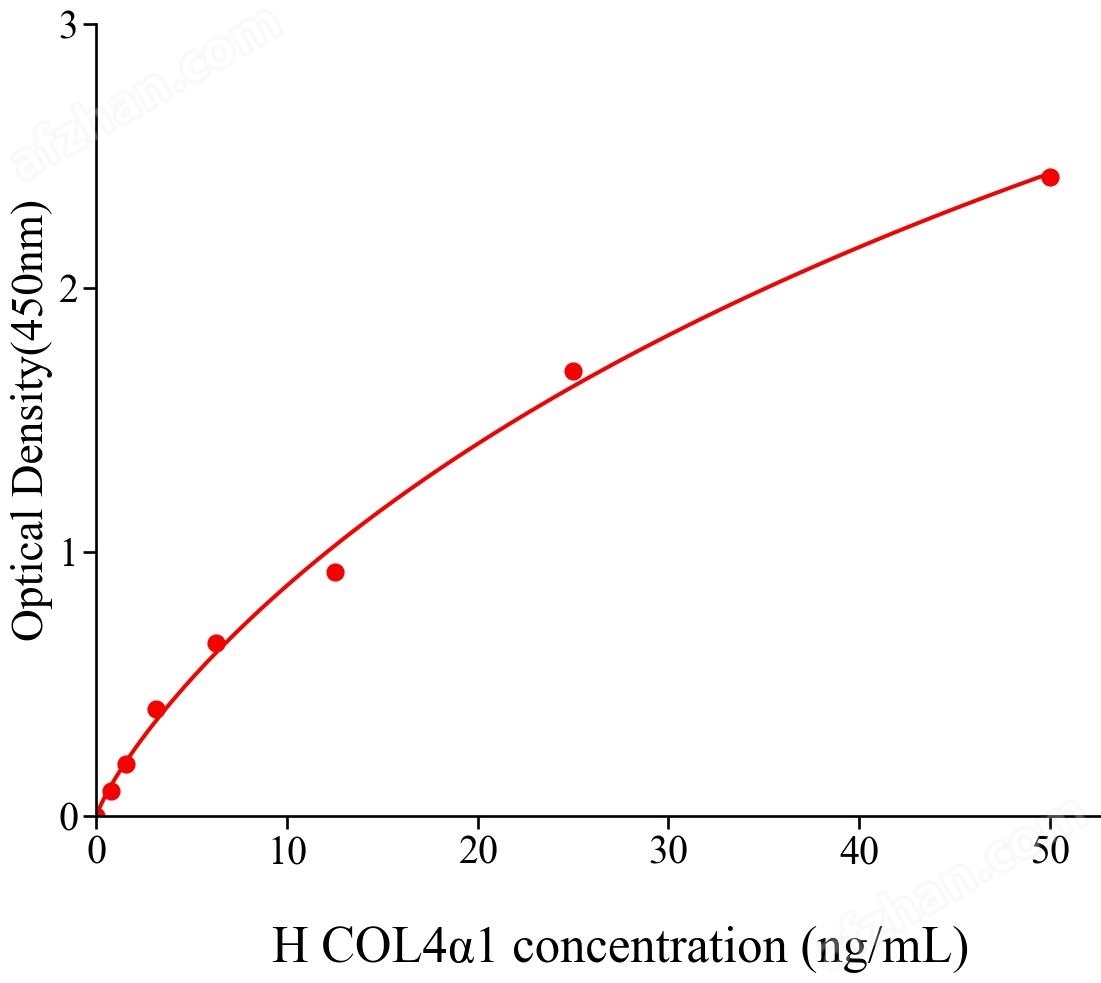
The standard curve shown in this figure is for example only, and the calculation of the results should be based on the standard curve drawn for the same test sample
sensitivity
According to sample testing, the detection sensitivity of this kit is0.39ng/mL。
specificity
This test kit can identify both natural and recombinant humansCOL4α1.
Other related proteins were prepared in dilution buffer as50ng/mL, And measure the cross reactivity. No significant cross reactivity was observed.
Summary of Experimental Steps
1. Add standard and sample, react at 37 ℃ in the dark for 1.5 hours, and wash 3 times.
2. Add detection antibodies,React at 37 ℃ in the dark for 1 hour and wash 4 times.
3. Add enzyme conjugates,React at 37 ℃ in the dark for 30 minutes and wash 4 times.
4. Add color reagent and react at 37 ℃ in the dark for 15 minutes.
5. Add stop solution and read within 5 minutes
personcollagenType IV alpha 1 (COL4 alpha 1)The reagent kit is used for quantitative detection of human in cell culture supernatant, serum, and plasmaCOL4α1Before using this product, it is necessary to read this manual completely, peopleThe ELISA kit is for scientific research purposes only and cannot be used for other diagnostic purposes.
Similar Product Recommend