-
E-mail
2881930832@qq.com
-
Phone
18721098078
-
Address
2nd Floor, Building 2, No. 253 Yulu Road, Jiading District, Shanghai
Product Categories
Ankerui Electric Co., Ltd
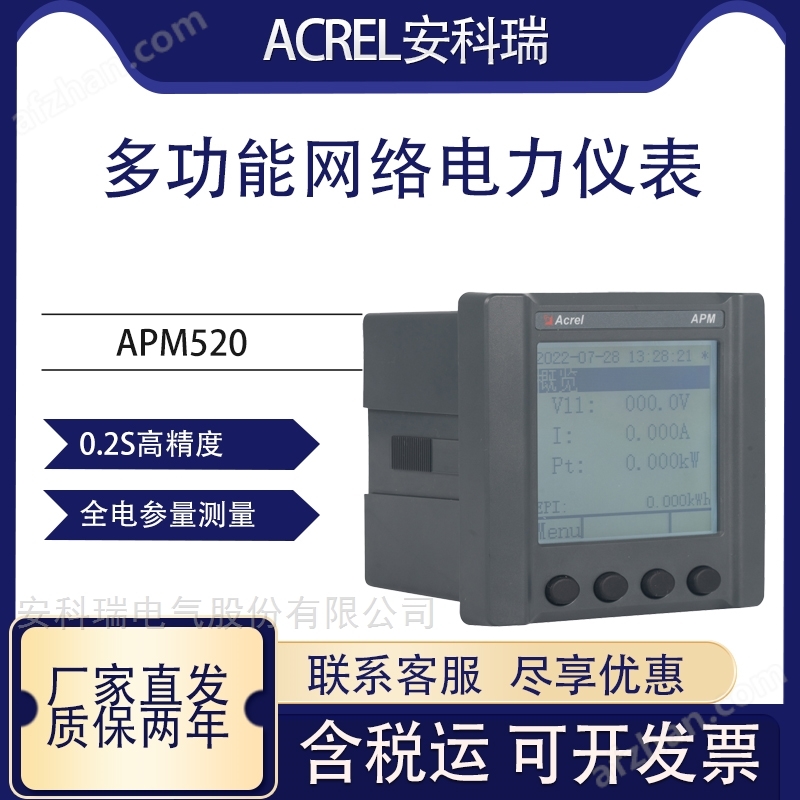


Zero carbon park system grid connected cabinet incoming cabinet network power instrument
NegotiableUpdate on 02/02
- Model
- Nature of the Manufacturer
- Producers
- Product Category
- Place of Origin
Overview
The zero carbon park system grid connected cabinet incoming cabinet network power instrument (hereinafter referred to as the instrument) is designed according to IEC international standards, and has functions such as full power measurement, power statistics, power quality analysis (including harmonics, interharmonics, flicker), fault waveform recording (including voltage temporary rise and fall interruption, impulse current recording, etc.), event recording, and network communication. It is mainly used for comprehensive monitoring of power supply quality in the power grid. This series of instruments is equipped with feature rich DI/DO modules, AO modules, wireless communication modules, and leakage temperature measurement modules, which can flexibly achieve full power measurement and switch status monitoring of electrical circuits.
Product Details
1. Overview
APM5 seriesZero carbon park system grid connected cabinet incoming cabinet network power instrumentThe instrument (hereinafter referred to as the instrument) is designed according to IEC international standards and has functions such as full power measurement, power statistics, power quality analysis (including harmonics, interharmonics, flicker), fault waveform recording (including voltage temporary rise and fall interruption, impulse current recording, etc.), event recording, and network communication. It is mainly used for comprehensive monitoring of power supply quality in the power grid. This series of instruments is equipped with feature rich DI/DO modules, AO modules, wireless communication modules, and leakage temperature measurement modules, which can flexibly achieve full power measurement and switch status monitoring of electrical circuits.
The ammeter and voltmeter used in the distribution cabinet are installed in an embedded manner. Real time detection and display of multiple electrical parameters such as three-phase voltage, three-phase current, active power, frequency, and kilowatt hour, with local display function. The detected data can be uploaded to the upper computer monitoring center through the built-in RS485 interface when needed. Equipped with RS-485 interface and MODBUS communication protocol.
Product model, specifications, and functions

Model Function
Measurement parameters: full energy measurement, four quadrant energy, phase separated energy, apparent energy, and multi rate energy
Pulse output: Total active and reactive power pulse output (72 only active power pulses)
Demand: three-phase current, active power, reactive power, apparent power, real-time demand, and extreme demand (including timestamp)
Extreme value statistics: current, line voltage, phase voltage, active power, reactive power and other electrical parameters, extreme values of this month and the previous month (including timestamp)
Power Quality: Current, Line Voltage, Phase Voltage Imbalance, Voltage Phase Angle, Current Phase Angle, Total (Odd, Even) Harmonic Content of Voltage and Current, Sub harmonic Content of Voltage and Current (2-63rd Order), Interharmonics (included when S is selected), Flicker (included when S is selected), Voltage Peak Coefficient, Telephone Waveform Factor, Current K Coefficient, Vector Graph Voltage and Current Real time Waveforms, Fundamental Voltage and Fundamental Current
Fault recording: voltage temporary rise and fall interruption, surge current, etc. (included with S option)
Event record: DIDO record, can record * nearly 128 DIDO records
Alarm records: can record * nearly 128 alarm records
Communication: Modbus RTU protocol, DL/T 645-2007 protocol, Ethernet communication/MODBUS-TCP
Switch quantity: 72 Appearance: 2 switch quantity inputs+2 switch quantity outputs; 96 appearance: 4-channel switch input+2-channel switch output
Appearance and installation dimensions
Multi functional power instruments and panel opening dimensions (unit: mm)


Installation method
1) Opening holes in fixed distribution cabinets;
2) Take out the instrument panel and remove the buckle;
3) The instrument is installed into the mounting hole from the front, as shown in the figure;
4) Insert the instrument buckle and secure the instrument as shown in the figure.

Voltage input:
The input voltage should not exceed 120% of the rated input voltage of the product (100V or 110V or 400V or 690V), otherwise PT should be used; a 1A fuse must be installed at the voltage input end; The wiring method of the product needs to be set according to the PT wiring method of the product
Current input:
The rated input current is 1A or 5A, and an external CT is required (it is recommended to use a wiring harness instead of directly connecting to the CT for ease of disassembly and assembly); Ensure that the input current corresponds to the voltage, the phase sequence is consistent, and the direction is consistent; If other instruments are connected to the CT circuit used, the wiring should be connected in series; Before removing the current input connection of the product, be sure to disconnect the CT primary circuit or short-circuit the secondary circuit first!
Communication wiring:
The instrument provides asynchronous half duplex RS485 communication interface, using MODBUS-RTU protocol, and various data information can be transmitted on the communication line. It is recommended to use shielded twisted pair cables for communication connections, with a cross-sectional area of no less than 0.5mm2 per core. When wiring, communication lines should be kept away from strong electrical cables or other strong electric field environments.

Zero carbon park system grid connected cabinet incoming cabinet network power instrument,With the widespread application of power electronic devices in various fields, the power quality of the power system is receiving increasing attention. The power quality analyzer, as a key tool for monitoring and evaluating power quality, is of great significance in ensuring the stable and efficient operation of the power system.
2、 Basic concepts
A power quality analyzer is a device specifically designed to monitor, analyze, and evaluate the power quality of the power system. It collects signals such as voltage and current from the power system, providing real-time and accurate power quality data, helping users understand the operating status of the power system, and timely discover and solve potential problems.
The main technical parameters of a power quality analyzer include measurement range, accuracy, sampling rate, etc. According to the measurement principle, power quality analyzers can be divided into two categories: analog and digital. Analog analyzers use analog circuits to measure power quality parameters, while digital analyzers use digital signal processing technology for measurement, which has higher measurement accuracy and stability.
III. Application
power industry
In the power industry, power quality meters are widely used in power plants, substations, transmission lines, and other places to monitor power quality parameters such as voltage fluctuations, harmonics, and flicker in the power grid, ensuring the stable operation of the power system. At the same time, power quality analyzers can also be used for fault diagnosis and maintenance of power equipment, helping power companies improve equipment operating efficiency and lifespan.
industrial sector
In the industrial field, power quality meters can monitor the power quality parameters during the operation of various power equipment, such as motors, frequency converters, welding equipment, etc. By analyzing and processing the harmonics generated by these devices, effective measures can be taken to reduce the impact of harmonics on the power system and improve the operational efficiency of power equipment.
Transportation industry
In the transportation industry, power quality meters are used to monitor the power quality of electric traction equipment such as subways, light rails, and trams. Due to the use of frequency conversion technology for speed control in these devices, the harmonics generated may affect the stable operation of the power system. The power quality meter can monitor harmonics in real time and suppress them to ensure the normal operation of the power system.
public facilities
In the field of public facilities, power quality meters are used to monitor the power quality of places such as hospitals, schools, and shopping malls. These places usually have a large number of electrical equipment, such as elevators, air conditioning, lighting, etc., which may generate power quality issues such as harmonics and flicker. By using power quality meters, these problems can be detected and solved in a timely manner, improving the operational efficiency and safety of public facilities.

4、 Future development of power quality analyzers
With the continuous advancement of technology, power quality analyzers will develop in the following directions in the future:
intelligentization
Intelligence is an important development direction for future power quality meters. By introducing artificial intelligence and big data technology, power quality meters can achieve more intelligent monitoring, diagnosis, and analysis, improving work efficiency and accuracy. For example, using machine learning algorithms to learn and analyze power quality data, automatically identifying potential problems and fault types, and providing more accurate advice and support for maintenance personnel.
High precision and high sensitivity
With the increasing demand for stability and safety in the power system, power quality meters need to have higher measurement accuracy and sensitivity. In the future, power quality meters will adopt more advanced signal processing techniques and algorithms to improve measurement accuracy and stability, achieving precise monitoring of small power quality parameters.
Multi functionality and integration
Future power quality analyzers will have richer functions, such as power quality monitoring, data storage, fault diagnosis, remote monitoring, etc. By integrating multiple functions into one device, work efficiency and convenience can be greatly improved. For example, power quality meters can be integrated with cloud platforms to achieve remote monitoring and data analysis. Users can view power quality data and alarm information anytime and anywhere through mobile devices.
green and environmentally friendly
With the continuous improvement of global environmental awareness, future power quality analyzers will pay more attention to green and environmentally friendly design. For example, adopting low-power design and renewable energy supply technology to reduce equipment energy consumption and carbon emissions; Made with environmentally friendly materials such as lead-free and fluorine free, reducing pollution to the environment.
5. Conclusion
As an important tool for ensuring the stable and efficient operation of power systems, power quality analyzers have been widely used in fields such as electricity, industry, transportation, and public facilities. With the continuous development of technology, power quality meters will continue to progress towards intelligence, high precision and sensitivity, multifunctionality and integration, and green environmental protection.

6、 Precautions for use:
| serial number | Precautions | description |
| 1 | Device Selection | Select wireless temperature measurement devices suitable for the application scenario, ensuring that their measurement range, accuracy, resolution, and other requirements are met. |
| 2 | safe operation | Operators need to undergo professional training to master the knowledge of equipment use and maintenance. |
| 3 | Installation location | Ensure that the equipment is installed in the appropriate location, avoiding direct sunlight, wind, or other external interference. Maintain good thermal contact with the object being tested. |
| 4 | power management | Pay attention to device power consumption and battery life, regularly check battery level, and replace batteries in a timely manner. |
| 5 | Waterproof and moisture-proof | Select temperature measuring equipment with corresponding waterproof and moisture-proof levels according to the application scenario. |
| 6 | anti-interference capability | Pay attention to the anti-interference ability of the device, choose the appropriate working frequency band and channel, and avoid conflicts with other wireless devices. |
| 7 | Operation prohibited | It is prohibited to use equipment in hazardous environments such as oxygen, corrosive media, etc. Prohibited for human body measurement or high-voltage testing. |
| 8 | protective equipment | When using, protective equipment such as insulated gloves, goggles, etc. should be worn. |
| 9 | Operate with caution | Handle equipment with caution to avoid unexpected situations such as collisions and falls. |
| 10 | Environmental Requirements | Do not expose the device to harmful environments such as high temperature and humidity to avoid affecting its performance. |
| 11 | exception handling | If any abnormal situation is found in the equipment, it should be immediately stopped from use and professional maintenance personnel should be contacted for inspection. |
| 12 | Storage and maintenance | Store the equipment in a dry and ventilated environment to avoid the influence of moisture and dust. Regularly inspect and maintain equipment to ensure its proper functioning. |
| 13 | Cleaning and Maintenance | If you need to clean the equipment, be sure to disconnect the power first and gently wipe it with a soft cloth. Do not use solvents or corrosive substances. |
Similar Product Recommend


