-
E-mail
2802943235@qq.com
-
Phone
18702111683
-
Address
No. 253 Yulu Road, Jiading District, Shanghai
Ankerui Electric Co., Ltd
Why are companies betting on solar energy storage and charging? It is not only a charging station, but also an "energy node"
Date: 2025-12-12Read: 25
Integrated charging station with light storage and charging: is it a gimmick or a new trend in the future industry?
Introduction:
Driven by the global energy transition wave and the "dual carbon" goal, China is accelerating the construction of a new power system dominated by new energy with determination and speed. In this grand context, as the core supporting facilities of the new energy vehicle industry, the green and intelligent upgrading of the charging infrastructure has undoubtedly become a key breakthrough point, carrying the responsibility of promoting high-quality development of the industry.
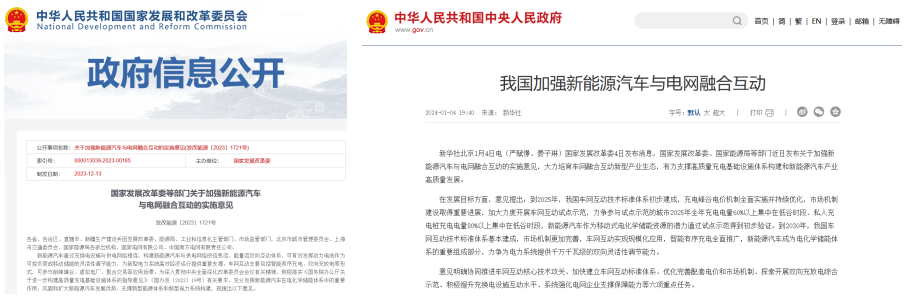
The National Development and Reform Commission and other departments jointly issued the "Implementation Opinions on Strengthening the Integration and Interaction between New Energy Vehicles and the Power Grid", which clearly proposes to "promote the construction of integrated charging stations for light storage and charging, and enhance the energy self-sufficiency and flexible adjustment capabilities of charging infrastructure". This policy orientation, like a strong east wind, has rapidly pushed the integrated charging station of optical storage and charging, which was originally in the stage of technological exploration, to the forefront of large-scale commercial use.
Is the integrated charging station of photovoltaic power generation, energy storage system, and intelligent charging a fleeting hype in the capital market, or a real opportunity for the entire industry to move towards new changes?
1 Market size and technological breakthroughs
Market size: Rapid growth, becoming the core engine of global growth
Global market:The global solar energy storage and charging market has surpassed its sizehundred billionChina holds a stable position with 51.09% of the global market share.
Chinese market:By 2025, the scale of China's photovoltaic storage and charging marketsignificantlyThe surge has led to a compound annual growth rate (CAGR) of 19.6%, becoming the core driving force of global growth.
Enterprise layout:Domestic enterprises dominate the system integration and equipment manufacturing processes by leveraging their capabilities in technology research and development and full industry chain integration; Internationally, V2G technology and supercharging networks are used to layout the market and form differentiated competition.
Technological breakthroughs: Three key turning points drive industry upgrading
costbreakthrough:The cost of photovoltaic power generation continues to decline, and the cost per kilowatt hour has approached the price of thermal power, providing an economic foundation for the integration of photovoltaic storage and charging.
Technological breakthrough:The cycle life of lithium iron phosphate batteries has been significantly improved, and new energy storage technologies such as sodium ion batteries and flow batteries are accelerating commercialization, resulting in a significant increase in the capacity and efficiency of energy storage systems.
charging speedbreakthrough:Implementation of Supercharging PileShorten charging time and increase range, V2G technology enables electric vehicles to become mobile energy storage units, increasing the overall energy efficiency of the system to 92%.
II Application scenarios and economic benefits
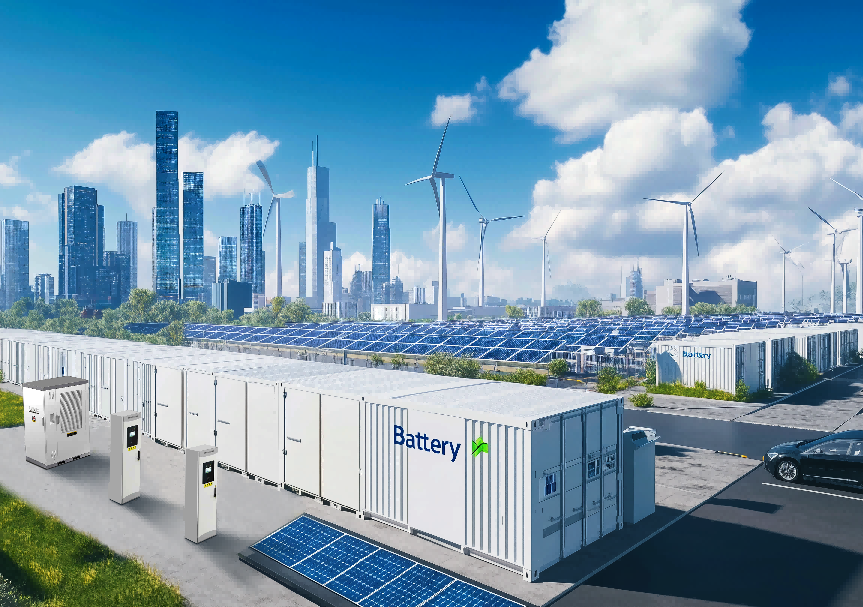
Application scenario: Diversified expansion, forming a coexistence pattern of core and emerging scenarios
Commercial complex:The photovoltaic carport+energy storage+charging pile mode meets the charging needs of employees and customers, while reducing the electricity cost of the shopping mall.
Public Parking:Utilize idle space to construct integrated light storage and charging stations, enhancing the city's green image.
High speed service area:Equipped with supercharging piles and energy storage systems to solve the anxiety of long-distance driving energy replenishment. For example, a service area project supports.
Airport/Train Station:Utilize rooftop photovoltaic power generation to provide clean electricity for electric buses.
Rural charging stations:Photovoltaic power generation covers the charging demand, reduces dependence on the power grid, and helps new energy vehicles go to rural areas.
Remote scenic spots:The photovoltaic charging system supports the operation of electric sightseeing vehicles and reduces the use of diesel generators.
Economic benefits: multi-channel income, shortened investment return cycle
Profit composition:Based on a typical 1MW project, the annual revenue includes electricity revenue (43%), charging service fees (24%), peak valley arbitrage (18%), demand response (11%), and carbon trading revenue (4%), with a total annual revenue of approximately 1.837 million yuan and a static payback period of approximately 4.5-5 years.
Cost reduction:With the advancement of technology and intensified market competition, the prices of photovoltaic equipment and energy storage systems continue to decline, reducing initial investment costs and further shortening the investment return cycle.
Business model innovation:Automobile companies, power grid companies, and real estate developers jointly develop a "photovoltaic storage and charging+community commerce" shared revenue model to enhance project profitability.
III Ankerui Integrated Charging Station Solution for Light Storage and Charging
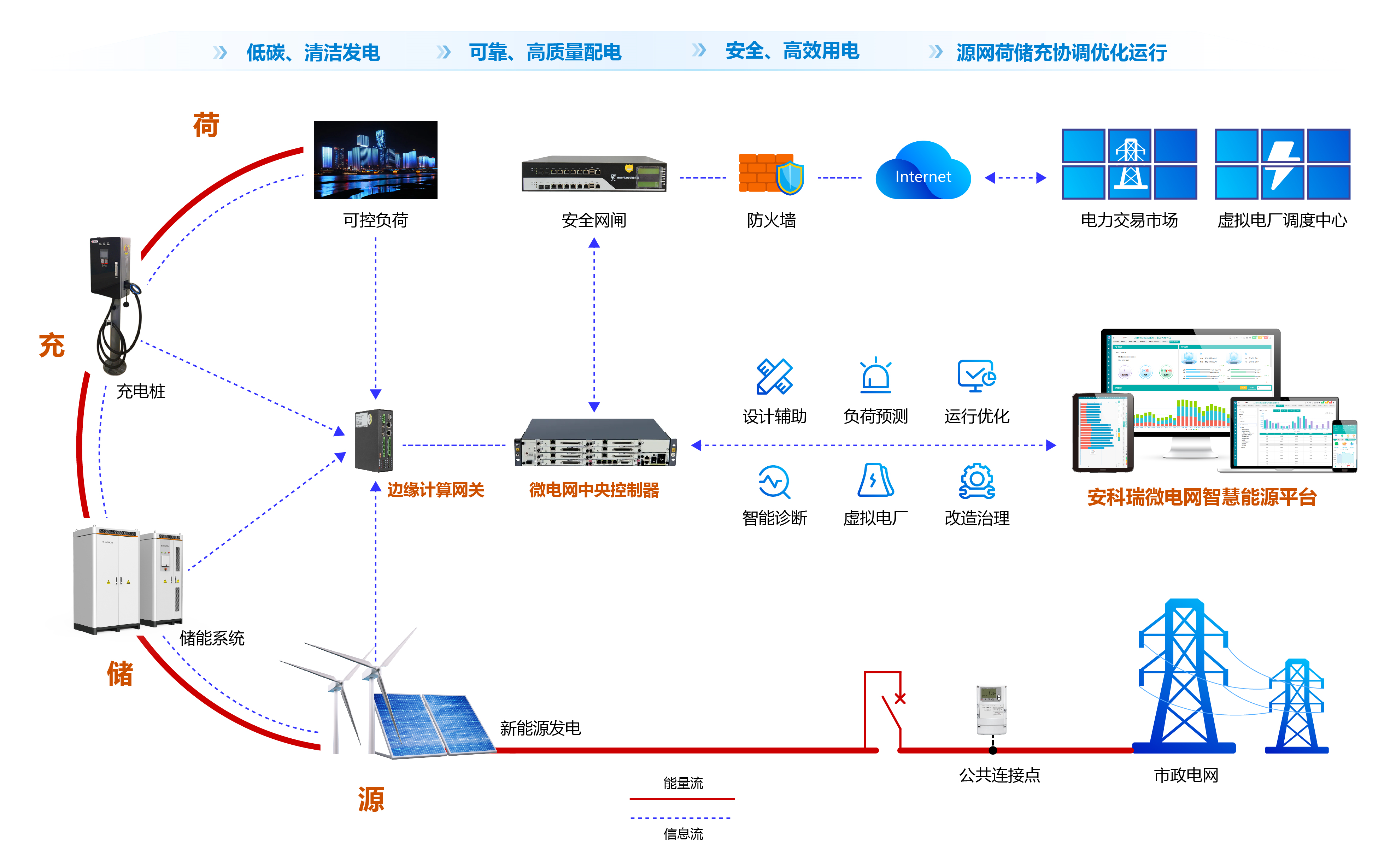
3.1 Solution Network Architecture
Photovoltaic power generation system:Composed of high-efficiency photovoltaic modules and string/centralized inverters. Photovoltaic modules convert solar energy into direct current, while inverters convert it into alternating current to power charging stations and energy storage systems.
Energy storage system:Using lithium iron phosphate batteries as energy storage media, AC/DC conversion and bidirectional charging and discharging are achieved through energy storage inverters (PCS). The Battery Management System (BMS) monitors the battery status (SOC, SOH) in real-time to ensure safe operation. The energy storage system can store excess photovoltaic energy and release it during peak electricity consumption or grid failures.
Supercharging station:Equipped with high-power DC fast charging piles, supporting mainstream charging standards such as CCS, CHAdeMO, GB/T, etc,Significantly alleviate users' energy replenishment anxiety.
Energy Management System (EMS):As the "brain" of the system, EMS achieves photovoltaic power generation prediction, energy storage charging and discharging strategy optimization, charging load scheduling, and grid/off grid mode switching through data collection and intelligent algorithms. For example, when photovoltaic power generation is sufficient, priority should be given to supplying power to charging stations, and excess electricity should be stored in energy storage systems; Release energy storage power during peak electricity consumption periods to reduce grid dependence.
3.2 Display of featured functions in the solution section
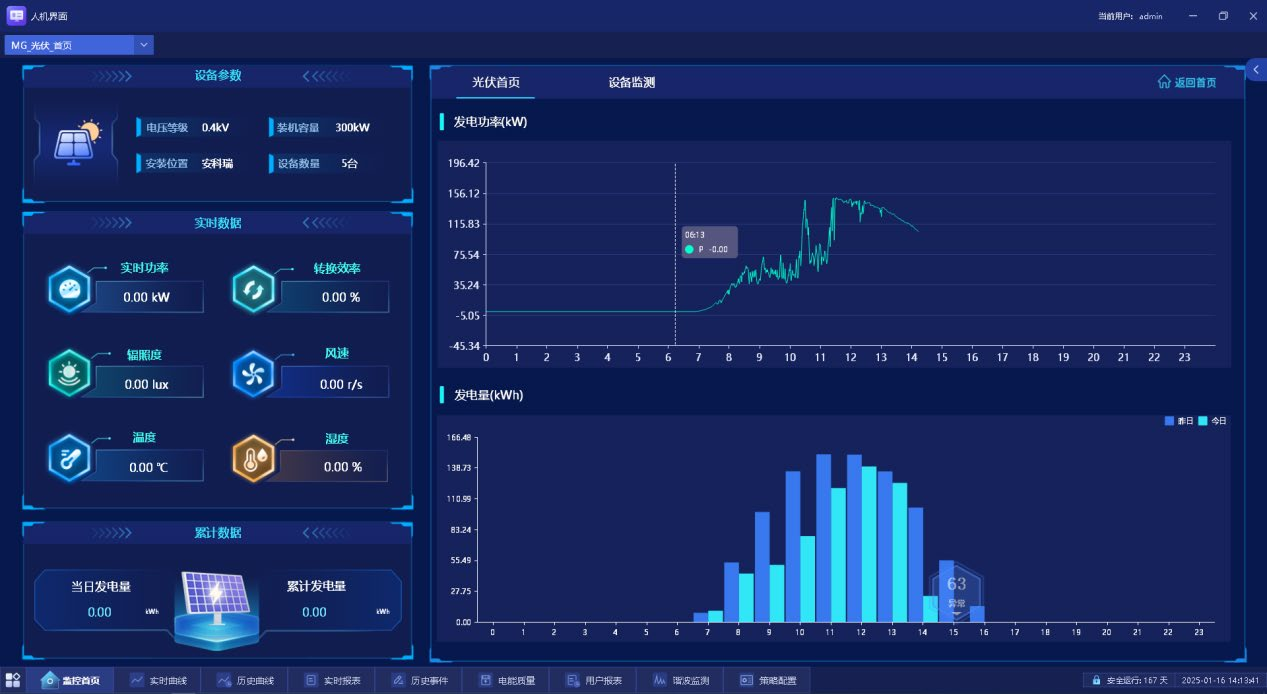
Photovoltaic monitoring:The total output of the photovoltaic system, monitoring and alarm of the DC and AC operation status of the inverter, statistics and analysis of the power generation of the inverter and the power station, monitoring and analysis of the power generation of the grid connected cabinet, statistics of the annual effective utilization hours of the power station's power generation, identification of inefficient power generation stations, statistics of power generation income (subsidy income, grid connection income), monitoring of irradiance/wind power/environmental temperature and humidity, monitoring and analysis of grid connected power quality;
Energy storage monitoring:System comprehensive data: electrical parameter data, charging and discharging capacity data, energy conservation and emission reduction data, operating modes (peak valley mode, planning curve, demand control, etc.), statistical electricity consumption, revenue data, energy storage system power curve, charging and discharging capacity comparison chart, real-time grasp of the overall operating level of the energy storage system;

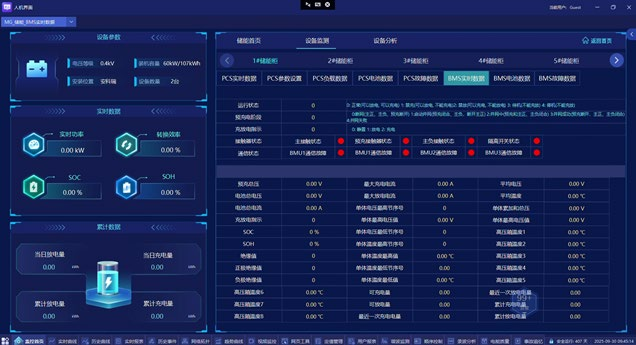
PCS、BMSmonitor:PCS real-time data (active power, reactive power, power factor), PCS parameter settings (power on/off, working mode, power settings), PCS load and battery data (phase current, voltage, active and reactive power, etc.), PCS fault data (hardware, AC grid, AC capacitor, system, switch faults), BMS real-time data (operating status, contactor status, communication status), BMS battery data (single battery voltage, single battery temperature), BMS fault data (including first level, second level, third level alarm information, etc.);
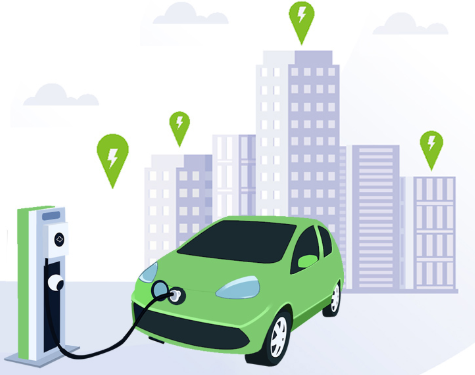
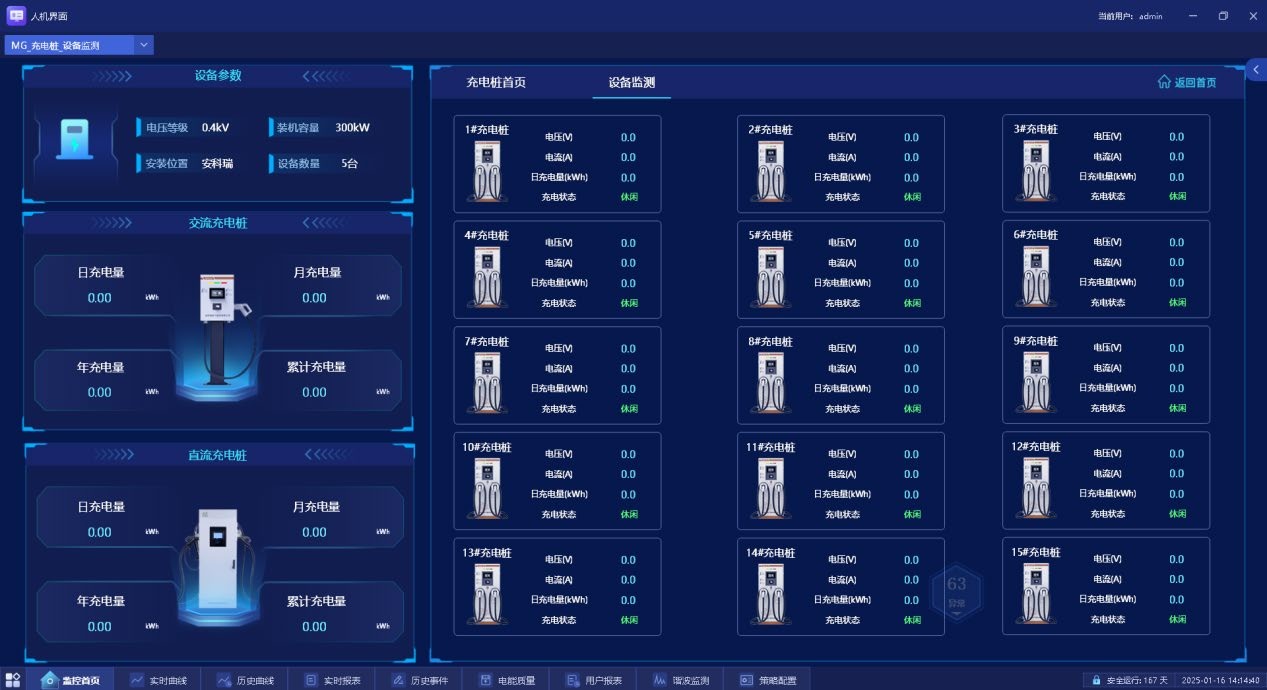
Charging station monitoring:Real time monitoring of the charging system (charging voltage, current, power, and operation status of each charging station), statistics of the charging amount and electricity cost of each charging station, fault alarms for abnormal information, and flexible adjustment of charging power according to the electricity load;
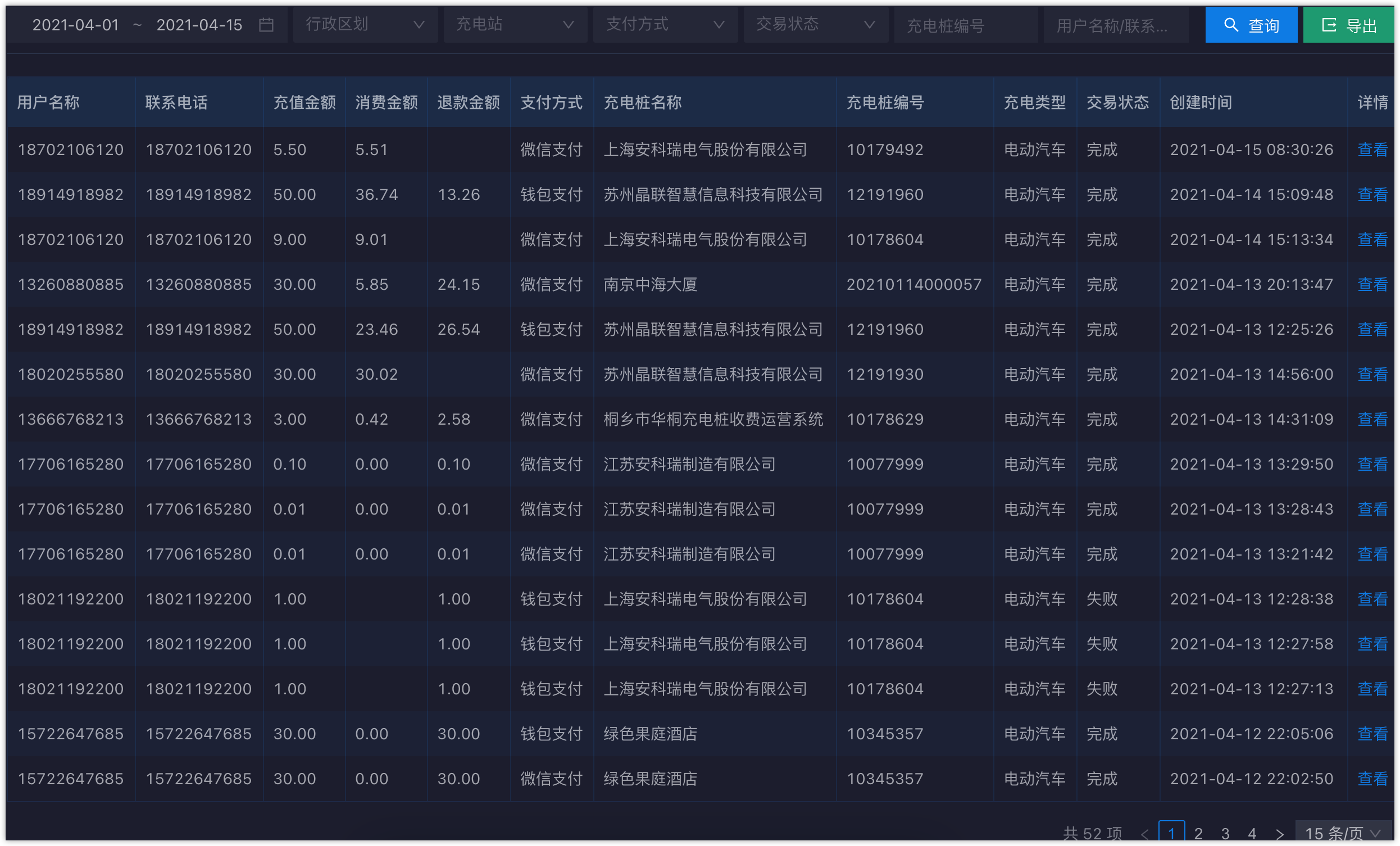
Transaction management:Transaction management includes functions such as account information, charging records, transaction flow, and recharge records;
Fault management:Fault management includes functions such as fault recording, fault handling, fault confirmation, and fault analysis;

Statistical analysis:Statistical analysis includes operational trends, energy consumption analysis, fault analysis, financial statements, inactive users, etc;
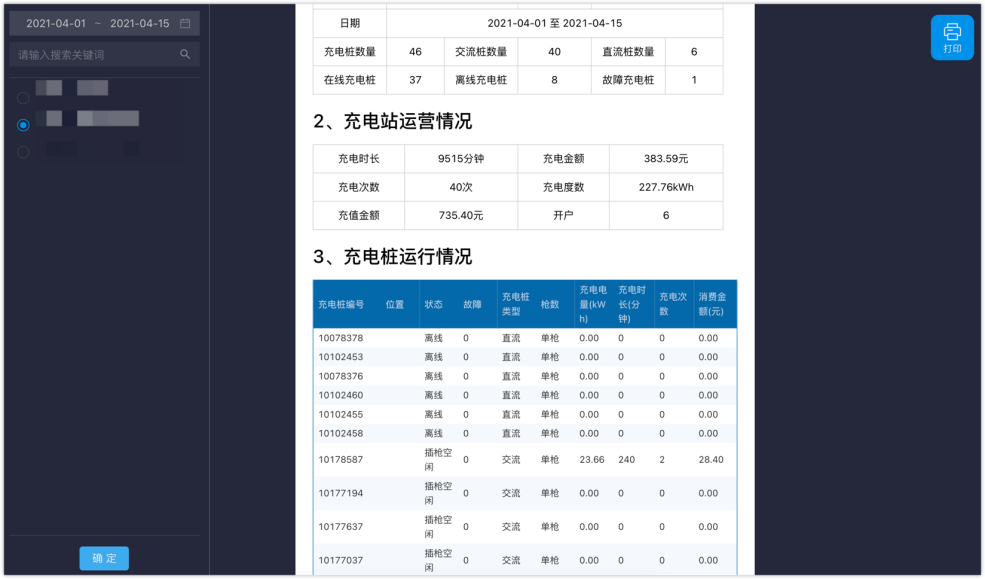
Merchant management:The platform can manage multiple merchants. Each merchant corresponds to multiple charging stations. Users can charge at each merchant's charging station. The consumption amount enters the corresponding merchant's WeChat/Alipay account. The wallet balance is not common among merchants. After users recharge in a merchant's wallet, they can use the wallet balance to charge at all charging stations subordinate to the merchant;

Mini program/APP function:
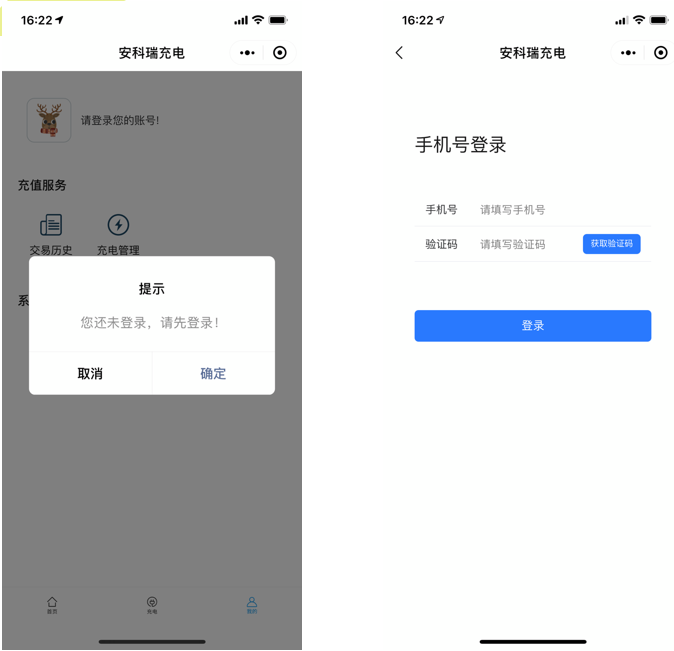
Scan code for charging:After scanning the code or entering the charging station number, enter the charging page, enter the charging parameters, click on start charging and payment, you can choose WeChat Pay or wallet balance payment. After successful payment, the charging will automatically start. When the wallet balance is insufficient, you can directly recharge;

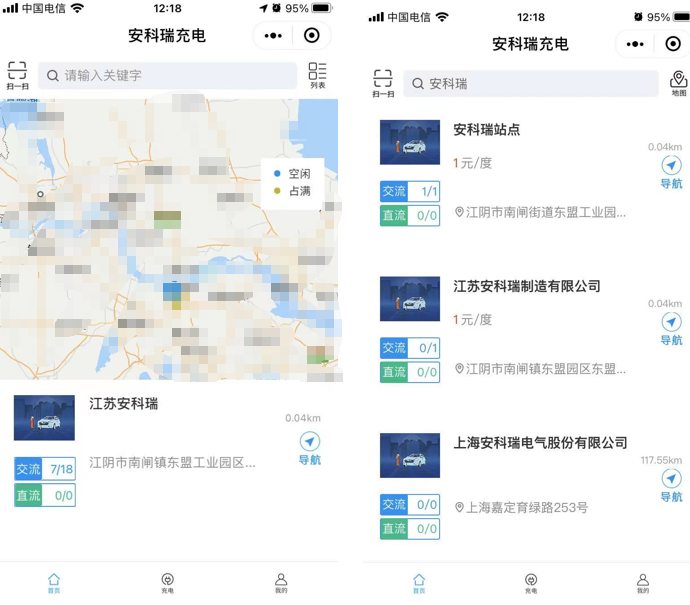
Charging station inquiry:By default, the map displays charging stations within 20 kilometers. Enter keywords to search for charging stations and navigate to designated charging stations;
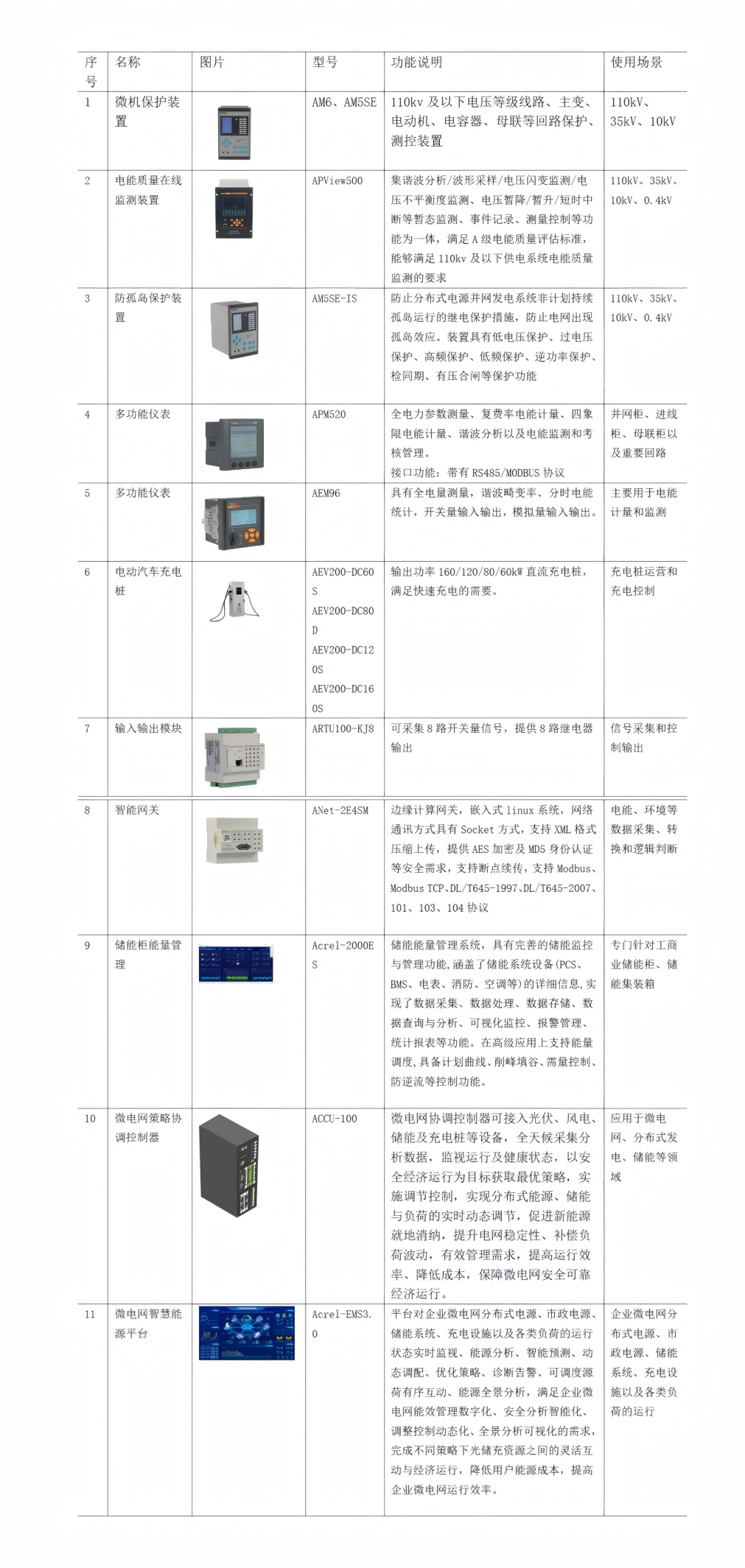
4 Solution related products
Conclusion:
From policy guidance to market practice, from technological breakthroughs to scenario implementation, the integrated charging station of light storage and charging has formed a virtuous cycle of "technology economy society" triple drive. It not only solves the "last mile" problem of new energy vehicle charging, but also reconstructs the supply and demand relationship of power system through energy Internet thinking. Against the dual background of the "dual carbon" goal and energy transformation, integrated charging stations for solar energy storage and charging are evolving from a new trend in the industry to a key infrastructure for new power systems, providing a Chinese solution for the global energy revolution. In the future, with technological iteration and business model innovation, this field is expected to give birth to a trillion dollar market and become the core engine for promoting high-quality development of the green economy.