-
E-mail
3008232806@qq.com
-
Phone
18701808662
-
Address
253 Yulu Road, Jiading District, Shanghai
Product Categories
Ankerui Electric Co., Ltd


Energy storage system anti backflow bidirectional metering meter
NegotiableUpdate on 01/08
- Model
- Nature of the Manufacturer
- Producers
- Product Category
- Place of Origin
Overview
The energy storage system anti backflow bidirectional metering meter $r $n can record the flow of electricity from the grid to the energy storage system and from the energy storage system to the grid separately, achieving bidirectional metering.
Product Details
With the intensification of energy transformation, energy Internet has become the common direction of energy system development in all countries. As a key technology supporting energy Internet, energy storage has been widely used in smart cities, industrial parks, community business districts, commercial office buildings and other large industrial and commercial energy consuming units, realizing intelligent energy management.
Measurement purpose:
Real time monitoring: Accurately measure and record the electrical input and output of the energy storage system, including key parameters such as voltage, current, power, and energy.
Bidirectional metering: capable of separately recording the flow of electrical energy from the grid to the energy storage system and from the energy storage system to the grid, achieving bidirectional metering.
Efficiency evaluation: By monitoring data, evaluate the operational efficiency of energy storage systems, identify energy loss points, and optimize energy management strategies.
Load management: Based on energy meter data, reasonably allocate the charging and discharging time and power of the energy storage system, balance the system load, and improve system stability and efficiency.
1、 Product Overview
The ADW300 wireless measuring instrument is mainly used to measure three-phase active energy in low-voltage networks. It has the advantages of small size, high accuracy, and rich functions. It also has multiple communication options, including RS485 communication and wireless communication methods such as Lora, NB, 4G, wifi, etc. It also adds a current sampling mode for external transformers, making it convenient for users to install and use in different situations. It can be flexibly installed in the distribution box to meet the needs of sub item energy metering, operation and maintenance supervision, or power monitoring for different areas and loads.
2、 Functional Features
5.1 Measurement Function
The ability to measure all electrical parameters includes voltage U, current I, active power P, reactive power Q, apparent power S, power factor PF, phase angle of voltage and current, voltage imbalance, current imbalance, frequency F, 31st harmonic, odd and even total harmonic content, and total harmonic content. Among them, voltage U is rounded to 1 decimal place, frequency F is rounded to 2 decimal places, current I is rounded to 2 decimal places, power P is rounded to 3 decimal places, phase angle Φ is rounded to 2 decimal places, and imbalance △ is rounded to 2 decimal places.
如: U = 220.1V,f = 49.98HZ, I = 1.99A, P = 0.219KW, Φ= 60.00°, △=0.00%
Support 4-channel temperature measurement, temperature measurement range: -40~150 ℃, accuracy ± 2 ℃
Residual current detection, initial range: 0-1000mA, adjustable range multiple (1-60)
5.2 Measurement Function
It can measure the current combined active energy, forward active energy, reverse active energy, combined reactive energy, inductive reactive energy, capacitive reactive energy, and four quadrant reactive energy.
5.3 Time sharing function
Three sets of time slot tables, each year can be divided into four time zones, with 14 daily time slots and four rates (F1, F2, F3, F4, peak and valley). The basic idea of time of use billing is to treat electricity as a commodity, using economic leverage to increase electricity prices during peak periods and lower prices during off peak periods, in order to reduce peak hours, improve electricity quality, and enhance overall economic benefits.
5.4 Demand Function
5.5 Historical Energy Statistics Function
Can provide historical electricity statistics for December (including electricity from 4 quadrants and various rates)
5.6 Switching input/output function
There are 2 switch outputs and 4 switch inputs. The switch output is a relay output, which can achieve "remote control" and alarm output. The switch input can not only collect and display local switch information, but also achieve remote transmission function through the RS485 of the instrument, that is, the "remote signaling" function.
5.7 Wireless Communication Function
ADW300 supports RS485 communication, LORA communication, NB, 4G, and WiFi communication. Specific protocols for NB, 4G, and WiFi communication can be obtained by contacting our relevant personnel.
3、 Wiring instructions
ADW300, ADW300-HJ, and ADW300W can all adopt four wiring methods: three-phase four wire connection through current transformer, three-phase three wire connection through current transformer, three-phase four wire connection through voltage current transformer, and three-phase three wire connection through current voltage transformer. When using three-phase three wire connection, it is necessary to modify the wiring system of the instrument through buttons or corresponding debugging software.
Note:
The ADW300W external transformer consists of two wires, red and white. The red wires are connected to instruments IA *, IB *, and IC *, while the white wires are connected to instruments IA, IB *, and IC; The ADW300-HJ external transformer consists of two wires, red and black. The red wires are connected to instruments IA *, IB *, and IC *, while the black wires are connected to instruments IA, IB *, and IC;
Both ADW300W and ADW300-HJ use built-in mA level transformers, and it is strictly prohibited to connect them to ordinary 5A or 1A output transformers, otherwise it may cause damage to the instrument;
When wiring ADW300W or ADW300-HJ, the transformer terminals must not be short circuited or grounded, otherwise it may cause inaccurate measurement or instrument damage;
When ADW300W or ADW300-HJ is used to measure the secondary line of on-site transformers, the instrument's built-in transformer should be kept at a distance from the on-site primary side transformer
(Greater than 30cm) to avoid interference.
Overall dimensions


wiring method
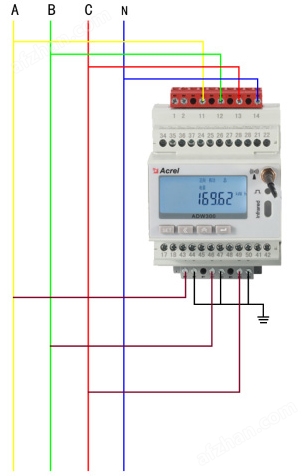
ADW300 three-phase four wire

ADW300 three-phase three wire
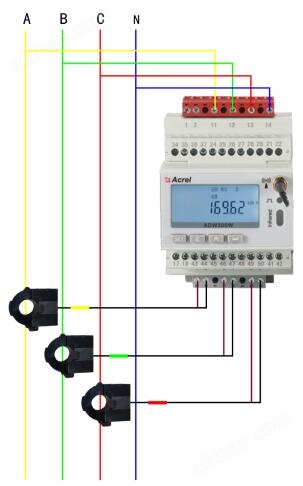
ADW300W three-phase four wire
Installation diagram
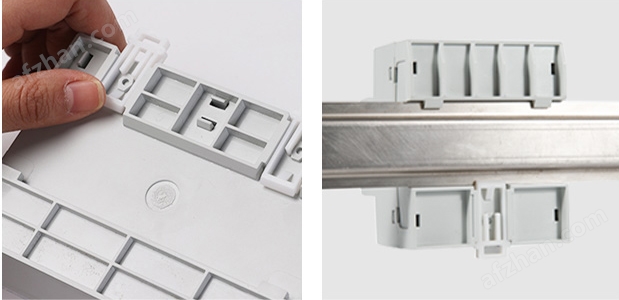
On site installation diagram

Energy storage system anti backflow bidirectional metering meter
Energy storage system anti backflow bidirectional metering meter
Similar Product Recommend