-
E-mail
2802943235@qq.com
-
Phone
18702111683
-
Address
No. 253 Yulu Road, Jiading District, Shanghai
Product Categories
Ankerui Electric Co., Ltd


Network port communication power collection module
NegotiableUpdate on 02/18
- Model
- Nature of the Manufacturer
- Producers
- Product Category
- Place of Origin
Overview
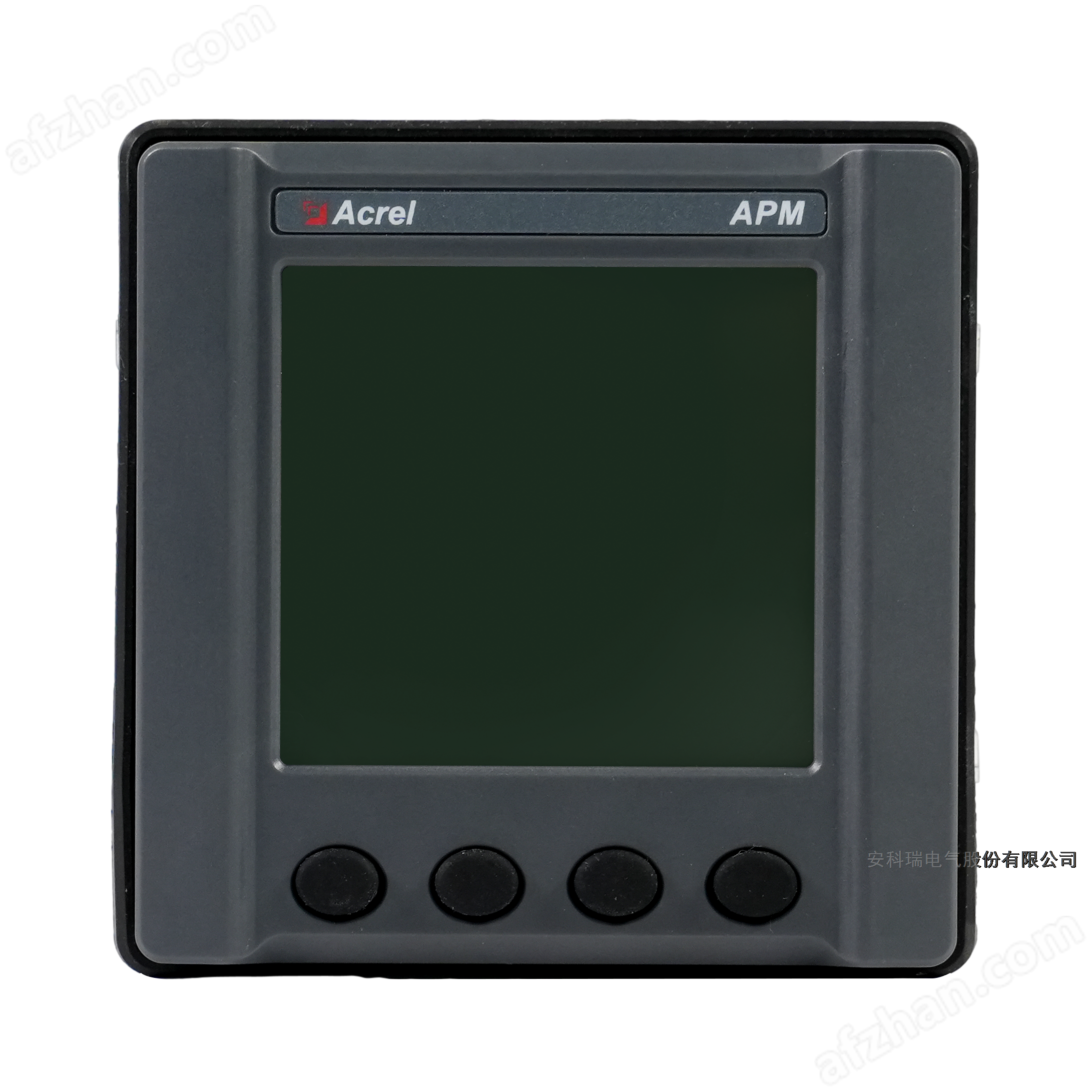
The APM5 series network power meter (hereinafter referred to as the meter) is designed according to IEC international standards and has functions such as full power measurement, power statistics, power quality analysis (including harmonics, interharmonics, flicker), fault recording (including voltage rise and fall interruption, impulse current recording, etc.), event recording, and network communication. It is mainly used for comprehensive monitoring of power supply quality in the power grid. This series of instruments is equipped with feature rich DI/DO modules, AO modules, wireless communication modules, and leakage temperature measurement modules, which can flexibly achieve full power measurement of electrical circuits and switch status monitoring. Network port communication power acquisition module
Product Details
1、 Overview of Ethernet Communication Meter
Ethernet communication electric meterIt is a smart meter designed based on modern communication technology, especially Ethernet communication technology. This type of electricity meter communicates through an Ethernet interface to achieve fast and reliable transmission of electrical energy data. Ethernet communication technology has been widely used in the field of smart meters due to its high speed, reliability, and good anti-interference performance.Network port communication power collection module
The working principle mainly involves collecting electricity data through the communication processing board in the electric meter, and processing the data through a microcontroller. Then, real-time measurement values such as current, voltage, active power, reactive power, etc. are transmitted through the bus to complete Ethernet communication. This type of electricity meter can not only transmit data in real-time, but also achieve remote collection and control, improving the efficiency and reliability of the smart grid.
The main advantages are fast communication speed, good anti-interference performance, and high reliability. It is not limited by the distance of serial communication and can achieve data transmission and monitoring over a wider range. In addition, this type of electric meter also has multiple peripheral interface functions, such as RS485 communication interface, analog output, etc., which can meet the needs of different users.Network port communication power collection module
In practical applications, it has been widely used in office buildings, smart communities, schools, government agencies and other places. These places usually have Ethernet installed, so it is convenient to establish an Ethernet based energy billing system to achieve real-time collection, transmission, and analysis of energy data. .Ethernet communication meter

2、 Overview of characteristic functions of electric meters
Full battery measurement:The APM520/CE meter can comprehensively measure electrical parameters such as voltage, current, active power, and reactive power, providing accurate data on energy consumption.
Electricity statistics:The electricity meter has the function of energy statistics, which can record and calculate various energy parameters, helping users better understand and manage energy consumption.
Power quality analysis:This meter can conduct in-depth analysis of power quality, including harmonics, interharmonics, flicker, etc., which helps to timely detect and solve power quality problems.
Fault recording function:The electric meter can record fault waveforms such as voltage fluctuations, interruptions, and surge currents, providing important data support for fault analysis and resolution.
Event recording function:This meter has an event recording function, which can record and store various important events such as voltage and current exceeding limits, providing a basis for subsequent troubleshooting and maintenance.
Network communication:The APM520/CE meter supports Ethernet communication, which enables remote transmission and monitoring of data, making it convenient for users to monitor their electricity usage in real time.
Modular design:The electricity meter adopts a modular design, combined with rich external modules such as DI/DO module, AI/AO module, Micro SD card (TF card) event recording (SOE) module, etc., which can flexibly achieve full power measurement and switch status monitoring of the electrical circuit.
These unique features enable APM520/CE meters to perform excellently in comprehensive monitoring of power supply quality in the grid, meeting the application needs of various complex scenarios. Whether in industrial, commercial or civilian fields, APM520/CE meters can provide reliable and accurate energy data support, helping to promote the intelligent and efficient operation of power systems.
 .
.
3、 Product Application Scheme Diagram

4、 APM5 series electric meter electrical parameters
display |
display mode |
Dot matrix liquid crystal; Switch between Chinese and English |
|
resolution |
128*128(510:47*39,520:62*58) |
||
backlight |
whiteLED |
||
viewport |
72Appearance:38mm*46mm(1.78inch/ 2.3inch); 96Appearance:56mm*60mm(2.46inch/ 3.2inch); |
||
signal |
network |
Three phase three wire and three phase four wire, please refer to the wiring diagram for details; |
|
frequency |
45~65Hz; |
||
voltage |
Rated value:AC 3*57.7/100VTheAC 3*63.5/110VTheAC 3*230/400VTheAC 3*400/690V(Only)96appearance); |
||
Overload:1.2 Double rated value(continuous);2 Double rated value/1Seconds; | |||
Power consumption:< 0.5VA(Every route); | |||
current |
Rated value:AC 3x 1 (1.2) ATheAC 3x5(6)A; |
||
Overload:1.2 Double rated value(continuous);10Double rated value/1Seconds; | |||
Power consumption:< 0.5VA(Every route); | |||
measurement accuracy |
voltage, current |
IEC 61557-12 0.2% |
|
Voltage harmonics, current harmonics |
IEC 61557-12 1% |
||
frequency |
IEC 61557-12 ±0.02Hz |
||
active power |
IEC 61557-12 0.5% |
||
reactive power |
IEC 61557-12 1% |
||
active energy |
0.5Slevel GB/T 17215.321-2008 Clevel GB/T 17215.321.2021 (Optional)SWhen, the accuracy is0.2SGrade) 0.2Slevel GB/T 17215.321-2008 Dlevel GB/T 17215.321.2021 (When using the built-in instrument panel)2When using a secondary transformer, the accuracy is1Grade) 1level GB/T 17215.321-2008 Blevel GB/T 17215.321.2021 |
||
Reactive energy |
IEC 62053-24 2level |
||
Power quality (optional only)SSometimes) |
waveform recording |
20A waveform, before and after each10A wave; |
|
Waveform capture |
Each waveform128One cycle point storage; |
||
Discrete input |
Dry contact input, built-in power supply; Response time: less than300ms |
||
relay output |
Contact type: normally open contact; Contact capacity:AC 250V/3A DC 30V/3A; |
||
Electric pulse output |
Output mode: optocoupler pulse with open collector; Pulse constant:10000imp/kWh(default); |
||
communication |
RS485interface/Modbus-RTUAgreement andDLT645Regulations; RJ45interface(Ethernet)/Modbus-TCPagreement; Wireless interface |
||
power supply |
Scope of work:AC 85V~265V;DC100V~350V Power consumption: Power consumption≤15VA; |
||
safety |
power frequency withstand voltage |
The power frequency withstand voltage between the casing, auxiliary power supply, and various input and output terminal groups isAC 4kV/1min; The power frequency withstand voltage between the auxiliary power supply and each input terminal and output terminal group isAC2kV/1min; The power frequency withstand voltage between the voltage input and other input/output terminal groups isAC 2kV/1min; The power frequency withstand voltage between the current input and other input/output terminal groups isAC 2kV/1min; The power frequency withstand voltage between the relay output and other input/output terminal groups isAC 2kV/1min; The power frequency withstand voltage between the terminal groups of switch input, communication, analog output, and pulse output isAC1kV/1min; |
|
insulation resistance |
Input and output terminals to the casing>100MOh? |
||
Electromagnetic Compatibility |
comply withIEC 61000standard(4level); |
||
environment |
Operating Temperature-25℃~+65℃; Storage temperature:-40℃~+80℃; Relative humidity:≤95%No condensation; Altitude: ≤2500m; |
||
Protection level |
display panelIP54; |
||
Similar Product Recommend