-
E-mail
1211810561@qq.com
-
Phone
15717872660
-
Address
Hurong Avenue, Macheng City, Hubei Province
Product Categories
Macheng Shimasai Industrial Automation Co., Ltd


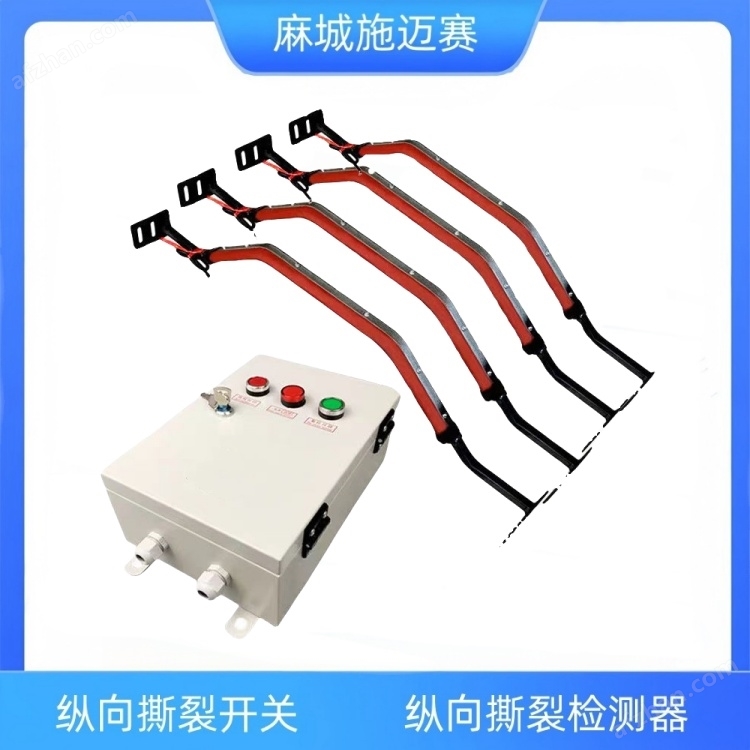
Deviation switch SN-BP6-TGZ belt protection anti deviation controller
NegotiableUpdate on 01/08
- Model
- Nature of the Manufacturer
- Producers
- Product Category
- Place of Origin
Overview
The deviation switch SN-BP6-TGZ belt protection anti deviation controller can promptly send an alarm signal to the microcomputer control system or directly stop the machine in case of deviation, misalignment and other faults in the belt conveyor, zipper machine, scraper machine, elevator and transmission machinery. Protecting equipment and life. In addition, as the signal can be sent to the microcomputer control system, it is convenient to achieve factory automation control, thus achieving the goal of reducing staff and increasing efficiency, centralized control, and facilitating production and scheduling.
Product Details
Deviation switch SN-BP6-TGZ belt protection anti deviation controllerUsed to detect the deviation status of the tape conveyor. Deviation is a common phenomenon in belt conveyors and may cause serious accidents. Installing this product can reveal the status of local or overall deviation of the conveyor belt, in order to make adjustments.
The deviation switch SN-BP6-TGZ stainless steel belt indicator light is used for conventional belt conveyors: underground, cableway support belt conveyors: ship loading and unloading systems; Stacking/retrieval conveyor; Tilt and shuttle conveyors; Cranes, excavators, boom limit: skirt feeder/conveyor: heavy-duty limit switch detects the deviation of the belt, which is a protective device for automatic alarm and shutdown of the belt conveyor control. Widely used in various belt conveyor equipment in metallurgy, coal, cement and building materials, mining, power, ports, metallurgy, chemical industry and other fields.
Basic principle:
When the conveyor belt deviates during operation, it touches the switch of the vertical roller and causes it to deflect. When the deflection angle of the vertical roller reaches the first level switch angle, the switch sends out an alarm signal. When the conveyor belt deviates severely and reaches the second level switch angle, the switch sends a stop signal, achieving automatic shutdown of the conveyor belt deviation fault. When the deviation fault is eliminated and the tape machine operates normally, the switch roller can automatically reset and return to the initial state.

Deviation switch SN-BP6-TGZ belt protection anti deviation controllerTechnical indicators:
1. Rated voltage: AC380V;
2. Rated current: 5A;
3. Number of contacts: Two independent sets of normally open and normally closed contacts;
4. Shell protection level: DT type dust tight shell, protection level IP67;
5. Environmental temperature: -25~80 ℃;
6. The switch can operate under vibration conditions with a frequency of 10-60Hz and an amplitude of 0.75mm (10g);
7. Dimensions: Shell L × W × H (mm) 190 × 135 × 100;
8. Operating force: 5-7 kg.
Category:
There are common types, wiring cavity types, and address coded types of deviation switches.
The ordinary type is the two-stage deviation switch mentioned above;
The wiring chamber type deviation switch is based on the ordinary type deviation switch and comes with a waterproof wiring chamber. The on-site control cable can be directly connected to the wiring chamber to prevent faults caused by moisture and virtual connection of cable joints.
The address coding type deviation switch integrates fieldbus technology on the basis of ordinary deviation switches to achieve address coding function. Suitable for remote monitoring of the operation of long belt conveyors as on-site equipment, it solves the inconvenience caused by workers searching for fault points.
The address coded two-stage deviation switch is connected to the comprehensive protection device (gateway) through fieldbus, supporting up to 128 addresses, and multiple switches can be used simultaneously at the same address. Its major feature is that only one two core cable is needed to complete data transmission simultaneously without the need for power supply. It can be flexibly linked with PLCs and computers from various manufacturers through fieldbus *.
The deviation switch SN-BP6-TGZ is a protective device used to detect the degree of belt deviation during the operation of a belt conveyor, issue an alarm, and automatically trigger an emergency stop.
Using a deviation switch can prevent damage to expensive conveyor belts and prevent further mining accidents and personal injuries.
Two level deviation switch can prevent protective devices in safe operation of conveying systems, and it is widely used in steel plants, thermal power plants, cement plants, chemical plants, ports, and so on.
When the deviation switch TMS-PBK-30 occurs during the operation of the conveyor belt, the conveyor belt touches the switch vertical roller and causes it to deflect. When the deflection angle of the vertical roller reaches the first level switch angle, the switch sends an alarm signal. When the conveyor belt deviates severely and reaches the second level switch angle, the switch sends a stop signal, achieving automatic shutdown of the conveyor belt deviation fault. When the deviation fault is eliminated and the tape machine operates normally, the switch roller can automatically reset and return to the initial state.
Installation and use of deviation switch SN-BP6-TGZ:
1. The deviation switch is set on both sides of the conveyor belt, and the vertical roller should be perpendicular to the plane of the conveyor belt edge, with both sides of the conveyor belt located at 1/3 of the height of the vertical roller.
The distance between the deviation switch vertical roller and the normal position of the conveyor belt should be 50-100mm.
3. The number of deviation switches should be determined based on the length, type, and layout of the conveyor. Generally, it should be set at the head, tail, convex arc section, concave arc section, and in the middle position of the conveyor.
(Note: When the conveyor is long, one pair can be placed every 30-35 meters in the middle of the conveyor.).
4. The deviation switch should be connected to the intermediate frame of the conveyor through an installation bracket. The switch bracket should be welded to the conveyor frame after the installation of the conveyor is completed. The deviation switch and the deviation switch bracket should be fixed with bolts.
Similar Product Recommend